
Peaceful diplomacy from the nation's voice bearers
Semarang (ANTARA) - The year 2/026 may become one of the hottest years on Earth in the last century. This is not only due to rising temperatures causing extreme droughts in various parts of the globe, but also because of increasing political tensions in several regions.
Consider the war between Russia and Ukraine, which has lasted for years without clarity on when it will end. Or the attacks by the United States and Israel on Iran, which have ignited war in the Middle East region, subsequently impacting the supply of crude oil from the area through the Strait of Hormuz.
Furthermore, the dispute between Saudi Arabia and the Houthi militia to the west has also disrupted the distribution of Middle Eastern crude oil via maritime routes.
In South America, Argentina, which recently became the runner-up for the 2026 World Cup, has brought the issue of the Malvinas Islands (or the British Falkland Islands) back into the international political arena.
These statements represent only a small fraction of the potential conflicts that could occur across the globe. In Southeast Asia, neighbouring countries have also engaged in clashes, such as Thailand and Cambodia in 2025.
Beyond physical ‘battles’, another equally terrifying and far-reaching threat is information warfare. Current advancements in information technology mean that content triggering disputes is appearing as rapidly as mushrooms in the rainy season.
Disinformation and misinformation have become serious global threats. The World Economic Forum 2026 has ranked disinformation and misinformation as the most dangerous short-term global risks, alongside social polarisation and geo-economic confrontation.
More than 80 per cent of global experts across various countries warn that the disinformation crisis is already occurring and impacting political stability.
The rise of artificial intelligence (AI) has caused deepfake fraud cases to surge by 3,000 per cent globally, exacerbating the production of disinformation content worldwide. Meanwhile, not all institutions, nations, or agencies have formal mitigation plans to face the disinformation crisis.
In Indonesia, from August 20lar to July 2026, the Ministry of Communication and Digital recorded 16,999 hoax or disinformation issues on social media. The media identified as spreading them totalled approximately 800,000 sites.
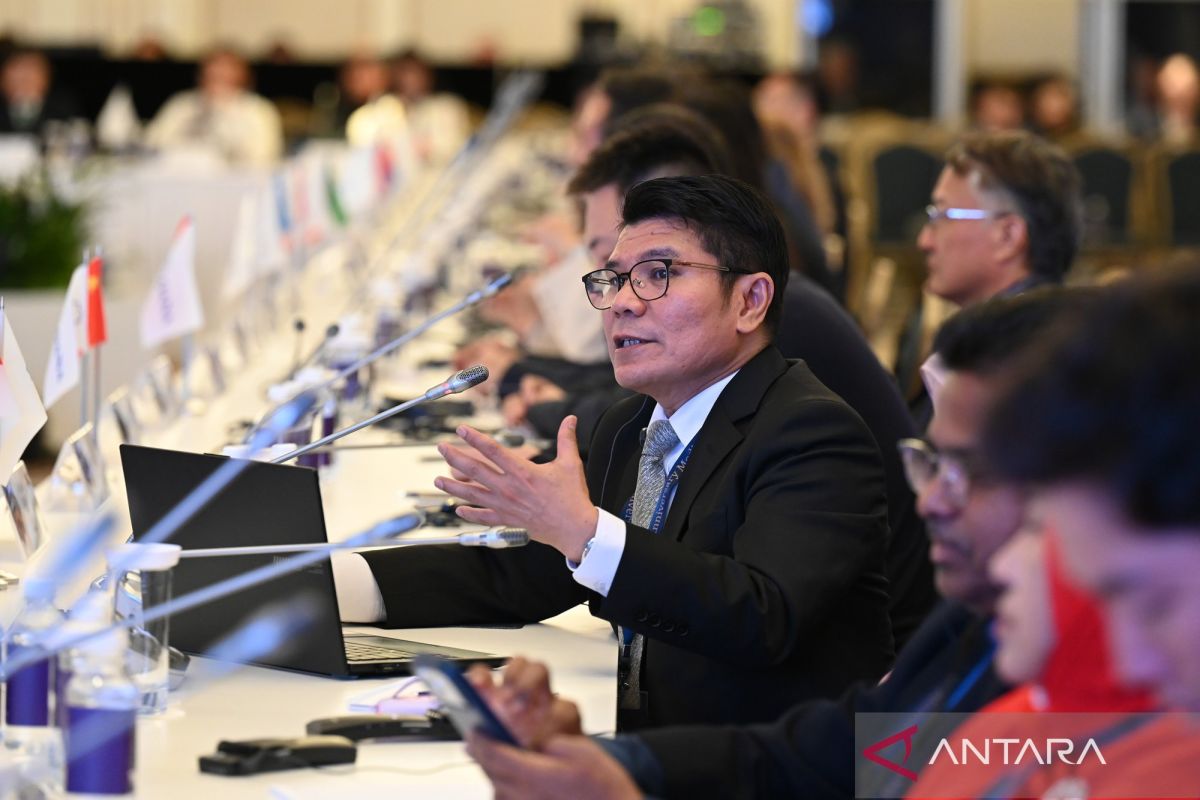
In response, ANTARA News Agency is taking important and strategic steps. The annual meeting of the Organisation of Asia–Pacific News Agencies (OANA) in Moscow, attended by 35 of its 41 members, served as a momentum to establish a permanent working mechanism to strengthen cross-border news verification in facing the spread of disinformation exacerbated by AI. The home countries of OANA member news agencies are recognised as being neighbours that frequently intersect politically in many aspects.
The President Director of LKBN ANTARA, Benny Siga Butarbutar, reminded that disinformation is no longer merely a media issue, but an accelerator of various global risks. If disinformation moves without borders, then truth must move faster, together.
As a news agency, the priorities are accuracy, speed, and the quality of issues raised or conveyed to the public. Therefore, the statement that truth must move faster and together is highly relevant to the tasks and functions of a national news agency.
Politically, OANA member countries possess significant influence in raising issues. The total population of OANA member states is estimated to reach 4.74 billion people. This figure covers more than half of the global population, which ranges between 8.1 to 8.2 billion.
India, China, Indonesia, Pakistan, Bangladesh, Russia, and Japan are among the OANA member countries with populations ranging from hundreds of millions to billions. The OANA news agency network is collectively responsible for producing and distributing approximately two-thirds of the entire flow of information and news spread worldwide.
Internet users range from 3.2 to 3.3 billion, while social media users are estimated at 2.5 billion. This is certainly not a small number. Indonesia, for example, has approximately 230 million internet users, 331 million active mobile connections, and about 180 million social media identities.
In China, there are about 1.1 billion internet users. India has slightly fewer, at around 1 billion. In the Gulf region, internet penetration has reached 100 per cent. The acceleration of digitalisation means that these figures in countries that are not yet 100 per cent connected will continue to increase every year.
Thus, it is unsurprising, quoting Benny Siga Butarbutar, that false narratives can spread rapidly among societies that increasingly rely on mobile devices and digital platforms.
If the spread of truthful information is faster than disinformation or misinformation, perhaps some geo-economic and geopolitical problems could be partially resolved. The remaining task is to reach an agreement so that all parties and nations can collectively maintain shared integrity.
The proposal for all OANA member countries to no longer merely serve as places for exchanging news, but to become a regional information integrity network, is a strategic step in facing challenges in the cross-border and international information sectors.
The hope is that amidst the turmoil of information spreading through every vein of life, OANA will become a relevant and trusted source. OANA should serve as a reference during periods of information chaos. As the voice of the nation, news agencies can serve as a channel for peaceful diplomacy.
Source: jawawa.id (https://jawawa.id/newsitem/peaceful-diplomacy-from-the-nations-voice-bearers-1790229936)
Originally published by Antara (Indonesian) (https://www.antaranews.com/berita/5756076/diplomasi-damai-dari-pembawa-suara-negara), translated from Indonesian