
PDIP urges grassroots women cadres to lead movements
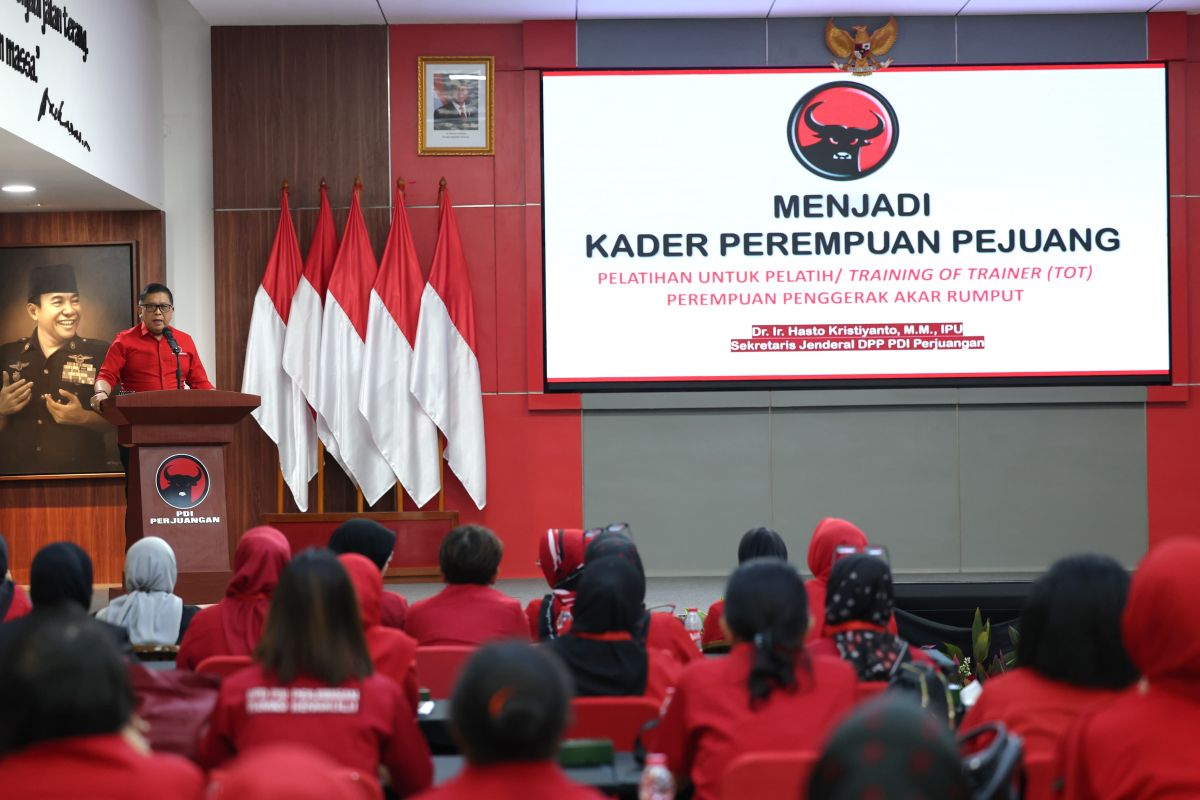
Jakarta - PDIP Secretary-General Hasto Kristiyanto has urged the party’s grassroots women cadres to study the life journey and learn from the ideological conviction firmly held by PDIP Chairwoman Megawati Soekarnoputri. “Conviction creates steadfastness, courage, and patience that will give birth to truth. That is what should become the driving energy. This is an inspiration for everyone, including women,” Hasto said in a written statement in Jakarta on Monday.
Hasto made the remarks during a training of trainers (ToT) session for women representatives from 38 provinces at the PDIP Party School in South Jakarta on Monday. The event also saw the launch of the ‘Perempuan Penggerak Akar Rumput’ (Grassroots Women Activists) application and jingle.
Hasto also conveyed a crucial historical perspective, noting that on 25 June 1933 in Bandung, women declared themselves to unite with the Marhaen people’s liberation movement. They called themselves Marhaeni. This movement was used by Bung Karno as a thesis in formulating the ideas explained in the book Sarinah. “The first phase, women strengthened their capacity within a patriarchal structure. They placed their function on domestic tasks. The second phase was the struggle for emancipation, equality, and the importance of equal rights between men and women. The third phase is when women and men struggle together to fight or at least correct the capitalist system with the Marhaen people’s liberation philosophy,” Hasto stated. He said PDIP places the women’s movement in this third phase.
He continued that grassroots women activists also have the task of building food sovereignty to provide nutritious food for the people. “If we talk about the scope of grassroots women activists, it is actually very broad to elaborate on what Ibu Mega means when she says that politics is a matter of life,” he said.
Hasto noted there is a large gap between the current reality and what the nation’s founders, including Bung Karno, had hoped for, including what Megawati has always envisioned regarding women. “Let us look at history, why Ibu Mega hopes that these grassroots women activists truly become pioneering cadres of the struggle with a burning spirit, with the ability to mobilise, with the ability to influence the thinking of the people at the grassroots, and then lead the movement,” Hasto said.
He expressed hope that through this training, PDIP cadres would dare to take a stand, defend the truth, and fight for justice regarding various issues in politics, the people’s economic life, and the struggle for the supremacy of law. “Therefore, this ToT training for grassroots women activists, besides being very timely, also has a very strong historical and ideological footing. Because of that, dare to speak up, dare to take a stand,” Hasto continued.
Hasto said Megawati hopes that these grassroots women activists will truly become pioneering cadres of the struggle. “Ibu Mega always emphasises that women are the path of civilisation. Therefore, in the current reality of democracy characterised by populist authoritarianism, the leadership role of pioneering women is very important so that democracy becomes more firmly rooted,” Hasto said.
Meanwhile, PDIP Central Executive Board Chair for Women and Children, I Gusti Ayu Bintang Darmawati, familiarly known as Bintang Puspayoga, said strengthening the role of women at the grassroots level is an important part of the effort to realise a society that is socially just, democratic, and civilised. Bintang quoted Bung Karno’s statement, “There is no revolution without women.” According to her, looking at Bung Karno’s thoughts, both in the books he wrote and his various speeches, he always gave appreciation to women. “Ibu Megawati also always says that women are not only objects of development, beneficiaries of development, but women are subjects of development. We take part in the development itself. Therefore, this grassroots women’s training is important to realise a just and civilised order of life, as mandated by our state foundation, Pancasila,” she said.