
PDIP Secretary-General: Major Changes Begin with the Ideas of Youth
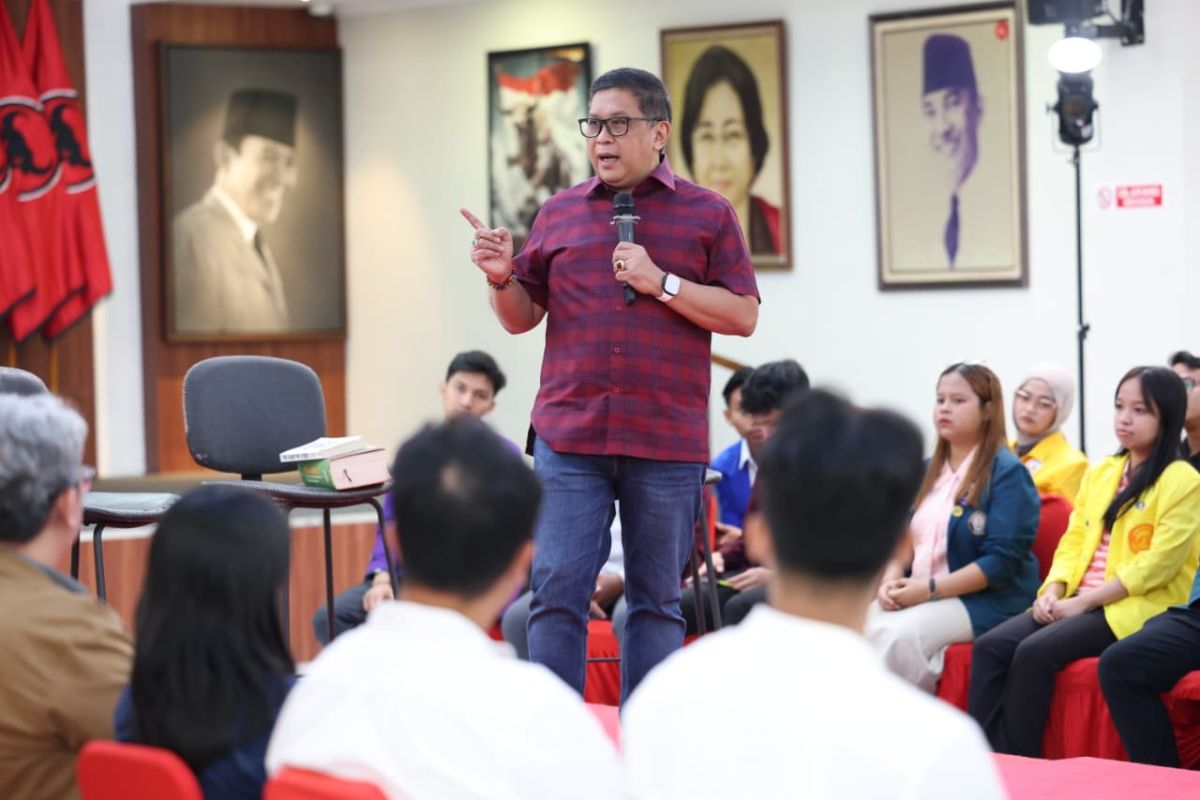
PDI Perjuangan (PDIP) Secretary-General Hasto Kristiyanto has outlined a crucial message regarding the power of ideas, concepts, and the imagination of the younger generation in forging the path of the nation’s historical struggle. Hasto asserted that youth are a symbol of ‘fire’, representing the strength of ideals, dreams, and hopes for the future. ‘At this Party School, all ideas and concepts, an imagination about the future, are opened as widely as possible by taking the spirit from our nation’s heroic figures, from Bung Karno, Bung Hatta, Syahrir, to Tan Malaka,’ Hasto said during the inauguration of a progressive young intellectual movement and forum named Public Pulse 28 at the PDIP Party School in Lenteng Agung, South Jakarta, on Tuesday. In anticipation of the 100th anniversary of the Youth Pledge, Hasto drew relevance between the historic 1928 oath and the ‘People’s Pledge’ that was born organically from the struggle against authoritarianism during the Kudatuli tragedy on 27 July 1996. Hasto explained that the mass movement during Kudatuli successfully reformulated the points of the Youth Pledge into a trigger for the fight against the suppression of democratic rights. ‘On 27 July 1996, when the Kudatuli attack occurred, “We, the youth of Indonesia” was made relevant as “We, the people of Indonesia”. “Having one homeland, the homeland of Indonesia” was made relevant as “having one homeland, a homeland without oppression”. “We, the people of Indonesia, having one nation, the nation of Indonesia” was made relevant as “a nation that is passionate about justice”. And “We, the people of Indonesia, having one language” was made relevant as “the language of truth”,’ he stated. Hasto also invited attendees to reflect on the genius of the composer of the national anthem Indonesia Raya, W.R. Supratman, who passed away at the very young age of 35 on 17 August 1938. Supratman’s profound contemplation of a unified Indonesia was considered ahead of its time, as it was born amidst the grip of colonialism. A similar genius was shown by Bung Karno, who at the age of 26 dared to establish the Indonesian National Party (PNI) on 4 July 1927 to unite young people and inspire the birth of the 1928 Youth Pledge. ‘How could we destroy the colonial power, which was the largest on earth at that time? It began with the ideas and imagination of young people. Bung Karno founded the PNI at the age of 26 because he was inspired by the spirit of the United States’ independence struggle against Britain. It was this PNI that inspired the birth of the Youth Pledge,’ Hasto said. Furthermore, Hasto stressed that major changes in the world, such as the French Revolution, were initially driven by only a handful of intellectual figures who dared to test the strength of their thinking within wider society. Through the presence of the first 28 young people in the Public Pulse 28 forum, Hasto hopes this movement will give birth to new intellectual leadership rooted in solving the real challenges of society. ‘The French Revolution was carried out by only a few people with three main intellectuals, and it was able to change the world from the hegemony of feudalism. Here, 28 people are gathered through Public Pulse; let us change Indonesia and the world through the power of these young people’s thinking,’ he concluded. The Public Pulse 28 intellectual forum is facilitated by the PDIP Central Executive Board, featuring speakers from various professional backgrounds close to the world of youth. Among them were Abigail Limuria, Co-Founder of What is Up Indonesia (WIUI) and author of the book ‘Makannya Mikir!’, and Berly Martawardaya, an economist from the Institute for Development of Economics and Finance (INDEF). Acting as the discussion moderator and host of Public Pulse 28 was young PDIP politician Muhammad Syaeful Mujab.