
PDIP Proposes Prabowo Adopt Sukarno's Geopolitics to Address Global Conflicts
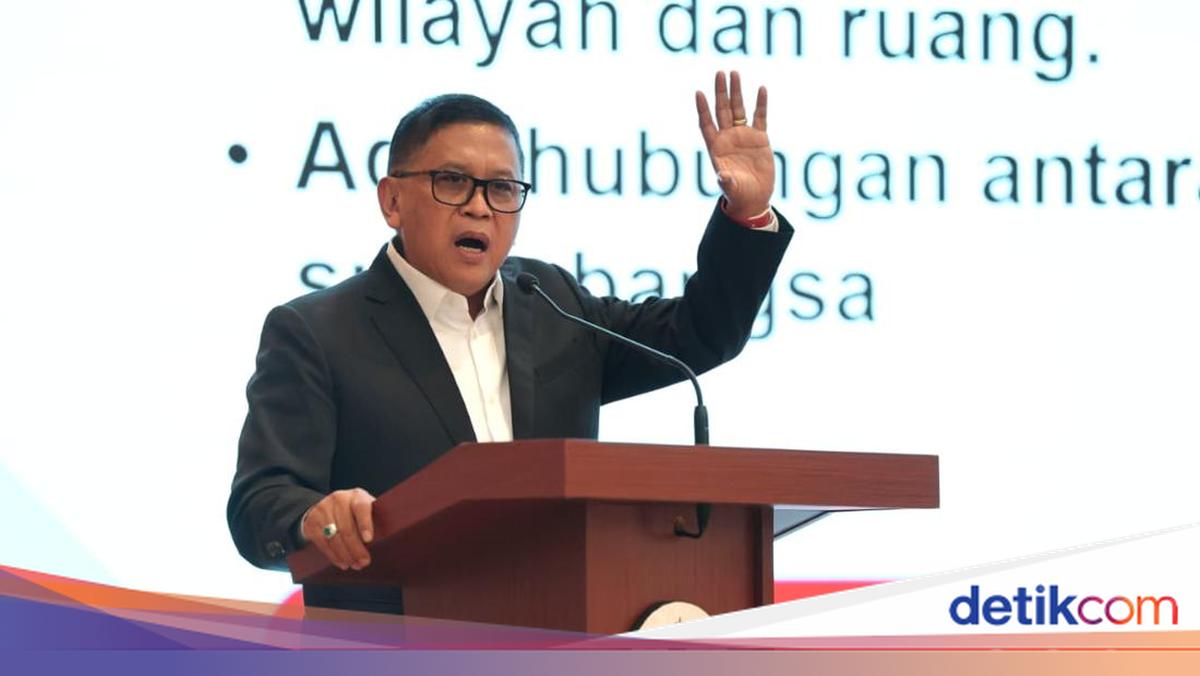
Hasto Kristiyanto, a permanent lecturer at Bung Karno University (UBK) and Secretary-General of the Indonesian Democratic Party of Struggle (PDIP), has elaborated on the importance of the geopolitical thinking of Indonesia’s first president, Sukarno (Bung Karno). He proposed that President Prabowo Subianto use Sukarno’s geopolitics to address global conflicts. Hasto made the remarks while delivering a public lecture entitled ‘Bung Karno’s Geopolitical Thinking’ in commemoration of Bung Karno University’s 27th anniversary, at the Ir. Soekarno Hall, UBK, Jakarta, on Thursday (11/6/2026).
In his explanation, Hasto assessed that Sukarno’s geopolitical framework or cycle is very relevant if President Prabowo Subianto wishes to position Indonesia as a peace facilitator on the global stage, particularly in de-escalating tensions in the Middle East. “If President Prabowo intends to make Indonesia a peace facilitator for Middle Eastern issues, this (Sukarno’s Geopolitical Cycle) can be used,” Hasto stated.
Hasto explained that Bung Karno’s geopolitical thinking does not move randomly but follows a systematic cycle. This cycle can be used to address various regional and global geopolitical dynamics in a measured way. Firstly, the cycle begins by formulating a clear national interest. Secondly, it moves towards global involvement by establishing new international law through a foreign diplomacy approach and international cooperation. Thirdly, it strengthens that aspect with defence diplomacy to build an effective deterrent effect.
“This cycle keeps turning. We create international law through our diplomatic approach, build international cooperation, until finally strategic defence diplomacy strengthens our defence posture,” Hasto added.
According to Hasto, this geopolitically scientific approach can be applied not only in the Middle East but also to help de-escalate conflicts on the Korean Peninsula (North Korea and South Korea) and tensions in the Taiwan Strait. He gave an example of how Indonesia’s active involvement in easing international tensions must remain based on national interest. “If we want to resolve the conflict on the Korean Peninsula, we can use this cycle. Through such diplomatic steps, our national interest also benefits. For instance, from South Korea we can obtain various technology transfers to accelerate our industry, while from North Korea we can build strategic understanding,” he explained.
Furthermore, Hasto suggested that President Prabowo take the initiative to hold a new international conference planned in detail, just as Bung Karno prepared the 1955 Asia-Africa Conference (KAA). This conference, according to him, could be a kind of ‘KAA Plus’ or a new movement directly initiated by Indonesia to mediate tensions in the Middle East. “How that conference is planned in detail. Bung Karno previously planned the KAA very meticulously, involving all elements including students to serve delegates with respect. That is part of the art of our diplomacy,” said Hasto. This step is deemed important so that every delegate attending feels respected, thereby giving the resulting peace agreements strong legitimacy recognised by the international world.