
PDIP: Kudatuli Monument Symbolises Mother's Love and Eternal Flame for Justice
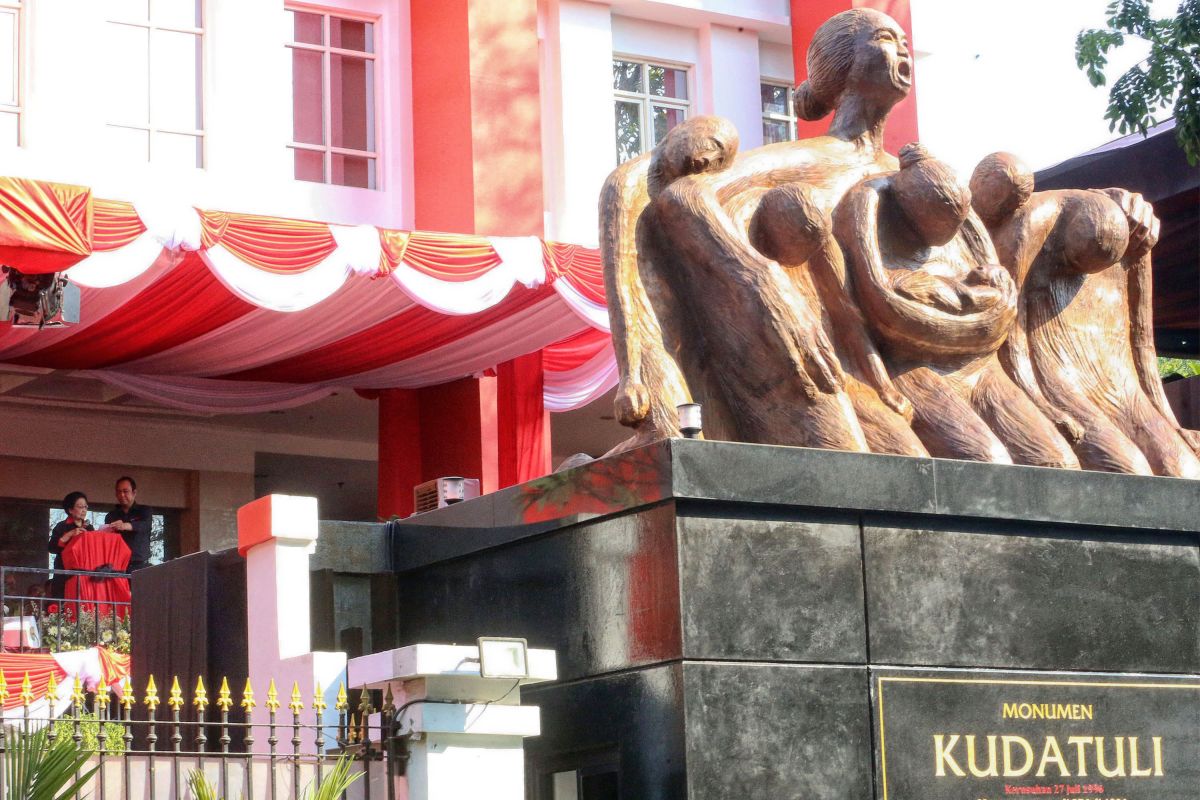
Jakarta (ANTARA) - DPP PDI Perjuangan (PDIP) Chairman Djarot Saiful Hidayat stated that the Kudatuli Incident Monument, officially erected today in the courtyard of the PDIP DPP Office on Jalan Diponegoro, Menteng, Central Jakarta, visualises the figure of Megawati Soekarnoputri as the ‘Mother of Civilisation’ who tightly embraces the victims of the tragedy. This visualisation carries the message of ‘A Mother’s Eternal Love’, a warm embrace that nurtures the hope that legal justice will eventually prevail. ‘The Kudatuli Monument reflects a hope that never fades. It always steps forward, embracing all the victims. Within that embrace, suffering is felt and the struggle is always pledged,’ Djarot said at the PDIP DPP Office in Jakarta on Monday. According to him, this timeless work carries a very strong moral message for the Indonesian nation that all forms of violence in the name of any power can never be justified legally or humanely. Djarot also elaborated on several complementary ornaments accompanying the monument’s establishment. The statue is surrounded by the glow of four continuously burning electric torches. The four torches represent the four spiritual strengths of struggle taught by Megawati Soekarnoputri: conviction, firmness, courage, and patience. These four noble values are fused together in the monument as a symbol that truth will ultimately prevail (Satyam Eva Jayate). ‘The Kudatuli Monument thus becomes a symbol of the eternal flame for all the nation’s children to never be afraid to fight for truth and justice,’ he said. ‘The Kudatuli Monument was born from deep contemplation about the darkness that shrouded a humanitarian tragedy which attempted to kill democracy in the name of power,’ Djarot stated. Djarot explained that although ‘Kudatuli’ was a term initially given by the ruling power at the time, the substance of the event is actually far deeper than just a physical riot. The event was a systematic attempt to silence freedom, imprison the democratic climate, and extinguish humanitarian values through a structurally engineered internal conflict. Although justice has been continuously pursued over the last three decades, the uncertainty of the fate of victims declared missing often leaves a deep sense of resignation among the victims’ families. ‘From this condition, the Mother of Civilisation continues to embrace the victims’ suffering. That is the depiction of Ibu Pertiwi gazing at the sky, shouting loudly, and begging for an answer regarding the arrival of justice from the Creator of Life,’ said the former Governor of DKI Jakarta. This attitude of resignation, according to him, reflects a cultured belief in God. Djarot specifically expressed his highest appreciation to sculptor Dolorosa Sinuga for her high idealism in creating this monumental work of art. For context, the Kudatuli Incident (Twenty-Seventh July Riot) was a bloody incident on 27 July 1996 at the PDI DPP office on Jalan Diponegoro, Central Jakarta. The tragedy was triggered by a power struggle within the Indonesian Democratic Party (PDI) between the faction of Megawati Soekarnoputri and the faction of Soerjadi, which was backed by the New Order government. The attack on the headquarters of Megawati’s supporters by pro-Soerjadi masses and security forces sparked mass riots. The Kudatuli Incident became the spearhead of the people’s movement against oppression by the New Order regime.