
PDI-P and Gerindra Respond to Controversy over Vice-President Gibran’s Diploma
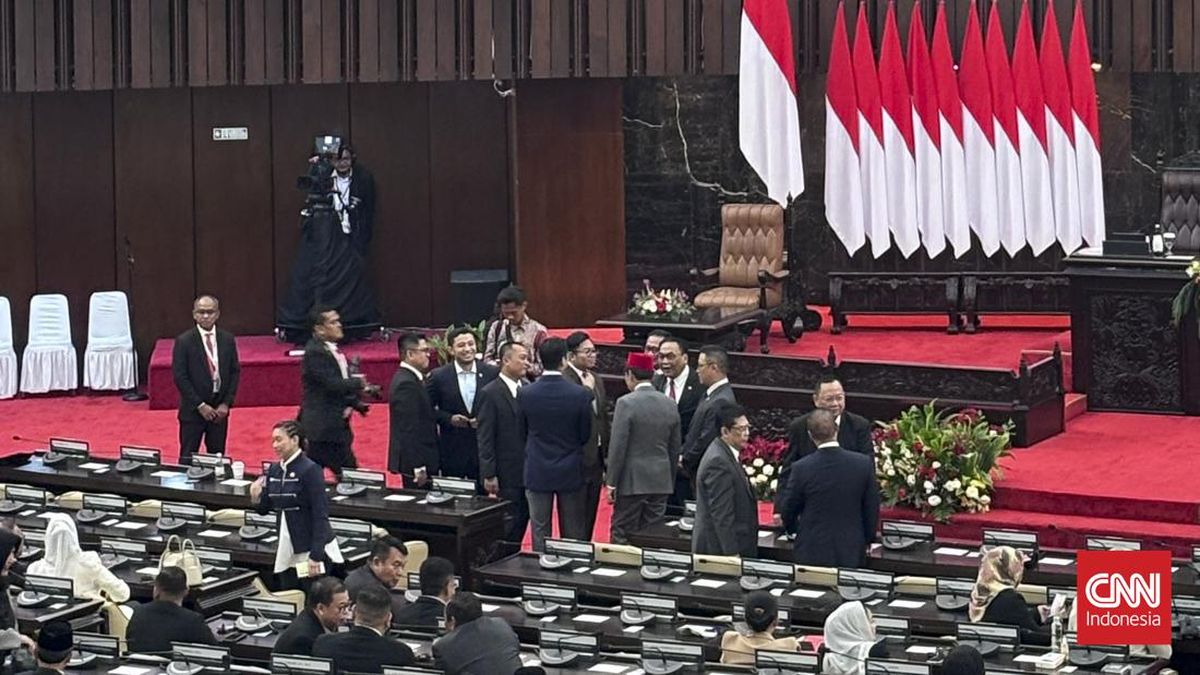
The Indonesian Democratic Party of Struggle (PDI-P) and the Gerindra Party have responded to controversy over a Constitutional Court (MK) ruling concerning a challenge to the validity of Vice-President Gibran Rakabuming Raka’s diploma.
PDI-P Secretary-General Hasto Kristiyanto said the MK ruling on Gibran’s diploma had become a burden for President Prabowo Subianto.
“This is a burden for President Prabowo because it undermines the legitimacy of Gibran Rakabuming Raka,” Hasto said at the PDI-P party school in Lenteng Agung, Jakarta, on Wednesday (21 October).
Hasto also said that PDI-P had recently received a copy of a joint statement from a number of professors following the court’s ruling. In his view, the government could no longer turn a blind eye to the criticism.
He said the government should take note of recent protests in France, adding that ignoring criticism would only generate a wave of discontent.
“We must learn from what happened in France. When the government’s response is perceived as disregarding the people’s voices, it can create a wave of dissatisfaction,” he said.
“PDI-P has an interest in ensuring that this government is truly healthy, listens properly and responds to the people’s aspirations,” Hasto added.
Meanwhile, Azis Subekti, a member of Commission II of the House of Representatives (DPR) from the Gerindra Party faction, said President Prabowo had no authority to dismiss Vice-President Gibran.
“The President does not have the authority to dismiss the Vice-President unilaterally,” Azis said in a statement quoted on Sunday (25 October).
Azis said political demands for Gibran’s removal should not be framed as a constitutional obligation of the President.
He said the Constitution provides a specific mechanism for removing the President or Vice-President, set out in Articles 7A and 7B of the 1945 Constitution.
“The President cannot be held constitutionally at fault simply because he has not complied with their demands,” he said.
Azis also referred to Constitutional Court Decision No. 01/PHPU.PRES-XXIV/2026. In its ruling, the court declared the applicants’ petition inadmissible because they lacked legal standing.
“Impeachment remains part of the Constitution, but its use requires the grounds and proof stipulated by the Constitution. It must not be treated as an unlimited extension of electoral disputes,” he said.
He acknowledged that the court’s reasoning raised questions about evidence of Gibran’s education. However, he said this should be distinguished from the operative part of the ruling, which neither annulled Gibran’s position nor ordered his removal.
“No one has the authority to add a removal order that the Court did not issue,” Azis said.
Azis urged all parties to consider the ruling in terms of its benefits to the public. He also said experts should help the public understand legal issues, including the limits of institutional authority and the legal consequences of a ruling.
In Azis’s view, now that the election process has ended, political leaders should refocus on public concerns rather than prolonging a power struggle.
“The time spent in political uncertainty is time that should be used to improve schools, create jobs, organise public services and strengthen family finances,” he said.
The Constitutional Court previously said it had found no valid document showing that Gibran held a high-school diploma or equivalent certificate of completion that he used to register as a vice-presidential candidate in the 2024 presidential election.
The court said that an equivalency letter issued by the relevant ministry on the basis of a certificate of attendance and a transcript was not a diploma or certificate of completion.
Although the court found no diploma for Gibran, it declared inadmissible the petition by Denny Indrayana and others seeking to disqualify him as Vice-President of the Republic of Indonesia, because the applicants lacked legal standing.
The court then referred the matter of the missing evidence of high-school-equivalent education to other institutions with authority under the 1945 Constitution. Under the Constitution, that authority lies with the House of Representatives (DPR). The issue has consequently prompted parliamentary factions to state their positions.
Source: jawawa.id (https://jawawa.id/newsitem/pdi-p-and-gerindra-respond-to-controversy-over-vice-president-gibrans-diploma-1792990305)
Originally published by CNN Indonesia (https://www.cnnindonesia.com/nasional/20261026101504-32-1419607/respons-pdip-dan-gerindra-soal-polemik-ijazah-wapres-gibran), translated from Indonesian