
PBNU Strengthens Protection for Students through 'Pesantrenku Aman' Movement
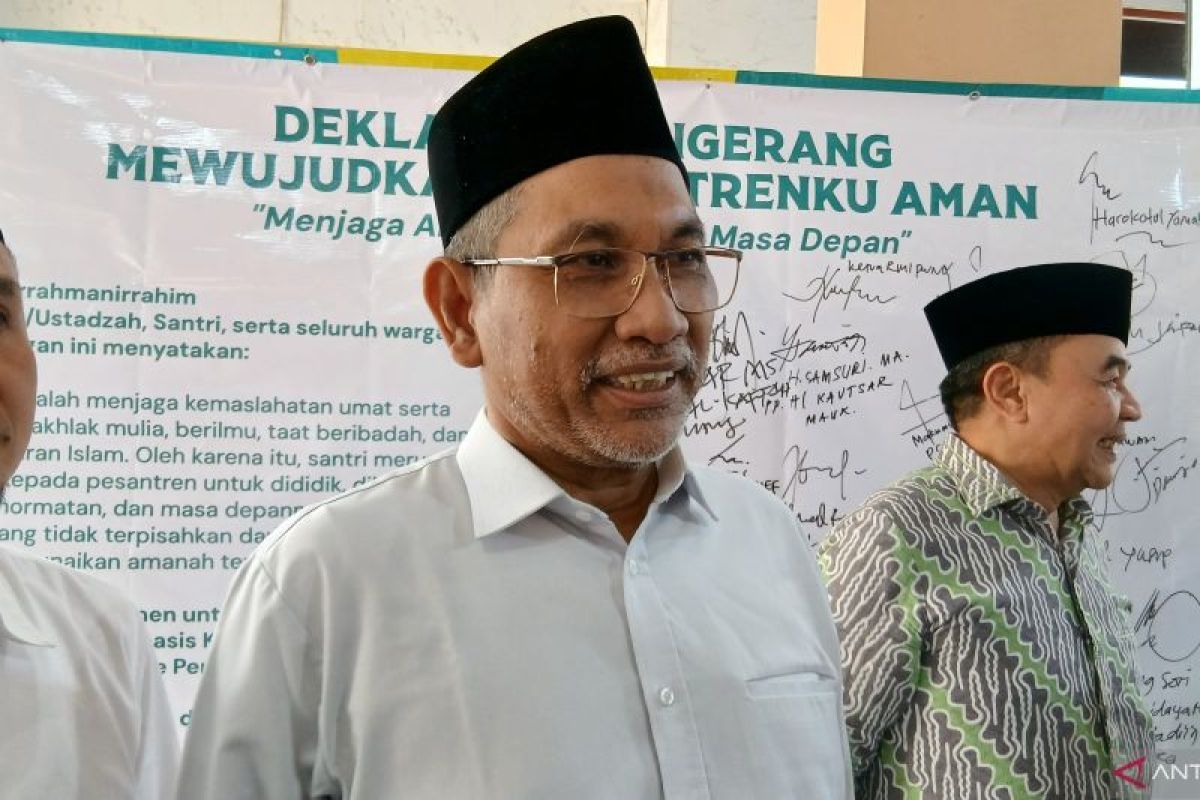
Tangerang Regency (ANTARA) - The Executive Board of Nahdly Ulama (PBNU) is continuing to strengthen its commitment to the protection of students (santri) through the declaration of the ‘Pesantrenku Aman’ movement, alongside religious leaders in Banten on Saturday.
The Head of PBNU for Organisation, Cadreisation, and Membership (OKK), KH Miftah Faqih, stated in Tangerang on Saturday that this step is crucial for creating an Islamic educational environment free from violence and discrimination, while guaranteeing the fundamental rights of students during their studies within the pesantren (Islamic boarding school) system.
“Safety and comfort in the teaching and learning process, comfort in receiving the transformation of knowledge from teachers, safety from bullying, safety from discrimination, and safety from the disruption of proper educational access,” he said after attending the declaration of Pesantrenku Aman at the Al Mubarok Islamic Boarding School, Tigaraksa District, Tangerang Regency.
According to him, the concept of a safe and comfortable pesantren is now being defined more comprehensively. Safety is no longer interpreted solely as being free from physical threats, but also encompasses a sense of security during the learning process, the smooth transfer of knowledge from teachers, and open access to proper education.
“Because the sense of security is a fundamental right of every human being. With a sense of security, students can explore their potential optimally, while remaining based on a sense of responsibility and clear boundaries,” he added.
Miftah noted that in the current era of digitalisation, the relationship between teachers or kiai (religious leaders) and students needs to be thoroughly evaluated, ensuring that the awareness of boundaries and capacities between elements within the pesantren remains proportional.
“Traditional relationship patterns from the past are considered no longer relevant to the dynamics of the present era,” he said. The influx of information today requires pesantren to adapt and move away from disciplinary methods that have the potential to cause psychological or physical violence.
“When I was a child, being scolded by a kiai was seen as a blessing. But in this instance, it cannot be like that because the era is different,” he remarked.
Under this initiative, institutions are tasked with providing quality assurance, which includes educational curricula such as clear minimum pesantren standards. This also involves the presence of Musrif/Musrifah (special supervisors) to monitor the daily lives of students and the implementation of the ‘three T’ principle: Taklim (interaction between teacher and student), Tartib (supervised daily learning practices), and Tarbiyah (intensive spiritual guidance).
Furthermore, modern parenting systems are being implemented in various pesantren, such as the Bahrul Ulum Silo Karangharjo Islamic Boarding School. In this institution, transparency regarding student progress can be accessed directly by parents through an integrated parenting programme.
“Education will succeed if there are three interconnected and mutually supporting elements: first, the teachers and kiai; second, the students; and third, the parents,” he said.
Meanwhile, the Regional Secretary (Sekda) of Tangerang Regency, Soma Atmaja, described the Pesantrenku Aman declaration as both a moral and institutional movement to strengthen child protection within educational environments. Soma stated that the Tangerang Regency Government will support the implementation of this declaration through collaboration across various regional apparatus organisations (OPD) and relevant agencies.
“This is an extraordinary movement. Pesantrenku Aman is not just a moral commitment, but must also be realised through institutional strengthening,” he said.