
Patriot Expedition Team Strengthens Healthcare Services in Yapsi District Through Digitalisation
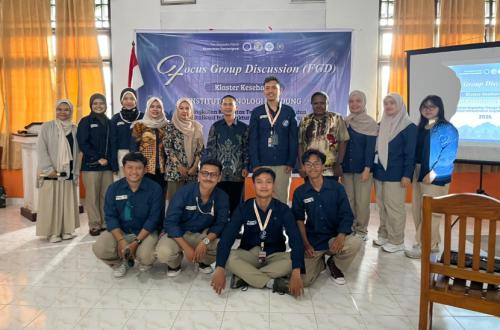
JAYAPURA — The 2026 Patriot Expedition Team (TEP) Health Cluster held a series of Focus Group Discussions (FGDs) at the Yapsi Community Health Centre (Puskesmas) UPTD, Yapsi District, Lereh Transmigration Area (KT), Jayapura Regency, Papua, on Friday, 11 September 2026. The activity formed part of efforts to strengthen healthcare services through digitalisation, improving public health service literacy, and building the capacity of health workers and community cadres based on field needs.
The FGDs were conducted by Team 11 and Team 12 with complementary themes. Team 11 addressed “Digitalisation and Strengthening Public Health Service Literacy”, while Team 12 covered “Strengthening the Capacity of Community-Based Health Workers and Cadres to Support a Healthy and Sustainable Transmigration Area”.
Attendees included the Head of Yapsi Puskesmas, Dr Maryon, a representative of the Jayapura Regency Health Office, Yeni Safitri, health workers from the Puskesmas and auxiliary clinics (Pustu) in Yapsi District, and the TEP 2026 Health Cluster. Team 12’s presentation was delivered online via Zoom by team leader apt. Yangie Dwi Marga Pinanga, Ph.D., while Team 11 presented in person at Yapsi Puskesmas, led by Dr Muhammad Yudhistira Azis, M.Si.
Puskesmas and Health Office welcome the collaboration
The event opened with remarks from Dr Maryon, who welcomed the Patriot Expedition Team and expressed support for collaboration with the Puskesmas and Pustu across Yapsi District.
“Welcome and welcome aboard at Yapsi Puskesmas. We warmly receive the Patriot Expedition Team and hope this cooperation brings benefits for improving healthcare services at the Puskesmas and Pustu, and for the people of Yapsi District.”
Yeni Safitri of the Jayapura Regency Health Office also expressed appreciation to the Bandung Institute of Technology (ITB) for its contribution to strengthening healthcare services in the Yapsi area.
“We convey our thanks and high appreciation to the Bandung Institute of Technology for its care and contribution in supporting healthcare services in Yapsi District. We hope this collaboration continues and produces concrete steps that match community needs and actual healthcare conditions in the field.”
Team 12: Strengthening the capacity of health workers and cadres
Team 12’s presentation, delivered online by apt. Yangie Dwi Marga Pinanga, Ph.D., discussed health conditions in the Lereh Transmigration Area as the basis for assessing capacity-building needs. The assessment was carried out through questionnaires, interviews with health workers and cadres, field observation, and data analysis at Yapsi Puskesmas and several Pustu. The mapping covered health worker and cadre capacity, training needs, availability of medicines and medical equipment, service constraints, and referral systems.
The assessment found disparities in capacity and facilities between Pustu. Some facilities faced shortages of medicines and equipment, such as oxygen, nebulisers, suturing sets, and delivery kits. In addition, 82.4 per cent of respondents had never attended training or needed competency refresher courses. The most requested training included maternal and neonatal emergency care, BTCLS/BLS, and Normal Delivery Care (APN).
Capacity building was also directed at Posyandu and malaria cadres, particularly in growth monitoring and stunting, early disease detection, recognition of danger signs, malaria prevention, vector control, sanitation, and referrals.
During the discussion, apt. Yangie emphasised that competency improvements should be tailored to each health worker’s role: BTCLS for nurses, APN for midwives, while emergency training could be developed across professions. She also expressed hope that all Pustu would receive equal opportunities for competency development.
Team 11: Digitalisation and public health service literacy
The FGD featured a keynote speaker, Dr Mingsep Rante Sampebua, S.T., M.T., a lecturer in information systems at Cenderawasih University Papua, presenting “The Lerehfarma Information System as a Healthcare Service at Yapsi Puskesmas, Jayapura Regency”.
Dr Mingsep explained the importance of information systems as a means of providing information to support decision-making and healthcare management, while encouraging more integrated, high-quality and accessible data management.
“An information system is not just about building an application, but about how information is managed and utilised to support services and decision-making.”
During the discussion session, participants raised questions about implementing health information systems in Yapsi District. One key point was the need for the new system to connect with applications already used by the Puskesmas and other health facilities to avoid duplication. Participants also stressed that system development must account for facility conditions, service flows, staffing, and users’ readiness, so technology adoption should proceed gradually and match real conditions in Yapsi.
“What matters most is that the system developed is actually used and genuinely helps meet healthcare needs in the field.”
Dr Muhammad Yudhistira Azis, M.Si., an ITB lecturer and leader of the TEP 2026 Health Cluster in Yapsi District, then presented on digitalisation and strengthening public health service literacy. He presented survey findings from six settlement units and three local villages, covering available health services, access to medicines, clean water conditions and access, transport access, digital health literacy, and health concerns in the community.
Malaria emerged as the most prominent health problem, alongside skin diseases, flu and cough, acute respiratory infections, diarrhoea, joint pain, and workplace accidents. Field findings also revealed challenges including limited medical equipment, clean water availability, internet access, health workers, and medicine supplies.
“These field findings are the basis for us to understand what communities truly need, so that the solutions developed are grounded in conditions found directly in Yapsi District.”
Dr Yudhistira explained that the survey results underpinned the development of Lerehfarma.id, a platform introduced to help meet community needs for health service information, access to and information on medicines, health education, disease data, and public reporting or complaints.
Clean water education and water pH checking tutorial
Dr Azis also delivered education on the importance of clean water for public health, linked to field findings on varied water sources and access across Yapsi District. The session included a hands-on tutorial on checking water pH, both for consumption and for sterilising medical equipment at the Puskesmas and auxiliary clinics.
“Maintaining health is not something we do only when we fall ill. One thing that needs attention is the water we use in daily life.”
Disease education and Lerehfarma.id demonstration
Dr Yudhistira also provided education on diseases of concern in Yapsi District, including malaria, acute respiratory infections, scabies, and HIV/AIDS. A key part of the session was the introduction and demonstration of Lerehfarma.id, where participants were shown its features and how to use the website — accessing the platform, finding health facilities, viewing medicine information, reading health education, submitting reports or complaints, and viewing disease data.
“Lerehfarma.id is expected to become a means to help the community obtain health information, including health facilities in Yapsi, medicine information, education on preventing the most prevalent diseases, and a complaint box and disease data.”
Discussion session and input for developing Lerehfarma.id
Dr Yudhistira then opened a discussion with participants, covering experiences, needs, and challenges in healthcare services in Yapsi District and the development of Lerehfarma.id. Key topics included medicine information management, the platform’s integration with systems already used at the Puskesmas and Pustu, and public complaint mechanisms. Participants also noted uneven internet access in some areas, including the possible use of alternative mechanisms to support information delivery and complaints where connectivity is limited.
On complaints, it was explained that public reports can be managed by health workers, with complainants able to monitor progress through the available mechanism, and urgent matters forwarded to the appropriate staff. Participants offered input including the need for more informative report statuses and proper recording of medicine transfers between facilities so that type, quantity, and origin remain clearly documented.
“Input from participants is vital, because a good system must be continuously developed based on users’ experiences and needs in the field.”
The interactive discussion became an important part of refining the Lerehfarma.id concept, with the input serving as consideration for developing services better suited to community needs and healthcare conditions in Yapsi District.
The TEP 2026 Health Cluster expressed its deepest gratitude to all staff of Yapsi Puskesmas who attended, participated actively, and provided input throughout the FGD. Appreciation was also conveyed to Dr Mingsep Rante Sampebua, S.T., M.T. as keynote speaker, and to Dr Muhammad Yudhistira Azis and apt. Yangie Dwi Marga Pinanga, Ph.D. as team leaders and presenters.
From mapping to follow-up
The two FGDs provided complementary pictures of healthcare needs in Yapsi District: Team 12 focused on health worker and cadre capacity, while Team 11 promoted technology use and public health literacy. As follow-up, TEP 2026 plans capacity building through training on self-medication and Dagusibu (understanding, using, storing, and disposing of medicines), BTCLS and APN, and medicine and medical equipment management. Training will be scheduled around each Pustu’s service timetable and supplemented with post-training mentoring.
Through collaboration between TEP 2026, Yapsi Puskesmas, the Jayapura Regency Health Office, universities, health workers, cadres, and the community, the activity is expected to be a concrete step towards more responsive, needs-based, and sustainable healthcare services in Yapsi District, Lereh Transmigration Area, Jayapura Regency, Papua.
Thanks were also conveyed to the Ministry of Transmigration of the Republic of Indonesia, DPMK ITB, the ITB School of Pharmacy, ITB’s Faculty of Mathematics and Natural Sciences, the Analytical Chemistry Laboratory of FMIPA ITB, and the ITB Patriot Expedition Team of the Lereh Transmigration Area, Jayapura Regency, for supporting the activity.
Source: jawawa.id (https://jawawa.id/newsitem/patriot-expedition-team-strengthens-healthcare-services-in-yapsi-district-through-digitalisation-1789462481)
Originally published by Republika (https://news.republika.co.id/berita/tlecny490/tim-ekspedisi-patriot-perkuat-layanan-kesehatan-di-distrik-yapsi-melalui-digitalisasi), translated from Indonesian