
Patients Should Know: Liver Cancer Can Be Treated Without Surgery
Jakarta, CNBC Indonesia — When doctors find tumour cells in the liver, patients and their families naturally have many questions: “Will surgery be necessary? Are there other treatment options?” The answer can differ from one patient to another. Treatment needs to be tailored according to the number and location of tumours, liver function and the patient’s overall condition.
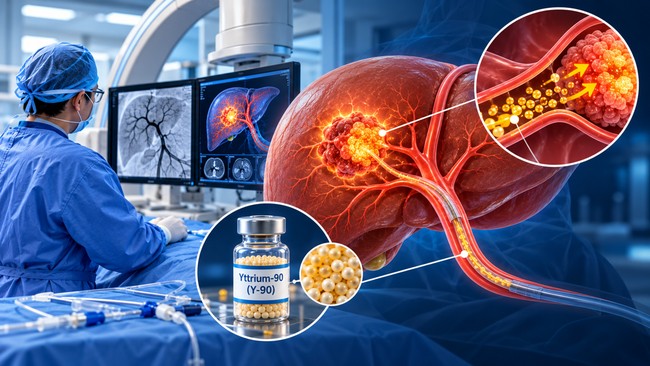
Among the various options for treating liver cancer is a method that is not yet widely available in Indonesia: Y-90 radioembolisation, or Selective Internal Radiation Therapy (SIRT), using tiny microspheres containing the radioactive substance yttrium-90 (Y-90).
This technique combines interventional radiology with nuclear medicine. Y-90 microspheres are delivered through blood vessels to a tumour in the liver, providing targeted radiation. The method is an option for targeting tumours in the liver, whether they originated there or spread from another cancer. The dose is planned individually according to the tumour’s characteristics, liver function and the patient’s condition.
The explanation was given by Prof. Pierce Chow, MBBS (NUS), M.Med (Surg), FRCS (Edinburgh), FAMS (Gen Surg), PhD (NUS), a Singapore-based surgical oncologist specialising in liver and bile duct cancers. He was speaking at Mayapada Power Talk, “Advancing End-to-End Digestive Cancer Care”. The forum brought together digestive oncology experts and Mayapada Hospital’s strategic partners to discuss diagnostic developments, the importance of multidisciplinary collaboration and current cancer treatments, including SIRT with Y-90 microspheres for liver cancer.
Prof. Chow said advances in interventional radiology techniques had made it possible to deliver doses more safely, leading to better treatment outcomes, including longer overall survival and progression-free survival.
“From what I have seen, Mayapada Hospital is a very progressive hospital. For liver cancer treatment, most of the necessary components are already available, and with the introduction of SIRT using Y-90 microspheres, Mayapada Hospital has an increasingly comprehensive range of capabilities,” Prof. Chow said in an official statement on Monday (12 October 2026).
Dr Pramlim Gunawan, Sp.Rad, a consultant interventional radiologist at Mayapada Hospital Jakarta Selatan, explained that SIRT with Y-90 microspheres involves several preparatory steps before treatment. These include a mapping angiogram combined with the radiopharmaceutical Tc-99m MAA and SPECT-CT to assess the potential flow of microspheres to the lungs (lung shunt fraction/LSF) or digestive tract (gastrointestinal/GI shunt). The results are used to calculate a personalised treatment dose based on the patient’s condition, using the partition or BSA model.
“Angiography is then performed to map the blood vessels supplying the tumour and to ensure that the treatment can be delivered safely. This preparatory stage is important in helping doctors determine the route of administration and ensure the microspheres can be directed precisely to the target area,” Dr Pramlim added.
Treatment planning for SIRT with Y-90 microspheres is also supported by SPECT scans. Dr Lim Andreas, Sp.KN, of Mayapada Hospital Jakarta Selatan, said SPECT scans play a role before treatment by helping determine the appropriate dose, as well as in post-treatment evaluation.
“The examination helps show the distribution of the tracer in the liver and confirm that it matches the target area, while also assessing the distribution of Y-90 microspheres after treatment. This gives doctors a more comprehensive picture to support both treatment planning and evaluation,” Dr Lim Andreas said.
In digestive cancer care, accurate diagnosis is an important step before treatment options are decided. One technology that supports diagnosis is endoscopic ultrasound (EUS), which enables doctors to examine abnormalities in digestive organs—particularly the pancreas and bile ducts—in greater detail.
Dr C. Rinaldi A. Lesmana, PhD, SpPD-KGEH, FACP, FACG, FINASIM, of Mayapada Hospital Jakarta Selatan, said EUS helps doctors detect and assess abnormalities in the liver and surrounding tissues, and can also assist with tissue sampling when needed.
“The results form part of a comprehensive assessment to determine the right treatment strategy through collaboration among a multidisciplinary team,” Dr Rinaldi said.
This approach is part of Mayapada Hospital’s end-to-end digestive cancer care service, in which patients receive care from diagnosis through to the selection of treatment suited to their condition, including Y-90 radioembolisation for liver tumour patients who meet the relevant criteria.
As a treatment that remains uncommon in Indonesia, SIRT with Y-90 microspheres offers an option involving collaboration among doctors from different disciplines, with care integrated from diagnosis through monitoring and follow-up. The approach is part of the end-to-end digestive cancer care service at the Oncology Centre of Mayapada Hospital Jakarta Selatan, covering consultation, diagnosis, treatment planning—including Y-90 when appropriate—and follow-up care. Services are supported by PET-CT and SPECT scan facilities in the Nuclear Medicine Clinic, as well as a multidisciplinary team through a Tumour Board and Patient Navigator, who help coordinate the care process.
Patients are advised to consult a doctor to find out which treatment options are appropriate for their individual condition.