
Pati Regency Government to Help Absorb Farmers' Salt Amid Production Surplus
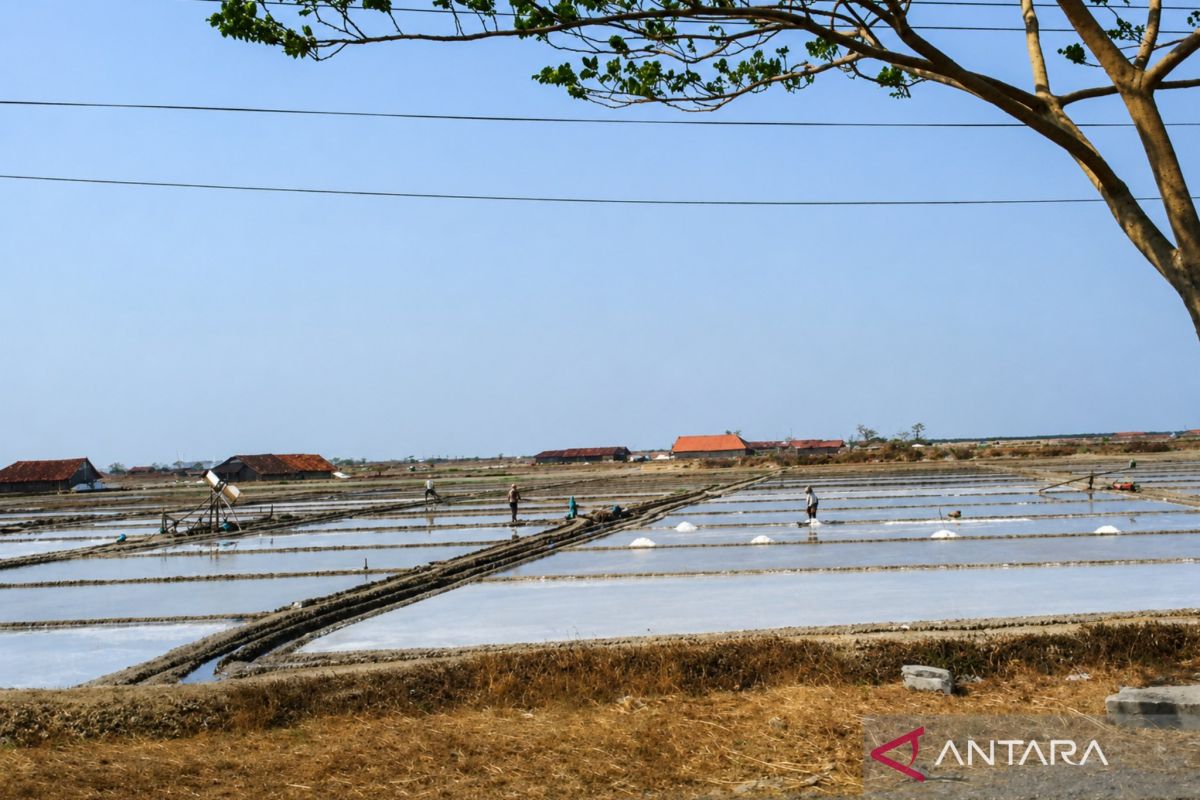
The Government of Pati Regency, Central Java, is committed to optimising the absorption of farmers’ salt following an abundant production entering the main harvest season, which has impacted the decline in the selling price of the commodity at the farmer level.
“The Pati Regency Government will certainly optimise the existence of industry and people’s salt storage warehouses to help absorb farmers’ production,” said Hadi Santosa, Head of the Marine and Fisheries Service (DKP) of Pati Regency, in Pati on Sunday.
According to him, the existence of PT Sarana Pembangunan Jawa Tengah (SPJT), an industrial salt processing plant in Raci Village, Batangan District, Pati Regency, can be optimised to help absorb farmers’ salt.
In addition, he said, in Pati Regency there are also three people’s warehouses plus five existing warehouses.
All these facilities can be optimised to increase the absorption of local salt.
In Pati Regency, he continued, there is also a salt cooperative whose task is to help absorb the production of salt farmers.
“The existence of village cooperatives can also be collaborated with, so that it can help improve the welfare of salt farmers,” he said.
Hadi revealed that salt productivity in this year’s dry season has actually decreased compared to the previous dry season.
This condition is influenced by the soil in the salt production area which still tends to be wet after previously experiencing a fairly long rainy season.
As a result, the salt production process takes longer, so that farmers’ productivity has decreased.
Ali Muntoha, a salt farmer from Ketitang Wetan Village, Batangan District, Pati, acknowledged that the current dry season is not like previous years, because the soil on the salt production land tends to be fresh, causing the salt production process to take longer.
“If previously within three days we could harvest, now it takes up to four days because the hot steam from the ground is not optimal because besides being fresh, the soil also tends to be wet. Meanwhile, the harvest yield has also dropped to 1 quintal from previously 1.5 quintals,” he said.
According to Ali, this condition can be felt from the hot temperature on the production land. If previously at around 10.00 to 11.00 WIB the hot temperature was already quite high, currently the heat produced by the soil at that time is not yet optimal.
Besides the productivity issue, farmers are also facing low salt absorption. Salt consumption manufacturing companies are said to have not yet received raw material supplies from farmers, impacting the selling price at the farmer level.
Ali said the price of salt, which previously reached Rp1,100 per kilogram, has now dropped to around Rp700 per kilogram.
Despite the price decline, he acknowledged that salt farmers still make a profit.
According to him, the more important thing is that the government does not import salt so that people’s salt production still has the opportunity to be absorbed by the domestic industry.
Pati Regency has a salt production land area of 2,901.63 hectares spread across four sub-districts, with salt production in 2025 recorded at 93,482.23 tonnes.