
Pasar Jaya supports waste sorting at source movement
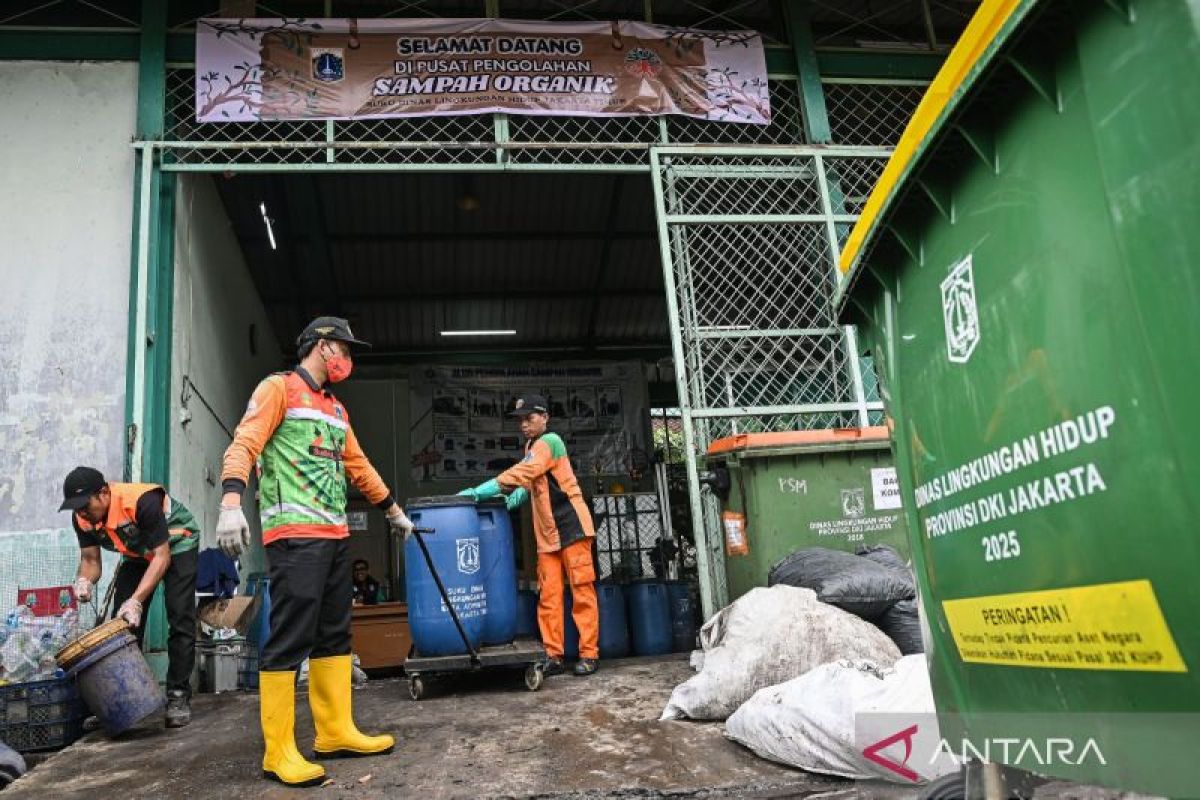
Jakarta (ANTARA) - Perumda Pasar Jaya is strengthening its commitment to supporting the waste sorting at source movement as part of efforts to build a new culture of waste management in Jakarta.
Perumda Pasar Jaya President Director Agus Himawan Widiyantoro said in a statement in Jakarta on Wednesday that the success of waste management does not depend solely on technology and processing facilities, but is also largely determined by changes in public behaviour starting from the source.
According to Agus, the habit of sorting waste needs to begin at home before waste is taken to collection points or processing facilities. This simple step is an important foundation for building a more effective, efficient and sustainable waste management system.
“The key remains with the community, namely sorting waste from home,” he said.
He said the waste sorting at source movement must be carried out consistently by involving all elements of society. This behavioural change is expected not to stop as a temporary programme, but to grow into a habit embedded in the daily lives of Jakarta residents.
“This movement truly becomes a new culture for Jakarta,” said Agus.
In this context, Perumda Pasar Jaya holds a strategic position because it manages around 153 traditional markets spread across various areas of Jakarta. Markets are not only centres of economic activity, but also spaces for interaction between traders and the public in large numbers every day.
Therefore, Pasar Jaya is encouraging waste management in market environments to be carried out in a more structured manner. These efforts include reducing the use of single-use plastics, reusing items that can still be used, and sorting waste by type.
These efforts are also in line with the Reduce, Reuse, Recycle (3R) principle. Through sorting from the source, waste that still has use value or economic value can be directed for reuse and recycling. Meanwhile, residual waste can be handled through appropriate processing facilities.
Agus stressed that the waste problem is not merely a matter of city cleanliness. According to him, the way people treat waste also reflects the level of awareness and the quality of a city’s civilisation.
“The civilisation of a nation is also determined by how we treat waste,” he said.
He added that Jakarta’s waste problem, which has not yet been fully resolved, requires collaboration from all parties. The government, market operators, traders, consumers, businesses, communities and the public each have roles according to their respective capacities.
“Jakarta’s waste problem, which has so far remained unresolved, can be overcome together,” said Agus.
In addition to encouraging sorting from the source, Pasar Jaya also supports various waste management innovations developed by the government, including the implementation of the circular economy concept and waste-to-energy (WtE) processing technology.
However, Agus stressed that waste processing technology must be positioned as part of an integrated management system. Waste reduction and sorting from the source remain the initial stages that greatly determine the quality of waste entering the subsequent processing stages.
With its extensive market network, Pasar Jaya is committed to making market environments one of the public education spaces regarding the importance of waste management.
The movement is ultimately directed at building shared awareness that waste management is not only the responsibility of the government or cleaning staff. Every household, trader and consumer has a role from the moment waste is first generated.
Through strengthening waste sorting from the source, Perumda Pasar Jaya hopes that the waste management ecosystem in Jakarta will become more effective and sustainable. This step is also part of joint efforts to realise a cleaner, healthier, more orderly and sustainable Jakarta.
In a separate place, Cempaka Putih Environmental Supervisor Agus Sasmita added that residents’ waste processing must first be separated from the source.
“So it cannot be done directly. The organic waste is processed, then it becomes food material or animal feed. Now, one of them is what from the source? From the source means from households,” he explained in the Public Discussion Jakarta Moves Together, Sort Waste from the Source, Become a New Culture for City Residents, on Wednesday.
In addition to sorting from the source, he continued, the public needs to understand the SOP for sorting household waste, so that the ultimate goal is that waste collection officers are not overwhelmed when transporting residents’ waste.
“So just like the SOP, it is separated. There may be 4 or 3 categories there. One of them is B3, but B3 is rare. Residues of hazardous materials such as mosquito repellent, medicines, syringes, those are probably rare,” he said.