
Part-time PPPK teachers can join 2027 civil service selection, here are their rights and obligations
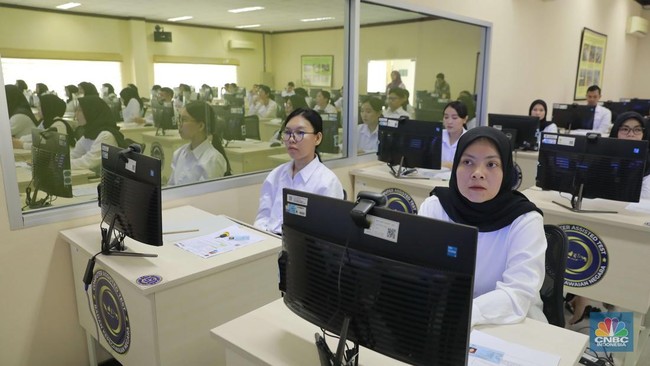
Jakarta, CNBC Indonesia - The government is preparing a scheme for part-time Government Employees with Work Agreements (PPPK) working as teachers to become full-time PPPK in 2027. Teachers who already hold full-time PPPK status will also be given the opportunity to take part in the civil servant (PNS) selection, which is expected to open in early 2027.
“Part-time PPPK will be given the opportunity to become full-time PPPK, which will be carried out in 2027. Then, PPPK teachers will also be given the opportunity to take part in the PNS selection, with registration expected in early 2027,” said Minister for Administrative and Bureaucratic Reform (PANRB), Rini Widyantini.
In the meeting, the PANRB Minister stated that there are 955,245 teachers with PPPK status and 231,246 part-time PPPK teachers. So what exactly are the rights and obligations of full-time PPPK?
- Employment Status
According to Article 1 of Law No. 5 of 2014, the State Civil Apparatus (ASN) consists of two types of employees: PNS and PPPK.
Civil Servants (PNS) are Indonesian citizens who meet certain requirements and are appointed permanently by the Personnel Development Officer (PPK) to occupy government positions.
PPPK are Indonesian citizens appointed based on a work agreement for a specific period in order to carry out government duties. This means PNS have permanent status, while PPPK have contract status with a minimum working period of 1 year and can be extended according to agency needs and performance assessment.
- Salary and Awards
Based on Government Regulation (PP) Number 49 of 2018, PPPK are given salaries and allowances in accordance with the provisions of laws and regulations applicable to Civil Servants (PNS).
In addition, in the context of competency development to support the implementation of duties, PPPK are given the opportunity for knowledge enrichment in accordance with competency development planning at Government Agencies.
Quoted from the Cabinet Secretariat, the implementation of competency development is carried out for a maximum of 24 (twenty-four) lesson hours in 1 (one) year of the work agreement period, except for PPPK who carry out duties as certain primary high leadership positions (JPT utama) and certain middle high leadership positions (JPT madya), according to Article 40 paragraphs (1,2) of this PP.
This PP also affirms that PPPK who have shown loyalty, dedication, skill, honesty, discipline, and work achievement in carrying out their duties may be given awards.
The awards referred to may take the form of:
honours;
priority opportunities for competency development; and/or
opportunities to attend official events and/or state events.
- Leave
Every PPPK is entitled to leave, consisting of: annual leave; sick leave; maternity leave; and collective leave.
PPPK who have worked for at least 1 (one) year continuously are entitled to annual leave of 12 (twelve) working days, according to Article 78 paragraphs (1,2) of this PP.
PPPK who occupy teacher positions in schools and lecturer positions in higher education institutions who receive holidays in accordance with the provisions of laws and regulations, according to this PP, are considered the same as PPPK who have used their annual leave rights.
Meanwhile, PPPK who are sick for more than 1 (one) day up to 14 (fourteen) days, according to this PP, are entitled to sick leave, provided that the person concerned must submit a written request to the PPK (Personnel Development Officer) by attaching a doctor’s certificate.
The right to sick leave as referred to is granted for a maximum period of 1 (one) month, according to Article 83 paragraph (4) of this PP. Meanwhile, for PPPK who do not recover from their illness within the period referred to, termination of employment is carried out.
This PP also affirms that PPPK who experience a work accident so that the person concerned needs treatment are entitled to sick leave until the end of the work agreement period.
For the birth of the first child up to the birth of the third child while serving as PPPK, according to this PP, PPPK are entitled to maternity leave for a maximum of 3 (three) months, and continue to receive income in accordance with the provisions of laws and regulations. As for collective leave for PPPK, according to this PP, it follows the provisions of collective leave for PNS.
- Discipline
PPPK who commit disciplinary violations are subject to disciplinary punishment, according to Article 51 paragraph (3) of the above PP.
This PP also regulates the termination of employment for PPPK. It is stated that termination of PPPK employment is carried out with respect due to:
the work agreement period has ended;
death;
at one’s own request;
organisational streamlining or government policy resulting in a reduction of PPPK; or
physical/mental incapacity so that they cannot carry out duties and obligations in accordance with the agreed work agreement.
Meanwhile, termination of PPPK employment is carried out with respect but not at one’s own request due to:
being sentenced to imprisonment based on a court decision that has obtained permanent legal force for committing a criminal act with a minimum prison sentence of 2 (two) years, and the criminal act was committed without premeditation;
committing a serious disciplinary violation of PPPK; or
failing to meet the performance targets agreed upon in accordance with the work agreement.
In addition, termination of the PPPK work agreement is carried out without respect due to:
committing deviation against Pancasila and the 1945 Constitution;
being sentenced to imprisonment or confinement based on a court decision that has obtained permanent legal force for committing a criminal act of office or a criminal act related to office and/or a general crime;
becoming a member and/or administrator of a political party; or
being sentenced to imprisonment based on a court decision that has obtained permanent legal force for committing a criminal act punishable by imprisonment of at least 2 (two) years or more and the criminal act was committed with premeditation.