
Papua accelerates rice field development towards national food self-sufficiency
Jayapura - The central and regional governments are continuously refining steps to accelerate the rice field creation programme in Papua, as part of the broader strategy towards national food self-sufficiency.
The programme, targeted at achieving 30,000 hectares, not only focuses on opening new land but also emphasises technical, social, and institutional readiness to ensure sustainable implementation and tangible impacts on farmers’ welfare.
Director General of Land and Irrigation of the Ministry of Agriculture, Hermanto, stated that the survey, identification, and design (SID) stages form the primary foundation of the programme. These stages are deemed crucial as they determine the direction of implementation before entering the field construction phase.
The SID process itself encompasses mapping land conditions, analysing irrigation systems, and assessing local community social readiness, including aspects of land ownership and usage.
“We will carry it out in stages until it meets the target of approximately 30,000 hectares this year, and this is still in the SID process,” he said during a working visit to Papua.
Some areas have completed the initial SID stages and will soon enter the construction process. Therefore, the government targets the initial phase of 15,000 hectares to be completed at the latest by August 2026. Thus, the land can be planted at the beginning of September 2026.
For the Ministry of Agriculture, the quality of the SID results will greatly determine the programme’s success, including in minimising potential land conflicts and technical obstacles in the field. Therefore, the involvement of regional governments is highly needed, particularly in socialising to customary land rights holders.
The Papua Provincial Government appreciates the central government’s attention through the Ministry of Agriculture in promoting agricultural sector development in eastern Indonesia.
Papua Governor Mathius D. Fakhiri emphasised that the rice field creation programme is a strategic step that not only aims at increasing food production but also directly impacts community welfare improvement.
The Papua Provincial Government views the programme concept, which utilises community-owned land and returns the results to the community, as creating a healthy economic cycle.
“The land comes from the community and the results return to the community, so the benefits can be directly felt,” said the former Papua Police Chief.
The Papua Provincial Government is also strengthening these efforts through policies to expand planting areas and providing agricultural machinery and equipment assistance (alsintan) to farmers as an effort to increase productivity and agricultural sector independence.
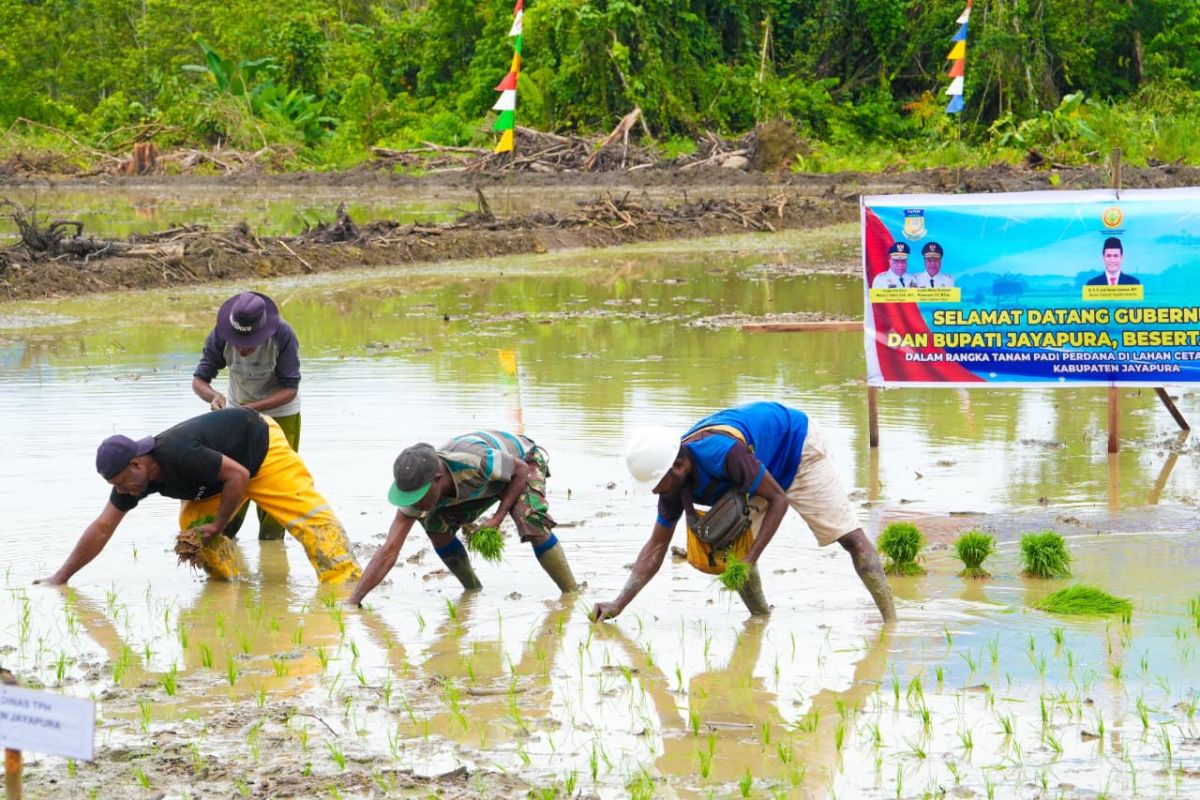
That assistance, such as in Swentab Village, Kemtuk Gresi District, Jayapura Regency, where the Provincial Government of Papua together with the Jayapura Regency Government conducted the inaugural rice planting on two hectares with a total target of 50 hectares.
In addition to planting, the Papua Provincial Government also distributed 43 units of agricultural equipment, demonstrating the government’s serious efforts in supporting improvements in the agricultural sector quality.
Based on data from the Central Statistics Agency (BPS), Papua’s Farm Business Income Index (NTP) in March 2026 experienced an increase of 0.23 percent to 103.30.
This increase was influenced by a rise in the index of prices received by farmers by 0.40 percent, higher than the increase in the index of prices paid by farmers by 0.16 percent.
Given this, the programme becomes a breath of fresh air for the agricultural sector. Nevertheless, the government still needs to maintain a balance between production increases and production cost stability so that farmers’ welfare can continue to improve.
Meanwhile, Acting Head of the Papua Food Crops and Horticulture Service, Lunanka Daimboa, stated that they target the development of rice fields up to 18,000 hectares in 2026.
That land is spread across several potential areas, such as Keerom Regency, Jayapura, Waropen, and Yapen Islands Regency.