
Panic Over 'Sell Indonesia' as Rupiah and Stock Market Plummet, Recalling Past Instability
Global investors are reportedly losing confidence in Indonesia at an accelerating pace, as the domestic stock market experiences one of the world’s fastest declines and the Rupiah hits historic lows. Just five months after reaching record highs, the Indonesia Composite Index (IHSG) has plummeted by 36%, officially becoming the worst-performing index globally among approximately 90 indices monitored by Bloomberg for 2026.
This shift marks a dramatic turning point for the commodity-rich nation, which was previously a mandatory allocation in emerging market portfolios. The primary source of anxiety for capital owners is President Prabowo Subianto’s political agenda, which is perceived as increasingly populist, alongside rising government intervention in an economy previously known for being investor-friendly.
“The major trade in Asia right now is ‘sell Indonesia’,” stated George Boubouras, Head of Research at hedge fund K2 Asset Management, as reported by the Straits Times. After decades of active investment in the country, Boubourlar decided to exit all positions starting in 2024. “I have zero exposure to Indonesia. I will not give them a chance,” Boubouras added.
Since taking office in October 2024, President Prabowo has pledged to drive annual economic growth to an 8% target. His administration has also launched a national free school lunch programme, expanded the state’s role in the economy, and allocated billions of dollars to the Danantara sovereign wealth fund. Recently, the President’s move to take direct control over key commodity exports to curb tax evasion triggered massive sell-offs in the exporter sector. For many global investors, the departure of former Finance Minister Sri Mulyani Indrawati in 2025 served as the tipping point for market confidence.
Sri Mulyani was widely regarded as the guarantor of fiscal discipline, reassuring markets that Indonesia would maintain conservative budgetary management—a policy that helped the country achieve investment-grade credit ratings and attract long-term foreign capital. Market participants are now questioning whether this commitment to fiscal stability will be upheld by the new administration. A regional foreign exchange strategist noted that domestic political uncertainty is a classic emerging market risk that prompts investors to adopt a ‘wait and see’ approach.
“Domestic political uncertainty is a typical emerging market risk that global investors respond to by staying on the sidelines until predictability returns,” said Tang Yuxuan, Asia Head of Rates and Foreign Exchange Strategy at J.P. Morgan Private Bank in Hong Kong. Given the current volatility, Yuxuan advised caution.
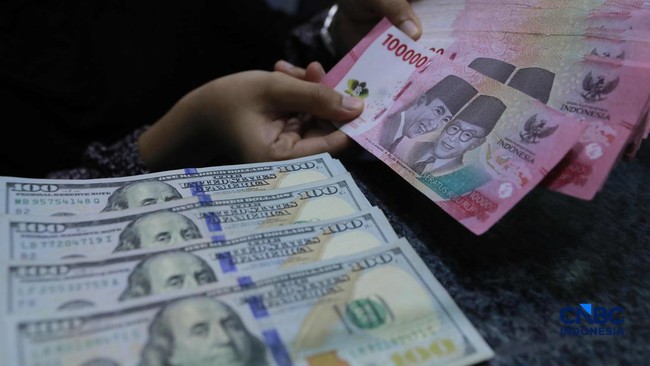
The Rupiah serves as the most visible reflection of market anxiety, having depreciated by approximately 14% since President Prabowo took office, making it the weakest currency in Asia in 2026. The Rupiah breached the psychological level of US$ 1 (Rp 18,000) on 4 June, and options markets are signalling even deeper declines. Forex traders estimate a 45% chance that the Rupiah could fall to US$ 1 (Rp 19,000) by December, with a 27% probability of it sliding to US$ 1 (Rp 20,000) within the next year.
“The core driver behind the short positions in Indonesia is the bearish outlook for the Rupiah, where investors remain concerned about macro imbalances and policy credibility, especially on the fiscal side,” said Gary Tan, Portfolio Manager at Allspring Global Investments.
This pressure has extended to the government bond market. Foreign investors have reduced their holdings of Indonesian government bonds by as much as Rp 86 trillion, a drop of about 9% since last August. These bonds have lost over 8% for dollar-based investors in 2026, contrasting sharply with the 1.6% gain seen in overall emerging market debt, despite repeated interventions by Bank Indonesia. Further concerns arise from the central bank’s significant ownership of government debt, which now stands at approximately 27% of total national bonds—a high figure for an emerging economy.
“What began as purchases to enhance bond market liquidity may have become more akin to a type of quantitative easing,” noted Rajeev De Mello, Portfolio Manager at GAMA Asset Management. De Mello added that investors urgently require clarity from the central bank regarding its holdings, stating, “Investors want clearer guidance on whether this ownership has stabilised or is likely to increase or decrease.”
This massive sell-off has revived long-standing fears regarding Indonesia’s sovereign credit profile, reminiscent of the period between 2012 and 2017 when the nation struggled to secure investment-grade ratings from major international agencies.