
PANDI Says Javanese Script Can Now Be Used in Internet Domain Names
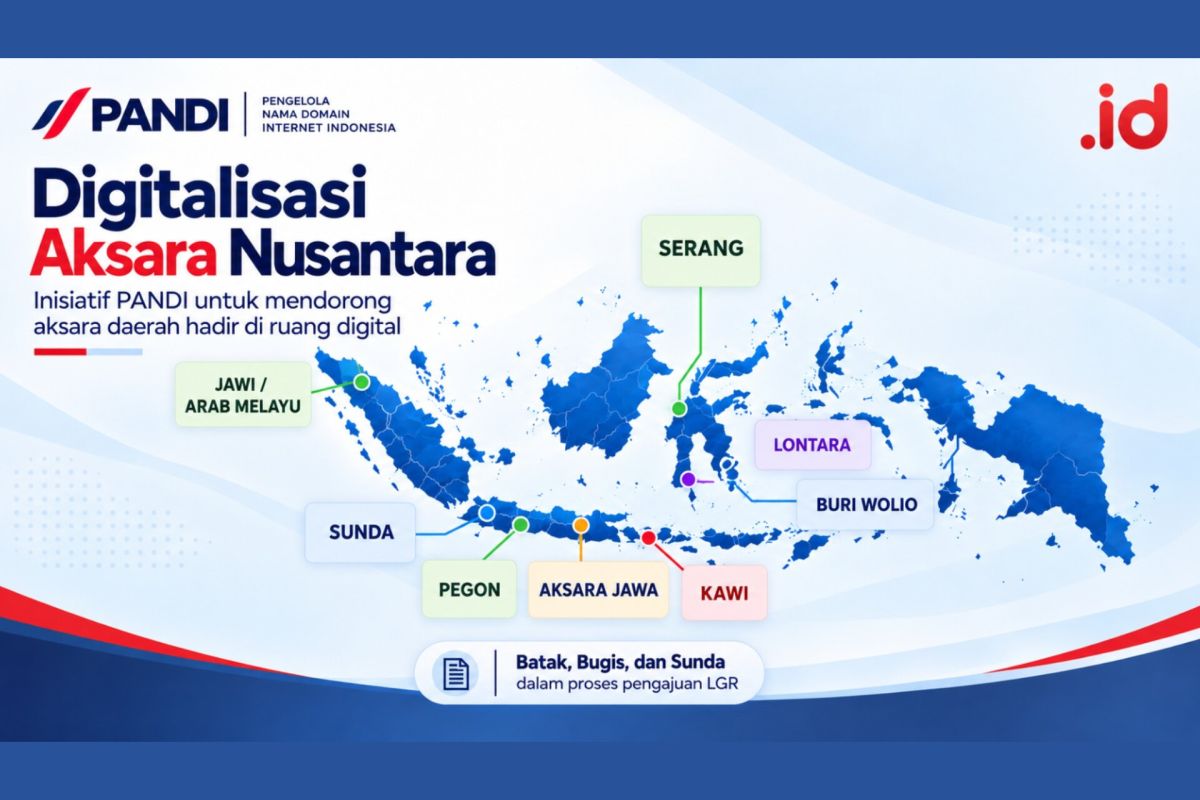
Jakarta (ANTARA) – The Indonesian Internet Domain Name Manager (PANDI) says Javanese script can now be used in domain names following its recognition by the Internet Corporation for Assigned Names and Numbers (ICANN).
In early October 2026, ICANN issued the technical standard known as the Second-Level Reference Label Generation Rules (LGR), enabling Javanese script to be used directly in second-level domain names.
“We welcome this development because it shows that Nusantara scripts are gaining more space in the global internet ecosystem,” PANDI chairman Isnawan said in a statement received and confirmed on Wednesday.
A second-level domain is generally the main identifying name or brand registered by a website owner. In the web address antaranews.com, for example, “antaranews” is the second-level domain and “com” is the top-level domain.
With the Second-Level Reference LGR for Javanese script in place, individuals and companies will in future be able to register their brands directly in Javanese script rather than using the Latin alphabet.
In addition to issuing the Second-Level Reference LGR for Javanese script, ICANN has updated the LGR for the group of scripts based on Arabic script.
This means Pegon, a modified Arabic script distinctive to the Nusantara region, can also be used in second-level domain names. Pegon encompasses Jawi, Malay Arabic, Serang and Buri Wolio scripts.
Isnawan described the development as a significant achievement and a crucial step towards expanding the direct use of Nusantara scripts on the internet.
“Using Pegon in second-level domains is an important step, and it also opens the way to a bigger vision,” he said.
That vision is the future development of a top-level domain (TLD) based entirely on Nusantara Arabic script.
“We want Indonesia’s script heritage not only to be documented, but to be truly alive and used in the digital space,” he said.
The three scripts are undergoing a series of steps towards Reference LGR status, including character studies, linguistic documentation, community validation and alignment with international technical standards.
However, digitisation efforts still face a number of challenges. Kawi script, for instance, has not yet been submitted for the LGR process because Unicode, the global industry standard, still classifies it as a historical script dating from the eighth to the 16th centuries. Its implementation therefore requires further study.
PANDI has also been in contact with regional stakeholders regarding Makassar and Rejang scripts, although progress on follow-up has been less than optimal.
In response, PANDI is urging that the momentum created by ICANN’s recognition strengthen collaboration across sectors. Digitising Nusantara scripts requires close cooperation and active support from regional governments, communities, academics and cultural institutions.
The effort is seen as important not only for preserving heritage, but also for ensuring that Indonesian linguistic and cultural identities remain present and relevant in the future of the global internet.