
Panda Nababan: More Than a Journalist
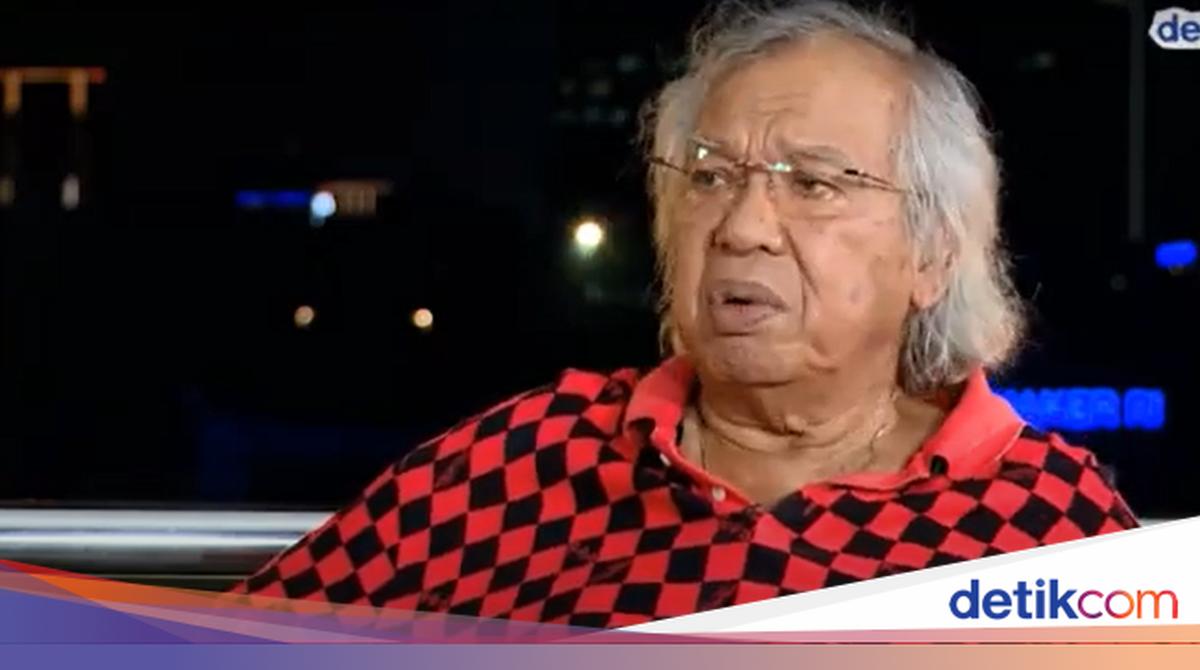
Mid-2012. As we waited our turn to visit an old friend who was being held at Salemba Detention Centre, our attention was drawn to a middle-aged man. He looked dishevelled: jeans, a black T-shirt and light-blue trainers. His greying hair was long and unkempt. Smoke seemed almost constantly to billow from his mouth.
Yet something made him stand out. He was treated with great respect. Inmates kissed his hand when they greeted him. Several officers who passed by also addressed him deferentially. We did the same. “Bang Panda is like Don now, isn’t he? Turns out he’s the godfather here,” a friend whispered.
While other inmates received visitors in an open area, Panda met his guests in a room divided by transparent glass partitions. Smoke filled the room.
Years later, after reading his two autobiographies, Born a Fighter and Riding the Waves and in the Whirlwind of Power, I began to understand why Panda was so respected. He was no ordinary journalist or politician. His experience, networks, courage and understanding of journalism had made him different from most people.
After Mochtar Lubis and Rosihan Anwar, Panda Nababan is, in my view, one of the true journalists worthy of emulation. Not because his life was without blemish, but because of his profound dedication and instinct for journalism.
Born on 13 February 1944, he was not only brave enough to be at the heart of major events. He was also adept at drawing on relationships and friendships with senior figures in the legal and military institutions for his journalistic work. He understood that proximity to power should be a gateway to gathering information, not merely a way to build access for personal gain.
Panda worked as a war correspondent, covering Vietnam in 1973, East Timor in 1975, Cambodia in 1979 and Afghanistan in 1980. He was also present at nearly every major event in the republic. These included the 1974 Malari riots, the sinking of the Tampomas II in January 1981, Operation Woyla in Bangkok in March 1981 and the Tanjung Priok tragedy in September 1984.
Panda was also known as an investigative journalist. He exposed extortion at Tanjung Priok Port, as well as smuggling and manipulation at Halim Perdanakusuma Airport. To uncover what was happening at Halim, he even went undercover as an air-cargo employee. He did not rely solely on information from sources; he entered the environment he was investigating himself.
His dedication and courage in journalism earned him the Adinegoro Award in 1976, one of Indonesia’s most prestigious press honours.
His willingness to confront those in power was also evident in an account of his return from covering Operation Woyla in Bangkok. Panda was once punched by General Benny Moerdani because he insisted on reporting that two of the Garuda plane hijackers, Abdullah and Wendy, were still alive. The authorities’ official account at the time said all the perpetrators had been killed.
Panda recounted the episode in one of his autobiographies. He was evidently not one to accept official statements at face value. In his view, some facts still needed to be investigated and questioned. Even when facing a highly influential general, his journalistic instinct did not waver.
After leaving Sinar Harapan, the newspaper that helped build his reputation, Panda helped launch Prioritas with Surya Paloh. He later played a part in the development of Media Indonesia. He also co-founded Forum Keadilan magazine with Karni Ilyas. For him, the press was not merely a workplace but an inseparable part of his life.
At the beginning of the Reform era, Panda entered politics. He became a member of the House of Representatives (DPR) with the Indonesian Democratic Party of Struggle (PDI Perjuangan) faction. But entering parliament did not make him dress like most politicians. He kept his scruffy style and was rarely seen in a smart suit and tie. A blue denim shirt and trainers became his trademark.
In parliament, Panda was appointed chair of the special committee on the Trisakti case. One important moment in the committee’s work came on 28 February 2001, when former Kopassus chief and former Kostrad commander Lieutenant General Prabowo Subianto appeared before the committee led by Panda. Prabowo, now President of the Republic of Indonesia, was questioned about the Trisakti events of 12 May 1998.
Panda spoke bluntly. But journalists who approached him could not expect him to share information easily. Only a handful of reporters in the DPR were bold enough to approach and talk with him.
Panda had a habit of testing every question put to him. He wanted to know how well the journalist understood the subject under discussion. Shallow questions, or reporters relying only on a recording device, were usually not enough to engage him. He seemed to want to make sure that those who approached him had done their homework: read, researched and understood the issue.
That approach may have seemed demanding to some journalists. I saw it as a senior colleague’s concern for the profession that had made his name. Panda wanted journalists to learn properly—not simply turn up, hold out a recorder and leave with a quotation.
I had the opportunity to share a stage with him on 27 April 2022 on the programme Adu Perspektif. Also appearing were communications expert Effendi Gazali and senior economist Rizal Ramli. Hosted by Budi Putro and Ari, the programme’s theme was “Reading Indonesian Politics through Mahfud Md”.
For me, the occasion was special. Panda, whom we usually called Opung, was not merely a senior figure with a long record in journalism. He was someone whose life and professional principles were worth studying. After the programme, I had a photo taken with Opung. He immediately asked me a question: “Have you read my book?”
He meant Born a Fighter and Riding the Waves and in the Whirlwind of Power. I had actually bought both books at Gramedia Margonda the previous year. Idham Samana, the executive producer of Adu Perspektif, then asked Panda to sign them.
I still remember that simple question. Behind his outspoken manner, Panda wanted to know whether the person in front of him had genuinely read and understood what he had written. Even in a brief encounter after a television programme, his journalistic instinct was still at work. He never stopped being curious.
Panda’s life was not without difficulties. In 2011, he was found guilty in the travel-cheque case connected to the election of the Bank Indonesia Senior Deputy Governor, won by Miranda Swaray Goeltom in 2004. The Jakarta Corruption Court sentenced him to one year and five months in prison and fined him Rp50 million, with a three-month custodial term in default. The Jakarta High Court upheld the ruling, and the Supreme Court rejected his appeal.
Notably, at the first-instance trial, two members of the panel issued dissenting opinions. They considered that there was no evidence showing Panda had directly received the travel cheques. The majority, however, found him guilty. In May 2012, Panda was granted conditional release.
That legal record is part of his life and need not be concealed. Respecting someone does not mean turning a blind eye to other aspects of their life. Panda was a human being, with all the choices and consequences that entails. His long journalistic record can still be remembered without erasing the legal episode that marked his life.
On 9 November 2026, Panda Nababan died aged 82 after battling leukaemia. He will be buried beside his beloved wife, Riama Purba, in Siborongborong, North Tapanuli, North Sumatra. Riama died earlier, on 13 September 2018. Farewell, Opung Panda!
Source: jawawa.id (https://jawawa.id/newsitem/panda-nababan-more-than-a-journalist-1794228707)
Originally published by detikcom (https://news.detik.com/kolom/d-8745500/panda-nababan-beyond-wartawan), translated from Indonesian