
PAM JAYA's Efforts Towards Equitable Access to Clean Water
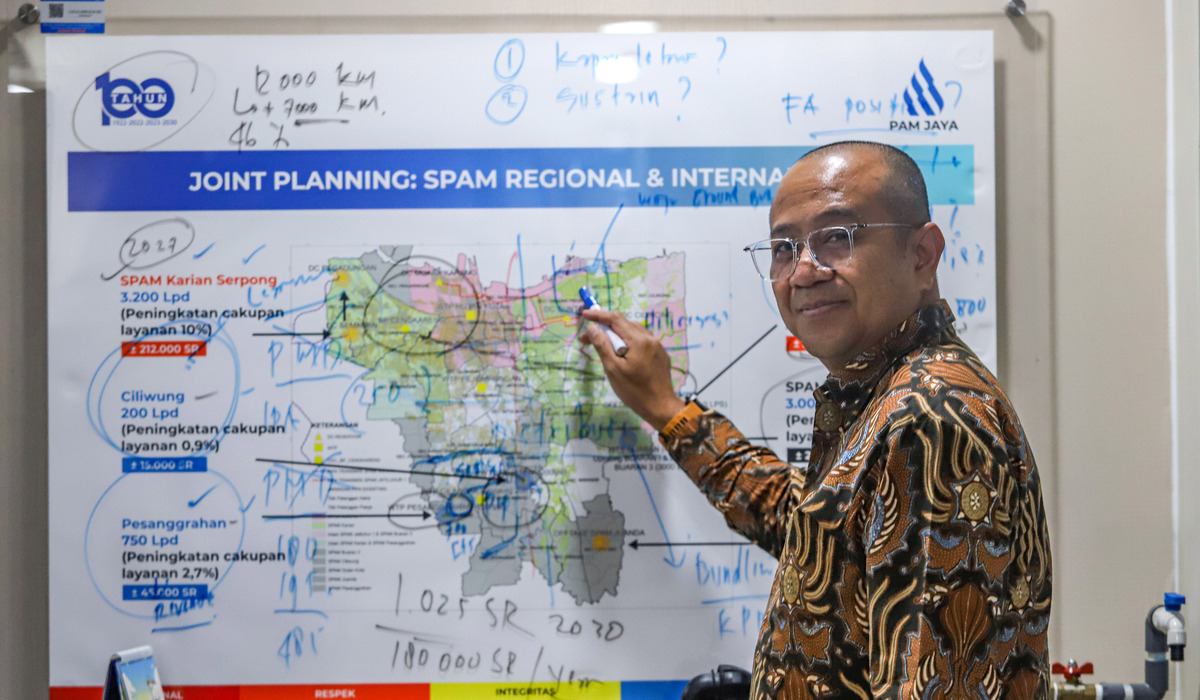
Efforts to accelerate the target of 100% piped water coverage in Jakarta are being intensified. To date, the service coverage of PT Air Minum Jaya/PAM JAYA (Perseroda) has reached 82.6%, driven by a significant increase in the number of customers.
This achievement serves as an important foundation for accelerating connections for residents who have not yet been served. The network expansion strategy is being carried out comprehensively, from the construction of main pipes to direct connections to customers’ homes.
“From 900 thousand (customers), now 1.2 million are enjoying clean water from PAM,” said PAM JAYA President Director Arief Nasrudin during a discussion with Media Indonesia at the PAM JAYA office in Central Jakarta on Tuesday (11/8).
Network expansion is currently most aggressive in East Jakarta and North Jakarta. Several areas that previously had no service, such as Marunda, Cilincing, Kebon Kosong, and the Marunda flats, are now beginning to be connected to the clean water pipeline network.
To strengthen supply, PAM JAYA relies on raw water supplies from the Jatiluhur Reservoir in West Java and the Buaran 3 Water Treatment Plant (IPA). This measure is focused on strengthening supply reliability, particularly in the eastern and northern regions of Jakarta. Communal reservoirs will also be built to increase clean water coverage.
Conversely, West Jakarta still faces its own challenges. The incomplete construction of supporting infrastructure from the Karian Dam in Banten to Jakarta means that service acceleration in that area has not progressed as quickly as in the east and north.
Arief emphasised that meeting the 100% service target is not limited to adding new connection networks. PAM JAYA must also ensure equitable water pressure so that all customers receive optimal service.
PAM JAYA is also faced with the challenge of repairing ageing pipeline networks. Of the total of approximately 13 thousand kilometres of existing pipelines, some segments are up to 104 years old.
A network rehabilitation programme has been prepared. Nevertheless, PAM JAYA has chosen to prioritise the expansion of new connections to avoid overlap between new network construction projects and the replacement of old pipes.
Given the scale of the work, PAM JAYA is seeking to apply advanced technology that allows network construction and rehabilitation to proceed with minimal disruption to residents’ activities. This is because PAM’s pipelines lie beneath vital road access routes and densely populated residential areas.
This measure is also intended to reduce public dependence on groundwater. Expanding piped coverage is seen as crucial in curbing groundwater exploitation, which is one of the main causes of land subsidence in Jakarta.
To eliminate the remaining 17.4% to achieve 100% coverage, Arief acknowledged that massive infrastructure development, close coordination between utilities, and patience from the public are required. “Indeed, the challenge of completing 100% of this service is not easy. But when we finish it all, everyone will be happy. Because water is a basic need that cannot be substituted,” Arief asserted.
On the other hand, PAM JAYA is now preparing to respond to the threat of reduced raw water availability due to fluctuating water levels in the Jatiluhur Reservoir. Arief revealed that the water level of the Jatiluhur Reservoir is currently at 99 metres above sea level (masl), down from the normal average level of 110 masl. “Although that is still a safe line. The alert is when it reaches 85 masl,” Arief explained.
As an emergency measure should the main raw water supply come under pressure, PAM JAYA has prepared mobile water treatment plant (WTP) technology. This technology facilitates the extraction of water from available alternative sources to be processed immediately into ready-to-drink water.
The processing time with a mobile WTP is relatively short, ranging from 30 minutes to a maximum of two hours. This unit has also previously been tested in helping to address clean water crises during disaster response outside the region. Arief confirmed that clean water distribution for Jakarta residents has so far continued to run normally without any drought conditions requiring the routine deployment of tanker truck fleets.
Meanwhile, Jakarta Public Service (JPS) researcher Rahmat Hidayat assessed that the transformation of PAM JAYA’s services is a solid foundation for providing modern, professional, and public-oriented piped drinking water access. “The fulfilment of clean water services is one of the fulfilments of basic needs, and this must certainly be supported together,” he said.
He assessed that comprehensive improvements, from accelerating leak handling, digitalising services, building new infrastructure, to strengthening good corporate governance, are the main capital for achieving equitable service.
In addition to setting a target of 100% service by 2029, PAM JAYA is also preparing strategic steps towards an initial public offering (IPO) in 2027 to strengthen its funding structure for expansion.
“We see how this company is not only focused on expanding the pipeline network, but is also serious about addressing fundamental issues such as network leaks, which have been a major challenge for years,” Rahmat concluded.
Source: jawawa.id (https://jawawa.id/newsitem/pam-jayas-efforts-towards-equitable-access-to-clean-water-1786643465)
Originally published by Media Indonesia (https://mediaindonesia.com/ekonomi/921676/ikhtiar-pam-jaya-menuju-akses-air-bersih-merata), translated from Indonesian