
PAM Jaya Explores Water Infrastructure Financing in Global Forum
PAM Jaya is exploring alternative financing schemes to accelerate the development of piped drinking water infrastructure in Jakarta. This move comes amidst the target of achieving 100 per cent piped water service coverage by 2029, which requires expanding production capacity to 32,950 litres per second and developing a pipeline network spanning 16,23ut4 kilometres.
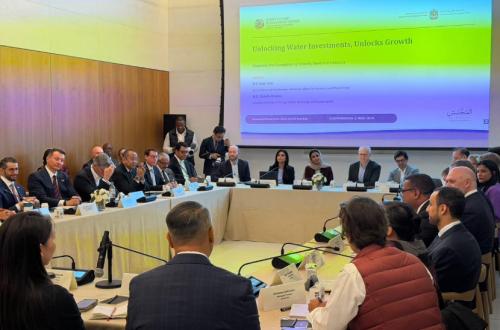
The exploration took place during a Private CEO Roundtable, held as part of the 81st UN General Assembly in New York, United States. PAM Jaya participated in the forum following an invitation from the Ministry of Foreign Affairs of the United Arab Emirates (UAE) as the organiser.
The President Director of PAM Jaya, Arief Nasrudin, stated that investment needs are a crucial factor in service development, including the revitalisation of pipeline networks and the reduction of non-revenue water (NRW).
“Investment needs are a vital part of service development. PAM Jaya continues to push for the revitalisation of pipeline networks to improve service quality while simultaneously reducing water loss or non-revenue water (NRW),” said Arief in a statement on Wednesday (23/9/2026).
According to Arief, most of PAM Jaya’s networks are more than two decades old. This condition necessitates investment and support from strategic partners to maintain and enhance infrastructure quality.
Arief noted that investment needs in the water sector encompass not only the construction of new networks but also the revitalisation of existing infrastructure. Such investment is required to improve service quality and suppress water loss within the piping system.
In addition to creative financing, PAM Jaya is conducting preliminary explorations with several industry players regarding the potential use of water for cooling needs in data centres. These discussions aim to assess the water demand arising from the development of technology-based industries and digital infrastructure.
“PAM Jaya targets 100 per cent service coverage by 2029, with a production capacity target of up to 32,950 litres per second and a pipeline network of 16,234 kilometres. This service expansion is also directed towards reducing dependence on groundwater and land subsidence, increasing resilience to climate change, and strengthening Jakarta’s capacity as a sustainable and continuously developing global city,” said Arief.
Arief added that water infrastructure development is also linked to urban economic growth. Reliable piped water availability is required not only for households but also to support industrial activities and new infrastructure development.
During the forum, Arief was the sole representative from Indonesia invited to present perspectives on piped drinking water management in Jakarta. Jakarta’s experience became part of the discussion regarding water investment related to economic growth, health, the environment, food security, and infrastructure development.
In terms of management, PAM Jaya is also undergoing a transformation through the use of technology, such as smart water meters, integrated billing systems, and Enterprise Resource Planning (ERP). The use of these technologies is intended to support efficiency and data accuracy in decision-making.
“Water is not merely a basic necessity, but a foundation for life, health, the environment, and economic growth. When we talk about future development, discussions regarding water must be placed at the most fundamental level,” said Arief.
Source: jawawa.id (https://jawawa.id/newsitem/pam-jaya-explores-water-infrastructure-financing-in-global-forum-1790207627)
Originally published by Republika (https://ekonomi.republika.co.id/berita/tlts6j416/pam-jaya-jajaki-pembiayaan-infrastruktur-air-jakarta-di-forum-global), translated from Indonesian