
Palu Magnitude 6.7 Earthquake a Stark Warning from Local Fault Activity
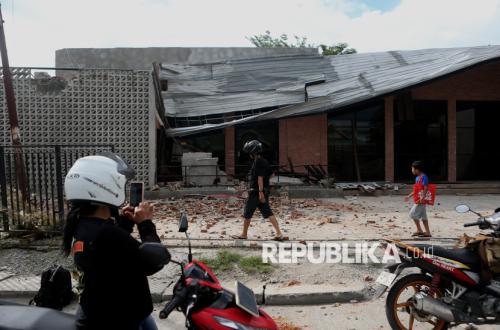
A tectonic earthquake with a magnitude of 6.7 shook the city of Palu, Central Sulawesi, on Tuesday (16/6/2026) at 10.27 WIB, followed by several aftershocks. According to data from the Meteorology, Climatology and Geophysics Agency (BMKG), the epicentre was located at sea at coordinates 1.04 degrees south latitude and 120.23 degrees east longitude, approximately 42 kilometres southeast of Palu at a depth of 10 kilometres.
Dr Daryono, a member of the Indonesian Association of Disaster Experts (IABI), warned that the magnitude 6.7 tectonic earthquake striking Palu serves as a stark alarm regarding the high risk of violent shaking triggered by the activity of local faults. In a statement in Jakarta on Wednesday (17/6/2026), he explained that disaster mitigation strategies in Central Sulawesi must no longer focus solely on the main fault zone, but must begin to prioritise the network of active fault branches in the surrounding area.
“Central Sulawesi has a very active and complex fault system. Mitigation must not only focus on the main fault zone, but also on the branches of active faults around it, which are often overlooked yet have the potential to trigger violent shaking,” he said.
Daryono elaborated that neglecting these branching fault clusters is highly risky because the earthquake characteristics in the region are shallow crustal in nature, which eject maximum destructive energy directly to the surface. This micro-tectonic condition has proven to trigger massive damage along the Palolo-Sausu corridor, due to the propagation of energy from the network of local faults such as the Sausu Fault, Palolo Fault, Malei Fault, Parigi Fault, Tokararu Fault, and the Saluki Segment.
The complexity of these fractures is further exacerbated by the phenomenon of stress partitioning, which causes simultaneous secondary ruptures outside the main Palu-Koro shear fault corridor.
Based on data from the National Disaster Management Agency (BNPB), by Tuesday evening the manifestation of the earthquake’s impact from the shallow fault branches had resulted in physical damage to at least 67 residential units in the affected areas.
The shaking from this local fault cluster also triggered significant land subsidence, completely severing accessibility on the main highway connecting the Palu-Sigi-Poso transport route. Therefore, according to Daryono, IABI is urging local governments and policymakers to immediately tighten spatial planning regulations based on microzonation and to audit the structural resilience of residential buildings to ensure they are adaptive to the threat of local faults.
Source: jawawa.id (https://jawawa.id/newsitem/palu-magnitude-6-7-earthquake-a-stark-warning-from-local-fault-activity-1781664756)
Originally published by Republika (https://news.republika.co.id/berita/tgr6n5409/gempa-palu-magnitudo-67-alarm-keras-dari-aktivitas-sesarsesar-lokal), translated from Indonesian