
Palm Oil Prices Plunge, Farmers Demand Government Clarify One-Stop Export Mechanism
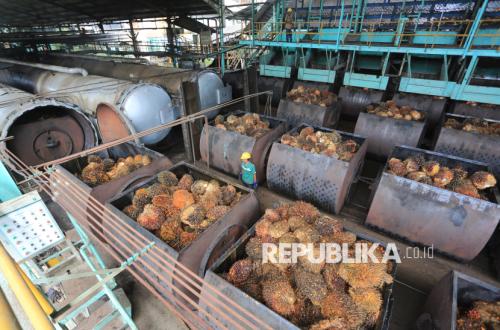
The Central Leadership Council (DPP) of the Indonesian Palm Oil Farmers Association (Apkasindo) supports the one-stop export policy through PT Danantara Sumberdaya Indonesia (DSI) and calls for immediate restoration of palm oil fresh fruit bunches (FFB) prices. DPP Apkasindo Chairman Gulat ME Manurung stated that palm oil farmers back the establishment of DSI, which is seen as strengthening Indonesia’s position as the world’s largest palm oil producer.
‘Both independent and contract farmers support DSI, but the government must clarify its mechanism swiftly. Farmers should not be left as victims of vague explanations about DSI,’ Gulat said in a statement in Jakarta on Thursday.
Apkasindo urges the government to quickly clarify the implementation mechanism to prevent further FFB price declines due to market speculation and information uncertainty. Gulat revealed that prices for independent farmers have plummeted to Rp1,800–2,200 per kilogram, a drop of Rp600–1,500 per kilogram on average.
‘Independent farmers are now getting as low as Rp1,800 to Rp2,200 per kilogram. Our cost price (HPP) is Rp2,000, meaning they are already incurring losses,’ Gulat said.
He noted that independent farmers are the most affected as they lack guaranteed purchase contracts unlike plasma or contract farmers. Currently, plasma farmers’ FFB prices remain around Rp3,600 per kilogram, while independent farmers face the greatest pressure.
‘If contract farmers have protection under Agriculture Ministerial Regulation No. 13 of 2024, independent farmers are the hardest hit, accounting for 93% of total smallholder palm oil plantations,’ he added.
Gulat argued that the FFB price drop is not due to weaker global crude palm oil (CPO) prices. On the contrary, CPO prices in Malaysia and Rotterdam are rising.
‘Global CPO prices are strong. When converted to rupiah, they average Rp18,000 per kilogram, so domestic prices should be around Rp15,800. But now it’s only about Rp11,000. It makes no sense for FFB prices to fall so sharply,’ he explained.
He attributed the issue to information bottlenecks and market speculation following the DSI policy announcement. Many industry players and markets have not received clear explanations on DSI’s mechanism, causing panic and reduced FFB purchasing prices.
‘Four hours after President Prabowo’s announcement on 20 May, prices dropped by Rp400. The next day, another Rp800, then continued to fall by Rp1,500. Yet exports were not halted and full implementation is set to take effect in January 2027,’ he said.
He added that DSI could strengthen national palm oil governance and Indonesia’s bargaining power in global markets.
‘Why sell palm oil individually overseas without price control? If DSI works well, it can become the conductor of Indonesia’s palm oil industry,’ he said.
Apkasindo also praised Deputy Minister of Agriculture Sudaryono for swiftly convening farmers’ associations, the Indonesian Palm Oil Producers Association (Gapki), and the Indonesian National Police Food Task Force to clarify the policy and stabilise FFB prices.
‘The meeting has clarified things. If prices are still suppressed after the five-point agreement, it means someone is deliberately defying the President’s policy,’ he said.
He also supported the Indonesian National Police Food Task Force’s monitoring of palm oil mills buying FFB below fair prices.
‘There is no excuse to buy FFB cheaply after today’s government clarification. Global prices are strong, exports continue, so there’s no reason to suppress farmers’ prices,’ he added.