
Palm Oil Farmers Complain of Plummeting TBS Prices as Deputy Agriculture Minister Announces Response
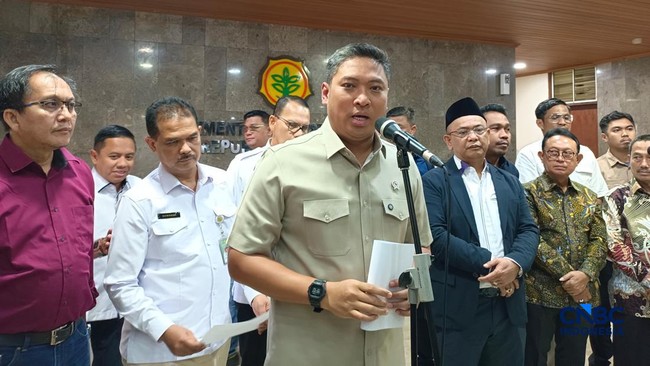
JAKARTA, CNBC Indonesia - Deputy Agriculture Minister Sudaryono responded to palm oil farmers’ complaints about falling fresh fruit bunch (TBS) prices following the new single-window natural resource export policy announced by President Prabowo Subianto some time ago.
Sudaryono immediately convened a meeting with palm oil industry players, palm oil farmer associations, and the National Police Food Task Force at the Ministry of Agriculture (Kementan) in Jakarta today, Tuesday (26 May 2026), to quell panic.
“We convened this meeting, initiated by the Ministry of Agriculture, with all Eselon I officials, particularly in the plantation sector, the Secretary-General present, and we invited GAPKI (Indonesian Palm Oil Entrepreneurs Association), as well as several palm oil farmer associations. We also invited the National Police Food Task Force to join the meeting,” Sudaryono told reporters.
He stated that the meeting was called to address the drop in palm oil TBS prices following the President’s announcement of a new single-window natural resource export policy managed by PT Danantara Sumberdaya Indonesia (PT DSI).
“In response to the decline in fresh fruit bunch (TBS) prices after the President’s announcement of new government regulations on the single-window natural resource export policy, which includes palm oil as a commodity,” he said.
Sudaryono said the main cause of the TBS price drop was identified as psychological factors and uncertainty among downstream industry players.
“First, the bottleneck identified in the meeting was psychological effects, worries, uncertainty, and lack of understanding regarding the new single-window export policy by PT DSI as the manager and overseer of natural resource exports, including palm oil,” he explained.
He stressed that PT DSI would only act as a manager and overseer of export activities, not taking profits from palm oil export transactions.
“PT DSI, as the manager and overseer of the single-window export policy, particularly for palm oil, will implement this policy transparently, accountably, and responsibly, without charging fees or taking profits from transactions,” he said.
“PT DSI does not take profits; it only manages and oversees export activities,” he added.
The government confirmed full implementation of the new single-window export policy will take place on 1 January 2027, following a transition period and periodic evaluations.
“We expect during the transition period to conduct three-month evaluations, followed by further assessments, with full implementation scheduled for 1 January 2027,” Sudaryono said.
The Ministry of Agriculture also warned of penalties for any violations in the policy’s implementation.
“Thirdly, if violations are suspected during implementation, the Ministry of Agriculture, under Regulation No. 13 of 2024, can impose administrative sanctions or revoke licenses as per applicable regulations,” he stressed.
Sudaryono said 139 palm oil mills (PKS) across Indonesia have been identified as reducing TBS purchase prices. Therefore, the government urges industry players to adjust purchase prices as the new policy’s implementation becomes clearer.
“We hope purchase prices for TBS will adjust following this announcement. We appeal to PKS operators and palm oil mills across Indonesia, which we have identified as lowering TBS purchase prices, to make the necessary adjustments,” he said.
“We hope that downstream actors will adjust uncertainty into certainty, ignorance into knowledge, and worry into confidence, leading to TBS purchase prices aligning with regional crude palm oil (CPO) reference prices,” he added.
Meanwhile, Apkasindo Chairman Gulat Manurung said palm oil farmers hope TBS prices will recover following the government and industry meeting.
“On behalf of the attending palm oil farmers, I thank the Deputy Agriculture Minister for his swift response to this issue. We hope the TBS price collapse will soon recover following this meeting,” Gulat said.
He also urged palm oil companies to continue recognising farmers as a vital part of government programmes.
“Corporations receiving TBS should view palm oil farmers as integral to President Prabowo’s Astacita programme, which serves Indonesia’s interests,” he said.
On the other hand, Gapki Chairman Eddy Martono acknowledged that industry players have also been confused about implementing the new policy.
“Yesterday, there was confusion and uncertainty—not just from us, but buyers too. They asked us, and we didn’t know. We weren’t involved in the process,” Eddy said.
He hopes the transition period until 2027 will allow the government to clarify technical trading mechanisms for palm oil.
“We hope today’s meeting clarifies all uncertainties. The transition to 2027 will require further steps, such as purchasing—who will handle it,” he said.
Source: jawawa.id (https://jawawa.id/newsitem/palm-oil-farmers-complain-of-plummeting-tbs-prices-as-deputy-agriculture-minister-announces-response-1779932051)
Originally published by CNBC Indonesia (https://www.cnbcindonesia.com/news/20260526125351-4-738101/petani-sawit-teriak-harga-tbs-anjlok-ngadu-ke-wamentan-ini-hasilnya), translated from Indonesian