
Palm Oil Farmers Call for Cancellation of Export Mandate Through State-Owned Enterprises
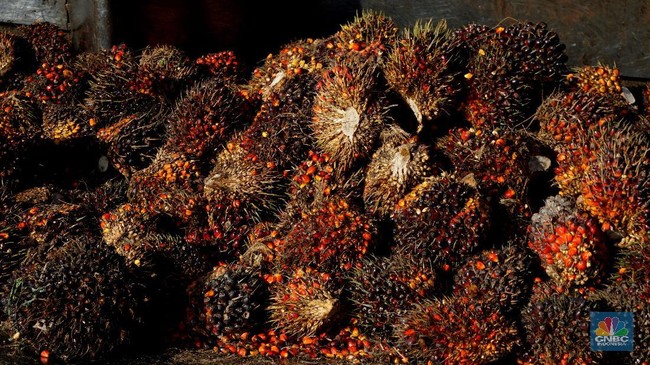
Palm oil farmers, members of the Indonesian Palm Oil Farmers Association (POPSI), are demanding that the government immediately revoke the new rules governing the export of natural resources (SDA). They argue the rules would threaten the livelihoods of millions of farmers across Indonesia.
“The most severe impact will be felt by independent palm oil farmers,” POPSI Chairman Mansuetus Darto said in a statement on Wednesday (20 May 2026).
“When the export channel is centralised and the number of buyers effectively dwindles, the competition to buy CPO (crude palm oil) and TBS (tand an buah segar) will weaken. In such a scenario, prices at the farm gate are very likely to be pressured,” Darto explained.
As history has shown in commodity trade, he continued, if market access narrows, the bottom margin is the first to be sacrificed, and that is the farmers.
“Let us not allow palm oil farmers to become victims of policies that do not favour the people,” he added.
Moreover, he continued, the new natural-resource-export governance policy, including palm oil, recently announced by President Prabowo Subianto, could worsen Indonesia’s position in facing various international market demands. This includes sustainability regulations such as the European Union’s anti-deforestation regulation (EUDR).
As a note, Indonesia has repeatedly negotiated with the EU on EUDR. It has also fought in the WTO against disputes that try to block Indonesian palm oil on environmental sustainability and traceability concerns.
“The international community today demands governance that is transparent, accountable, and independently verifiable. Centralising trade through a single entry point could risk creating a negative perception of Indonesia’s palm-oil governance transparency,” he said.
“Palm oil is a global industry that is highly complex and integrated with international markets. It involves cross-border trade, a wide range of derivative products, futures market mechanisms, international trading houses, a global refinery network, and strict compliance and traceability systems. Centralising palm-oil trade is considerably more complex and risky than in the past,” Darto added.
Therefore, he continued, sustainable palm-oil growth cannot be built through trade monopolies, but through openness of governance, farmer protection, healthy competition, supply-chain transparency, and participation by all stakeholders.
“POPSI is asking the government to promptly undertake an open evaluation of the palm-oil export governance framework by involving all stakeholders, especially palm-oil farmers, farmer cooperatives, business players, academics, and civil society,” he said.
“If this policy is still to be implemented, the government must ensure there is no trade monopoly or market domination by any group. Therefore, the policy must be cancelled for justice and economic democracy,” Darto asserted.
“Additionally, he urged the government to guarantee that rent-seeking, elite capture, and abuse of power do not arise in the national palm-oil trade governance.”
“Palm-oil farmers must retain price protection and fair market access. The export mechanism should be transparent, accountable, and publicly auditable, not a monopoly chosen by the State,” he said.
“National palm-oil governance must preserve Indonesia’s competitiveness in the global market and not worsen Indonesia’s position in facing international market demands such as EUDR. All policies must be conducted in accordance with the principles of economic democracy and in favour of smallholders,” Darto insisted.
“Furthermore, POPSI urged the government to learn from various past experiences of commodity governance. Centralised trade historically bred inequality, rent-seeking, and ruin for farmers.”
“If this policy continues to be implemented, the government must ensure palm oil does not become a new monopoly tool that only benefits a handful of elites,” Darto said.
As is known, during the President’s address to the 19th Plenary Session of the DPR RI on the matter of KEM and PPKF RAPBN 2027 in the 19th Plenary Session for the 2025-2026 session year at the Nusantara Building of MPR/DPR/DPD-RI, Jakarta, on Wednesday (20 May 2026), President Prabowo Subianto announced the issuance of a new Government Regulation (PP) and the establishment of a new state-owned enterprise dedicated to a special export of commodities.
With this PP, Prabowo explained, all sales of all natural-resource outputs, from palm oil to coal and to ferroalloys, will be required to go through a government-designated BUMN.
“The new state-owned enterprise is named PT Danantara Sumber Daya Indonesia.”
“The main objective of this policy is to strengthen oversight and monitoring, and to stamp out under-invoicing, transfer pricing practices, and the leakage of export proceeds (DHE),” he said.
“This policy will maximise tax revenue and state revenue from the processing of our natural resources. It could be like Mexico, the Philippines, and similar neighbouring countries. We do not want our revenue to be the lowest because we are not willing to manage our own assets, owned by the Indonesian nation,” he emphasised.