
Palm Oil Company in Riau Damaging Riverbanks Faces Up to 10 Years' Imprisonment
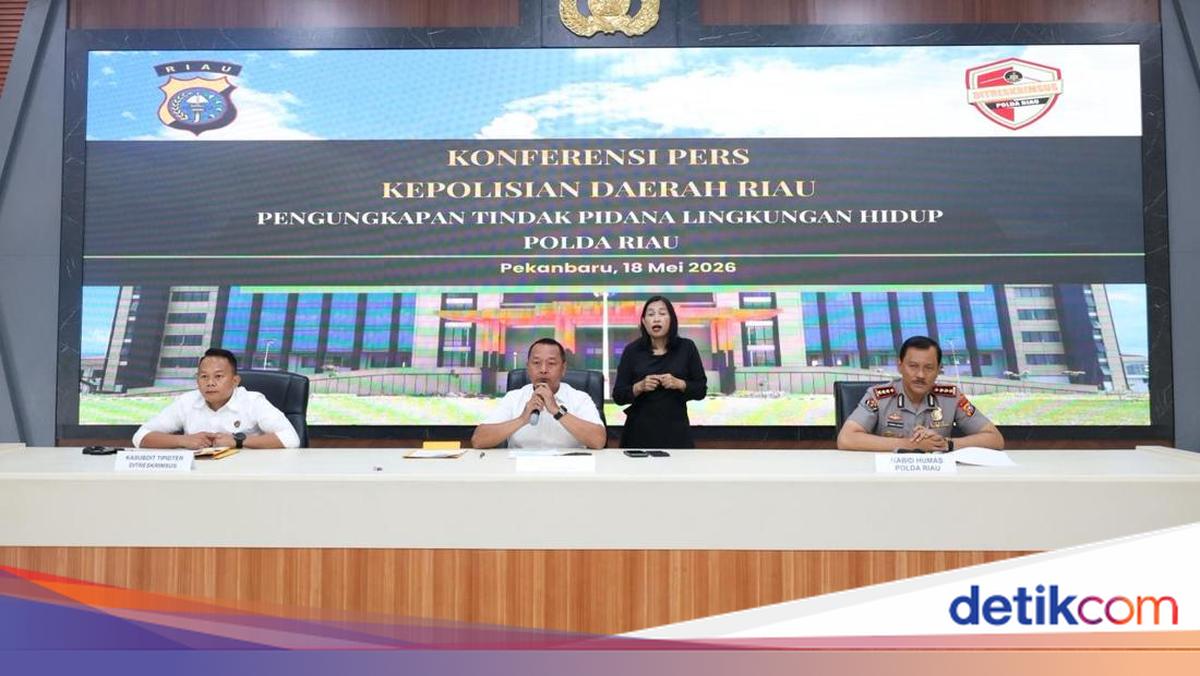
Director of Reskrimsus Polda Riau, Kombes Ade Kuncoro Wahyu, said authorities have charged PT MM under Article 98(1) in conjunction with Article 99(1) in conjunction with Article 116 of Law No. 32 of 2009 on Environmental Protection and Management relating to Corporate Criminal Liability. ‘The maximum prison sentence is 10 years and the maximum fine is Rp 10 billion,’ he told reporters on Tuesday (19 May 2026). Ade explained that, in terms of corporate criminal liability, it is the company’s directors or managerial staff who are liable. ‘A corporation as a legal subject represented by its administrators, could be the board of directors or managerial staff,’ he added. Ade Wahyu explained that PT MM has conducted oil palm plantation activities in Estate IV Division F of PT MM, Air Hitam Village, Ukui District, Pelalawan Regency, for years. The land has been cleared since 1997-1998 and in 2022-2024 the company has earned profits from palm cultivation. But the fault is that PT MM did not observe the boundary of the palm planting area along the riverbank. In other words, PT MM did not observe the Environmental Impact Assessment (AMDAL) in its palm planting. Referring to Minister of Public Works and Public Housing Regulation No. 28 of 2015, Article 6(1-3) which sets the distance of the riverbank boundary, where small rivers are 50 metres away and large rivers 100 metres away. In the field, it was found that PT MM almost cleared the entire riverbank area. ‘In the field, the distance of PT MM’s palm planting was found to be only 2 to 5 metres from the riverbank boundary lines. The palm trees are also not a type of plant permitted to be planted on the river edge,’ he said. Another fact revealed in the investigation: environmental experts stated there had been damage along the river bank planted with PT MM’s palm. Among others, there were landslides with depths of 1-2 metres, down to subsidence. ‘Then soil erosion of 10-15 cm in depth and 50-60 cm in width, as well as the loss of native vegetation or 0 percent,’ he said. Meanwhile, laboratory tests of soil samples confirmed that soil damage parameters resulting from PT MM’s palm planting at the site had exceeded threshold limits. ‘Lab results from soil samples confirm that soil damage parameters (for clay and sand fractions) have exceeded the environmental damage quality threshold,’ he added. In this case, investigators also consider that the company’s activities contravene its own AMDAL document, Presidential Decree No. 32 of 1990 on Protected Area Management, Government Regulation No. 35 of 1991 on Rivers, and other riverbank protection provisions. Additionally, according to Regulation No. 28/PRT/M/2015 of the PUPR Ministry, riverbank areas can only be used in a limited manner and must have a permit. ‘In the course of the investigation, PT MM was said to not have a permit to utilise riverbank land from the Sumatera III River Basin Authority (Balai Wilayah Sungai Sumatera III),’ he disclosed. He stressed that riverbank areas have an important ecological function as spaces to protect water bodies, control erosion, and act as buffers for environmental balance. Therefore, palm cultivation in these areas is believed to potentially cause environmental damage and disrupt the ecological function of the river. ‘Law enforcement is not merely about administrative permitting, but concerns the protection of ecosystems and long-term environmental safety,’ he concluded. (mea/dhn)