
Pakistani Astronaut Joins Ranks of Muslims to Travel into Space
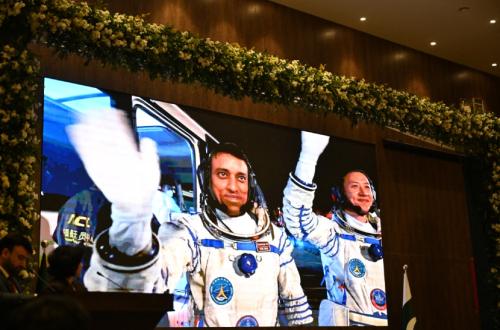
ISLAMABAD — Pakistan is celebrating a historic achievement in space exploration. Muhammad Zeeshan Ali, a Muslim from Pakistan, has reached orbit, becoming the first Pakistani to join a crewed space mission. He has also made history as the first foreign astronaut to set foot on China’s Tiangong space station.
Forty-year-old Zeeshan Ali arrived at Tiangong on Wednesday (25 November 2026), after the Shenzhou-24 spacecraft carrying him and two Chinese astronauts was launched from the Jiuquan Satellite Launch Centre in north-western China.
The achievement was greeted with joy in Pakistan. Government officials, scientists, students and members of the public watched the launch live, marking a new chapter for the South Asian country’s space programme.
Ali’s achievement, however, is more than an individual success. He has become a symbol of Muslim countries’ participation in the development of space science and technology, an area long dominated by nations with advanced space programmes.
Before the launch, Ali said the journey was not for his personal benefit. “I am not flying for myself. I am carrying Pakistan’s name on my shoulders,” he told reporters on Tuesday (24 November 2026).
Pakistan’s Prime Minister Shehbaz Sharif also welcomed the achievement. In a post on social media platform X, Sharif described Ali’s journey as representing the hopes of around 240 million Pakistanis, particularly young people, scientists and the nation’s ambitions.
“This is not merely one astronaut’s journey, but the journey of 240 million Pakistanis,” Sharif said.
Not the first Muslim in space
Although Ali is the first Pakistani astronaut to reach orbit, he is not the first Muslim to travel into space. A number of Muslim astronauts have already made history in global space exploration.
The first Muslim in space was Saudi Arabia’s Prince Sultan bin Salman Al Saud. He flew aboard NASA’s Space Shuttle Discovery on the STS-51G mission on 17 June 1985. Sultan was also the first Arab to travel into space.
Two years later, Syrian astronaut Muhammed Faris joined a Soviet Union space mission in July 1987. He travelled aboard the Soyuz TM-3 spacecraft to the Mir space station and spent nearly eight days in space.
From South-east Asia, Malaysia sent Sheikh Muszaphar Shukor to the International Space Station (ISS) in October 2007. The Muslim doctor carried out several scientific experiments and drew attention across the Muslim world for observing the fast and celebrating Eid al-Fitr in orbit. His experience prompted Malaysia to draw up guidance on religious observance for Muslim astronauts in space.
Meanwhile, Anousheh Ansari, an Iranian-American woman, became the first Muslim woman to travel into space in 2006.
Ali’s achievement therefore adds to the long list of Muslim scientists and astronauts involved in space exploration. It has particular significance, however, because Pakistan has for the first time sent a representative on a crewed space mission.
Ali is not merely a passenger on the journey. He is serving as a payload specialist, responsible for conducting a number of scientific experiments.
Alongside Chinese astronauts Tang Hongbo and Wu Yi, Ali is expected to spend around five to 10 days aboard Tiangong.
The Shenzhou-24 mission is scheduled to conduct around 90 scientific experiments. One study involving Ali concerns photosynthetic cyanobacteria, microorganisms with the potential to support oxygen supplies and food production on long-duration space missions.
Pakistan and China’s space cooperation is part of an agreement between the two countries signed in February 2025. Under the agreement, Pakistan sent two astronaut candidates to China for training. Ali was selected for the crewed mission in April 2026.
During seven months of training in Beijing, Ali studied not only spacecraft operations and safety procedures but also Mandarin, so he could communicate and work with Chinese astronauts.
Chinese President Xi Jinping described the joint mission as a tangible expression of the deep friendship between the two countries.
Ali hopes his first mission will mark the beginning of greater cooperation in space. “This mission is not a finish line, but a launchpad,” he said.
He hopes Pakistan-China cooperation will grow from one astronaut and one flight to multiple joint missions, including journeys to the Moon and Mars.
The achievement also gives Pakistan an opportunity to strengthen its scientific and technological capabilities. Amid competition among major powers to explore the Moon and Mars, Ali’s presence demonstrates that developing countries, too, can take part in humanity’s exploration of the universe.
Source: jawawa.id (https://jawawa.id/newsitem/pakistani-astronaut-joins-ranks-of-muslims-to-travel-into-space-1795600389)
Originally published by Republika (https://news.republika.co.id/berita/tp1w8r393/astronaut-pakistan-tambah-daftar-muslim-yang-mengantariksa), translated from Indonesian