
Painful! Paradise in the Heart of the Arab World Dragged into the Hell of the Middle East War
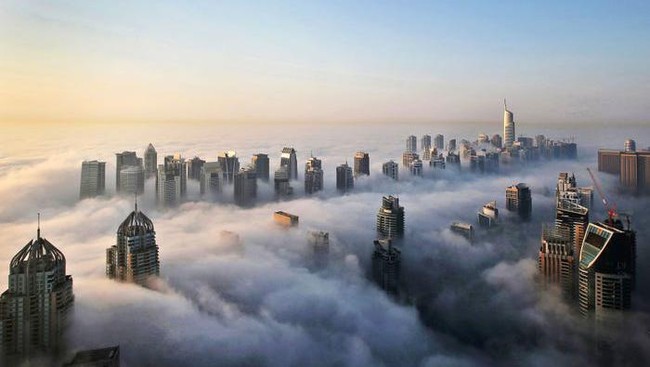
Jakarta, CNBC Indonesia — Geopolitical tensions in the Middle East have shaken the foundations of the economy of one of the Gulf’s wealthiest and most stable countries, the United Arab Emirates. The country, which for decades has marketed itself as a safe global business hub in a conflict-prone region, is now being pulled directly into the vortex of the war between Iran, the United States, and Israel.
According to The Associated Press, on Wednesday (20 May 2026), during the fighting, the UAE was described as the country receiving the most missile and drone strikes from Iran among the region’s countries. Those attacks, coupled with Iran’s control over the Strait of Hormuz, have caused UAE crude oil and natural gas exports to plunge by more than half.
The tourism and international conference sectors that Dubai has long relied on have also begun to suffer severely.
The UAE, located right across the Persian Gulf from Iran, has sought to present a calm front in facing the situation. But behind this, the government has begun to take bold steps, including announcing plans to build a new pipeline to reduce reliance on the Strait of Hormuz.
In addition, the country has decided to exit the OPEC oil cartel to enable higher energy production in the long term, something that had actually been considered even before the war broke out.
Although the war began with US and Israel strikes against Iran, the UAE’s position is now said to be increasingly entangled in the conflict. A drone strike on the Barakah nuclear power plant last Sunday showed that security risks remain very high even as a fragile ceasefire is in force.
The UAE Government has emphasised that it will not stand idle in facing these threats. In a statement on Sunday night, the UAE Ministry of Foreign Affairs said the country “will not tolerate any threat to its security and sovereignty under any circumstances.” The UAE also asserted that it “has full, lawful, sovereign, diplomatic, and military rights to respond to any threat, accusation, or hostile act.”
Aggressive Policy
The UAE is a federation of seven small kingdoms or emirates, governed monarchical, including Dubai and Abu Dhabi. The Federal Supreme Council is the country’s highest body, but decision-making is heavily dominated by the ruler of Abu Dhabi, Sheikh Mohammed bin Zayed Al Nahyan, and his family.
Analysts say the Abu Dhabi ruling family has, in recent decades, pursued a much more aggressive foreign policy. The UAE has previously been involved in the Yemen war against Iranian-backed Houthi rebels.
The country has also helped bring Egyptian President Abdel-Fattah el-Sisi to power in 2013, and has been accused of supplying weapons to various warring parties in Sudan and Libya, charges repeatedly denied by the UAE.
Sheikh Mohammed himself rarely speaks in public. However, when visiting victims of the Iranian attack at a hospital in March, he gave a brief statement that is now widely quoted again. “The UAE is attractive, the UAE is beautiful, the UAE is a model. But I told them: do not be fooled by the appearance of the UAE,” he said. “The UAE has thick skin and bitter flesh; we are not easy prey.”
Flares in the Strait of Hormuz
Iran’s closure of the Strait of Hormuz has severely disrupted the UAE’s ability to export oil and gas. While a few tankers have still managed to exit, export capacity is now far more limited.
Currently, the UAE can only export around 1.8 million barrels of oil per day via a pipeline to Fujairah, a port city in the Gulf of Oman located outside the Strait of Hormuz. The government is now accelerating the construction of a second pipeline to double that capacity.
The war’s impact has also hit the UAE’s tourism and international conference sectors, estimated to account for more than 12% of the country’s total economy.
Since the war began on 28 February, more than 70 international events in the UAE have been postponed, cancelled, or disrupted, according to Northbourne Advisory, a Qatar-based communications firm monitoring the war’s impact.
The UAE government has not issued an official ban on public events, but many organisers are said to be altering plans due to insurance issues and elevated security risks.
On 4 May, the national carrier Emirates announced that almost all flight schedules from Dubai International Airport had returned to normal. However, on the same day, Iran launched another missile and drone attack, triggering alarms on residents’ mobile phones and raising anxiety in the UAE’s business community.
Dubai Airport itself was reported to be installing protective structures around aircraft fuel tanks, although airport authorities declined to comment.
Empty Hotels, Business Starting to Feel the Pinch
A number of luxury hotels in Dubai, including the iconic sail-shaped Burj Al Arab, are temporarily closed for renovations as occupancy levels decline. Occupancy has fallen to around 20%. Moody’s Analytics estimates it could drop to as low as 10% in the June quarter, down from about 80% prior to the war.
Moody’s also warned that occupancy levels are likely to remain low throughout 2026 as international travellers stay wary even if the conflict subsides.
In an analysis published last Monday, the Institute of International Finance said: “Dubai’s openness makes it vulnerable to shocks in travel, logistics, and confidence, while Abu Dhabi’s balance sheet and energy assets give the federation the capacity to absorb the blows.”
The Art World in the Shadow of War
Dubai continues to show that it remains open to the international community. Last weekend, the city still hosted the annual Art Dubai art fair, albeit in a smaller format. The war atmosphere was strong at the event, particularly at
Source: jawawa.id (https://jawawa.id/newsitem/painful-paradise-in-the-heart-of-the-arab-world-dragged-into-the-hell-of-the-middle-east-war-1779543023)
Originally published by CNBC Indonesia (https://www.cnbcindonesia.com/news/20260520172415-4-736477/pedih-surga-di-jantung-arab-terseret-neraka-perang-timur-tengah), translated from Indonesian