
Oxford Graduate Aishah Rumaysa Prastowo Chooses to Become a High School Teacher
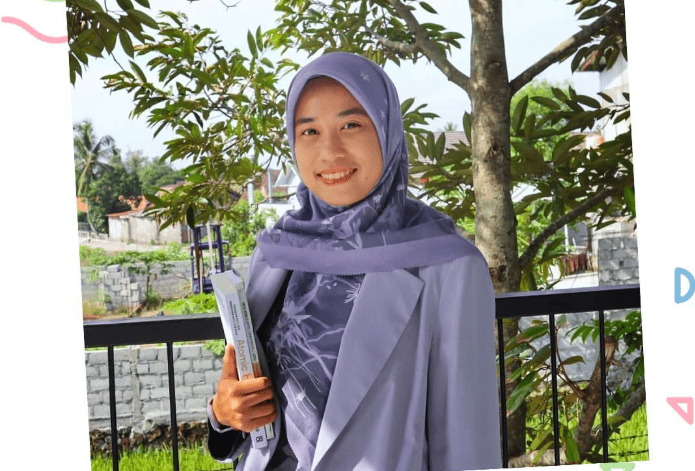
Aishah Rumaysa Prastowo, S.T., M.Sc., D.Phil., was one of the early recipients of an LPDP scholarship. She now diligently serves as a head of school, teacher, and inspirer in the world of education. Aishah is not just any figure; she boasts an impressive educational background, from her Bachelor’s degree in Engineering Physics at Universitas Gadjah Mada (2007), to a Master’s in Interdisciplinary Approach to Life Science at Université Paris Descartes (2011) with a scholarship from the French government, and a D.Phil in Multiphase Microfluidics from the University of Oxford (2014) funded by LPDP.
Despite her impressive academic record abroad, Aishah chose to return to her homeland to dedicate herself to teaching. The head of Praxis High School admitted she always had a desire to return to Jogja, and it coincided with her getting married after graduation. ‘I am from Jogja and I wanted to return to Jogja,’ she said. From Jogja, she remains connected to the global world as both an educator and an inspirator. She has several times guided her students to achieve international recognition, including securing second place at EDUtech Asia 2025: Planet Protectors Sustainability Challenge 2025, where the Green Pioneers team from PRAXIS High School finished as runners-up to a team from NUS High School, Singapore.
When asked why she chose to be a school teacher rather than a university lecturer, she called it a ‘million-dollar question’ and stated it was a matter of personal choice. Her interest in education was something she wrote about in her essay when applying for the LPDP scholarship. ‘If asked to choose a field where I want to contribute to the nation’s progress, I would mention education and research,’ Aishah wrote at the time. She expressed a desire to transmit the spirit of scientific research to Indonesian children, teaching them that science is fun and does not have to be expensive, and that ideas and creativity are paramount. ‘Through this, I want to restore our educational spirit, learning for the advancement and welfare of humanity, not just for grades and personal or school prestige,’ she added.
That essay became a reality when Aishah chose to teach at Praxis High School, where she teaches STEAM (Science, Technology, Engineering, Arts, and Mathematics) to secondary school students. She explained that through the STEAM approach, students are invited to think within a scientific framework and use technology and engineering to create solutions for real-world problems, while also using art and mathematics to justify the solutions they offer. She acknowledged that STEM is currently developing, including in Indonesia, but stressed that the most important aspect of STEAM is reasoning, the foundation of which must be built from primary education. The two strong foundations needed to learn STEAM are the ability to reason and to calculate, meaning children must have their literacy and numeracy strengthened in basic education. She also noted that a challenge in developing STEM in Indonesia is determining the direction of STEM education, questioning whether the learning is aimed towards industry or elsewhere.