
Owners of 25 Counterfeit Fortified Rice Brands May Become Suspects? Bapanas Responds
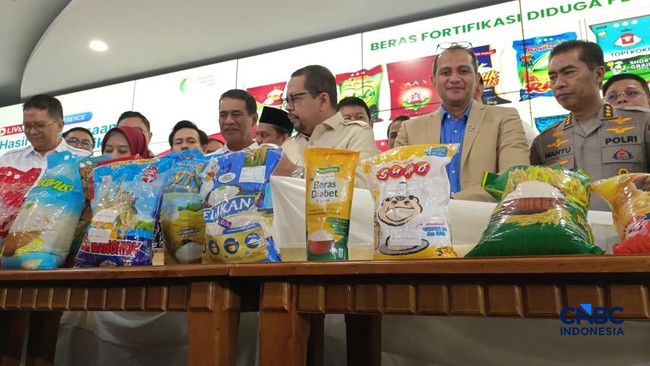
The National Food Agency (Bapanas) has revealed developments in the handling of the case involving fortified rice found to be non-compliant with regulations. Out of the 25 samples inspected, two companies have had their cases escalated to police reports (LP).
This was stated by the Deputy I for Food Availability and Stabilisation at Bapan_panas, Hermawan, when met at the Cipinang Rice Wholesale Market, Jakarta, on Friday (2/10/2026).
He noted that the legal process against these two companies is still underway and has not yet reached the stage of naming suspects.
“Currently, from the process of 25 samples (fortified rice suspected of being non-compliant), two have been escalated to police reports. There are two that have been upgraded to police reports,” said Hermawan.
Nevertheless, Hermawan stated that no parties have been designated as suspects in the case yet. Investigators are still conducting examinations of witnesses and evidence before a case review is conducted.
“Not yet. It is still in progress, because there will be another case review. There is a process of examining witnesses and evidence during the investigation, then it will be reviewed again before suspects can be determined,” he explained.
Previously, the Minister of Agriculture and Head of the National Food Agency (Bapanas), Amran Sulaiman, released a list of 25 fortified rice brands declared as Not Meeting Standards (TMS). All brands with TMS status were announced using initials, namely: WFO, WFR, TKS, IMF, NUR, TKL, HOK, BRV, IMR, IHJ, IAK, PBK, GNB, DTR, TKR, WJK, PLK, MKY, IMC, PTK, ARP, ARN, SKM, GNM, and TAR.
Amran stated that these trademarks are products marketed as fortified rice, but after laboratory testing, their contents are suspected to be inconsistent with the labels provided.
“It turns out there is an allegation of a shift from premium to fortified rice. They claim it is fortified. After we checked in four credible labs, we found it does not match the labels,” Amlam said during a press conference at his office recently.
He mentioned that the selling prices of these products were also recorded far above their fair market value. One of the highest was the brand with the initial WFO, which was recorded being sold at Rp57,600 per kg, while the fair price is Rp13,500 per kg. This results in an alleged fraudulent difference of Rp44,100 per kg.
Furthermore, the WFR brand was recorded being sold at Rp42,500 per kg, with a fair price of Rp13,500 per kg. There is also the WJK brand, sold at Rp33,800 per kg, despite a fair price of Rp14,900 per kg.