
Overwhelmed and Lacking Support, Tanjung Puting Firefighting Volunteers Withdraw
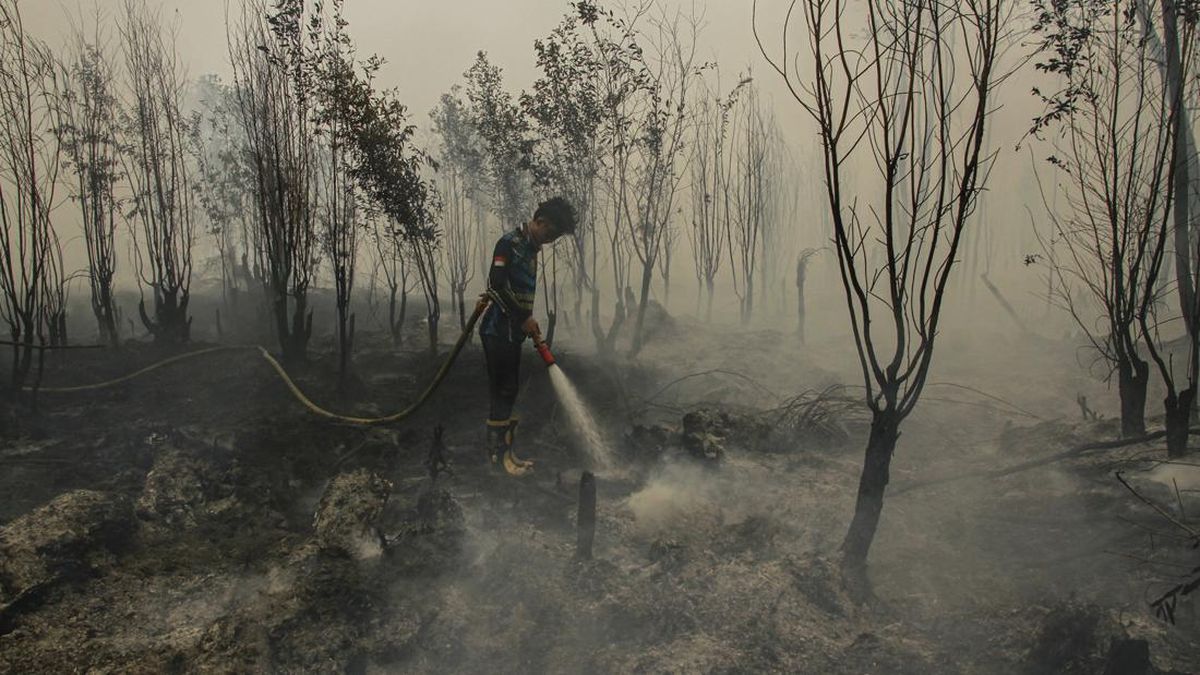
Volunteer teams from the Green Kalimantan Orangutan Foundation (YOHK) and the Indonesian Tourist Guides Association (HPI), who had been tackling forest and land fires in Tanjung Puting National Park (TNTP) in West Kotawaringin, Central Kalimantan, have decided to withdraw all their members from firefighting operations on the ground.
Moncos, a representative of YOHK-HPI in West Kotawaringin, said the group was pulling out because it felt its efforts had not been matched by adequate support. He made the statement in a video that went viral on social media.
“For now, I’m withdrawing because there’s no point continuing if nothing changes significantly,” Moncos told detikKalimantan when contacted on Sunday (11 October).
The volunteers decided to pull out their personnel after agreeing to temporarily suspend firefighting operations in the field.
They said their efforts had not produced significant results, while their capacity to fight the fires had reached its limit.
Moncos said the decision to withdraw also stemmed from volunteers’ disappointment at the lack of attention from the government. They hope the government will take the fires more seriously in an area that is orangutan habitat.
“For the volunteers, temporarily stopping firefighting does not mean the threat has passed. They are instead asking the government to take concrete action promptly so that efforts to control the fires can resume, with equipment and strategies suited to conditions on the ground,” Moncos said.
Volunteers are now primarily urging the government to deploy water-bombing aircraft to speed up firefighting in TNTP.
“Even so, operational needs, the condition of the fire hotspots and the readiness of aerial support must be assessed by the relevant authorities to ensure the response is appropriate,” he said.
Moncos added that the most urgently needed support was aerial firefighting, or water bombing. This would help reach fires in the forest’s core zone, particularly those that volunteers find difficult to control.
“We’re only asking for water bombing to help put out the fires in the core zone,” he said.
Moncos said the team had done all it could but was constrained by its limited capacity and support. That was why it was asking the government to take stronger action against the fires.
“We’ve done everything we can, right up to the limit of our abilities. That’s why we’re asking the government to send water-bombing aircraft as soon as possible,” he said.
The area affected by the fires is estimated at about 54,000 hectares. However, the figure is only an estimate and has not been confirmed.
“My information is that it’s around 54,000 hectares; it could be less or more, as that’s only an estimate,” Moncos said.