
Overcoming the Digital Divide, Indonesian Student Builds DesaLink
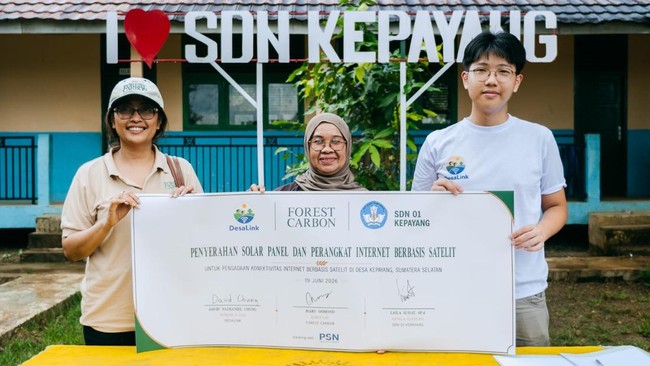
Amidst Indonesia’s rapid digital transformation, many villages still lack adequate internet access. This condition not only limits communication but also narrows access to education, public services, information, and economic opportunities. Recognising this, David Nathaniel Chung, a student at Jakarta Intercultural School (JIS), took the initiative to develop DesaLink. Driven by the belief that technology must provide tangible benefits to society, he developed a collaboration-based connectivity model utilising satellite internet to reach areas not served by conventional telecommunications infrastructure.
The initiative received appreciation and support from PT Dian Swastatika Sentosa Tbk (DSSA), a strategic partner of the national satellite company PT Pasifik Satelit Nusantara (PSN). As a company that supports young talent development, DSSA provided backing for the development of DesaLink as an innovation aimed at expanding digital access in rural areas.
The development of DesaLink began in 2025 when David N. Chung was preparing for an internship programme at the conservation company Forest Carbon. During his first visit to Kepayang Village in Musi Banyuasin Regency, South Sumatra, he witnessed firsthand how limited internet access affected the community. At the age of 15, he saw students having to travel to other locations to get internet access for their studies, teachers struggling to access digital learning materials, and the village government unable to optimally utilise internet-based administrative services.
“That experience made me realise that the digital divide is not just a matter of internet signal, but a matter of opportunity. When access to information differs, opportunities to learn, grow, and obtain services also become different,” he said in an official statement.
From there, David N. Chung studied various approaches to providing connectivity in remote areas. He engaged in discussions with telecommunications practitioners, village governments, and various other parties to find a sustainable solution. This led to the establishment of DesaLink, a collaborative model that brings together the private sector, village government, and the community to make technology a part of education and village development.
This approach connected DesaLink with PSN. For its first project, DesaLink collaborated with PSN and Forest Carbon, which has long assisted the Kepayang Village community through a forest conservation programme. Through this collaboration, two solar-powered satellite internet facilities were installed at SD Negeri 01 Kepayang and the Kepayang Village Office on 19 June 2026. The facilities are expected to support digital learning at the school while improving administrative services and public service access at the village level.
Kepayang Village Head Berry Andrianto welcomed the DesaLink programme, stating that it addressed a long-awaited need of the community. With the satellite internet initiated by DesaLink, public services at the village office can run more quickly, and the school gains better access to digital learning resources. “The benefits will be felt by approximately 2,600 residents across 717 families in Kepayang Village,” he said.
Meanwhile, the Head of SD Negeri 01 Kepayang, Laila Suhat, stated that internet access would provide new opportunities for the school’s 222 students and 12 teachers. She noted that the school had been waiting for such connectivity for years, as limited internet access had been a challenge for the teaching and learning process. “With an internet connection, students can access digital learning materials and videos, including tools to improve their English skills through online platforms. For teachers, this connectivity opens access to training, accreditation exams, and various competency development programmes that were previously difficult to attend,” she said.
For David N. Chung, the implementation of this infrastructure is not the end goal. He initially thought the connectivity issue was solely about the availability of physical networks. However, after going directly to Kepayang Village, he realised that internet access has a broad impact on almost every aspect of community life. He believes that technology is fundamentally just a tool, while its true essence lies in how far it can open new and better opportunities for the lives of local residents.
The challenge of equitable digital access in Indonesia cannot be solved by one party alone. Therefore, DesaLink was developed as a collaborative model combining satellite technology, solar power, village government, the private sector, and the community so it can be applied in various regions with similar characteristics. If replicated more widely, this approach has the potential to expand access to education, health, and economic opportunities for remote communities. Through the principle of No One Left Behind, the use of this technology is targeted to remove internet access barriers for schoolchildren during exams, while creating more equal life opportunities for communities not yet reached by conventional telecommunications infrastructure. With the motto “Connecting villages, empowering communities, transforming lives”, DesaLink collaborates with communities, government, and the private sector to deliver solutions that can be implemented in more areas.