
Over a Thousand Red-and-White Cooperatives in Central Java Built on Protected Farmland
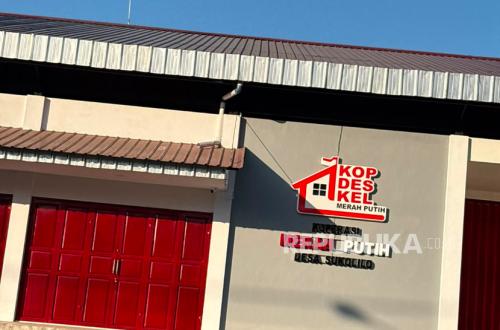
The Head of the Public Works and Spatial Planning (PUPR) Office of Central Java Province, Henggar Budi Anggoro, has confirmed that a number of Merah Putih Village/Neighbourhood Cooperatives (KDKMP) have been built on Sustainable Food Agricultural Land (LP2B). The number exceeds 1,100 buildings.
According to Henggar, the matter has been reported to the central government. “Indeed, on the ground there are many KDMP that have been built on green land, and even on LP2B as well,” Henggar said in a recent interview.
He explained that his office is still mapping the locations of KDKMP on green land and LP2B across Central Java, including how much land has been used. Nevertheless, Henggar claimed the area of green land that has changed function is not significant.
Henggar said he has reported the existence of KDKMP buildings in Central Java standing on green land and LP2B to the Ministry of Agrarian Affairs and Spatial Planning/National Land Agency (ATR/BPN). “We have communicated with colleagues at the Ministry of ATR/BPN, and they have indeed been informed about the green land and so on where the KDMP are located. We have conveyed this,” he said.
“But again, in terms of area, cumulatively speaking, the green land used by KDKMP is not too large,” Henggar added.
Hariadi Agus Setiawan, a Senior Spatial Planning Functional Officer at the Central Java PUPR Office, revealed that the office does not yet have data on how much green land, particularly LP2B, has been converted into KDKMP buildings. “Because the data provided by the regencies and cities regarding the location of the village cooperatives only consists of points. When viewed in the spatial plan, it turns out their positions are on farmland, on rice fields,” he said.
He said 30 of the 35 regencies and cities in Central Java have submitted data on KDKMP construction in their respective areas. So far, the Central Java PUPR Office has recorded 4,808 KDKMP that have been established.
“Of those 4,800-odd, we have the coordinates for about 4,700 of them. When we looked at them against the spatial plan, almost 24 per cent are located on LP2B. That is around 1,100,” Hariadi said.
He added that the location data for KDKMP submitted by regency and city governments to the Central Java PUPR Office consists only of points. “Because they are in point form, we do not know the area involved,” he said.
Hariadi explained that, under the regulations, LP2B may not be converted. Even if the land is ultimately used, the implementation must meet a number of requirements.
“There are requirements for construction on sustainable food agricultural land. One example is for public interest. If it is for public interest, building is permitted there, but the land must be replaced at three times the size of the land used, with equivalent quality,” Hariadi said.
However, to Hariadi’s knowledge, there has never been a case in Central Java where converted LP2B land has been replaced. The prohibition on converting LP2B is regulated in Article 44 paragraph (1) of Law Number 41 of 2009 on the Protection of LP2B.
However, Article 44 paragraph (2) of Law Number 41 of 2009 sets out exceptions for LP2B conversion, namely for public interest. Yet this must be done by meeting several conditions, including conducting a strategic feasibility study, drawing up a land conversion plan, obtaining the release of rights from the owner, and providing replacement land for the LP2B that has been converted.