
Over a Decade, Hundreds of Whale Sharks Stranded on Java's Southern Coast: What Does It Signify?
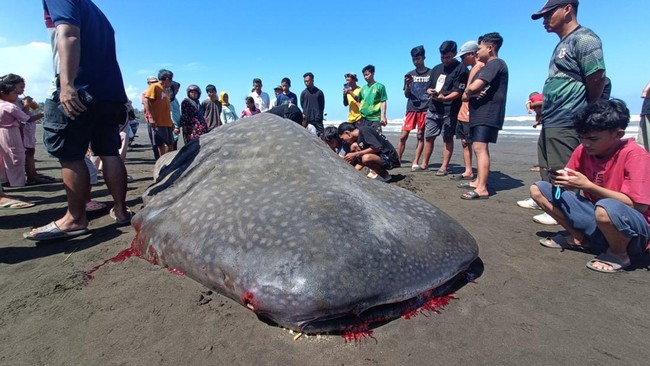
The phenomenon of hundreds of whale sharks entering and stranding on the southern Java coast over the past decade has raised serious concerns. This trend is seen as a signal of disruptions in Indonesia’s marine ecosystem.
This is as reported in research by Elasmobranch Institute Indonesia researcher Edy Setyawan and Conservation Indonesia oceanographer Mochamad Iqbal Herwata Putra, published in an article titled “Why have hundreds of whale sharks stranded in southern Java over the past 13 years? Our research has found the answers,” which appeared in The Conversation on 18 March 2026.
Whale sharks (Rhincodon typus) are known as the world’s largest fish, reaching lengths of up to 20 metres. However, over the last three generations, or about 120 years, the sub-population in the Indo-Pacific has declined by 50-79%.
In research published in the journal Scientific Reports, 115 whale shark stranding incidents were recorded across 23 provinces over 13 years. A total of 127 individuals were found stranded from 2011 to 2023, with 80 reported dead.
This number even exceeds the total global cases previously compiled over 141 years in various countries. This shows that the increase in cases in Indonesia has occurred significantly in a relatively short time.
Based on spatial analysis, the southern Java coast has been identified as the main stranding hotspot for whale sharks. Nearly half of the cases were recorded in West Java, Central Java, Yogyakarta, and East Java.
Most incidents did not occur en masse but rather as individual strandings trapped in shallow waters. More than 90% of cases were reported as single strandings.
More worryingly, the majority of stranded whale sharks were young individuals measuring 4-7 metres. However, male whale sharks only reach reproductive maturity at around 8-9 metres, while females require even larger sizes.
As a result, the death of each young individual has the potential to reduce future generations. This condition can slow the recovery of a population that naturally reproduces very slowly.
This phenomenon is explained by the sea dynamics south of Java, particularly during the southeast monsoon winds from June to November. During this period, upwelling occurs, bringing cold water from depths of about 1,000 metres to the surface along with nutrients.
A plankton and small fish boom then follows due to increased water fertility. This attracts whale sharks, especially juveniles, to approach the coast while feeding.
As they chase prey, whale sharks unwittingly enter shallow waters and become trapped. Additionally, high waves push their bodies towards the shore, worsening the situation.
On the other hand, human activities also contribute to the increased risk of stranding. Pollution from pond waste, agriculture, domestic sources, and plastic rubbish is said to cause health disruptions in whale sharks.
Exposure to toxic substances can weaken the whale sharks’ condition, leading to stranding. Even the presence of plastic in the stomachs of dead whale sharks has been found in several studies in various countries.
Tissue tests from a case in Kebumen in 2023 also showed indications of organ damage. Strong suspicions point to exposure to toxic substances from coastal pollution, including shrimp pond waste.
Interactions with fishing gear such as beach nets further increase the risk of injury and stress to whale sharks. This makes them more vulnerable to stranding in shallow waters.
Overall, whale shark strandings are triggered by a combination of natural factors and human activities. Sea dynamics, pollution, and coastal activity pressures play simultaneous roles in this phenomenon.
The increase in cases also serves as an indicator that marine ecosystem health is being disrupted. As plankton feeders, the movements of whale sharks reflect the productivity and stability of the marine environment.
Unfortunately, responses have tended to be reactive after incidents occur. However, patterns of stranding in space and time have been identified, so preventive steps should be taken earlier.
Proactive efforts such as strengthening rapid response teams, scientific investigations, and involving coastal communities are deemed necessary immediately. With such steps, the potential for rescue and prevention can be enhanced.
Geographically, Indonesia plays an important role as a migration route for whale sharks between the Indian Ocean and the Pacific. Thus, conditions in Indonesian waters will directly impact the sustainability of the regional whale shark population.
Scientists estimate that whale shark population recovery will take up to a century. If the stranding trend continues to rise, the chances of recovery will become even slimmer.
For Indonesia, this poses a serious threat to marine ecosystem sustainability. The seas, which have long been important habitats for young whale sharks, risk losing one of their key species.