
Over 174 Hectares of Perhutani Land in Central Java Affected by Forest and Land Fires in 1.5 Months
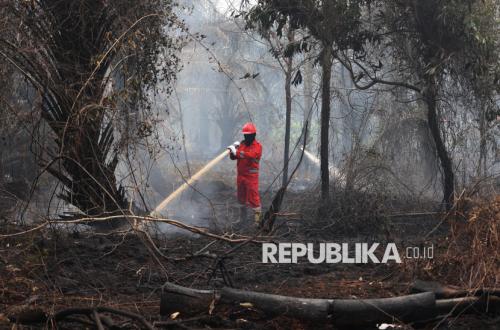
The Environment and Forestry Office (DLHK) of Central Java Province has revealed that more than 174 hectares of Perhutani land in Central Java have been affected by forest and land fires (karhutla). This figure is predicted to increase as the dry season has not yet ended.
“Data up to 24 August 2026 shows 174.25 hectares have been reported. This is Perhutani forest area,” said Soegiharto, Head of the Environmental Management and Forest Protection Division at DLHK Central Java, when asked about the karhutla issue in Central Java on Friday (28/8/2026).
He said that over the past 1.5 months, DLHK Central Java recorded 154 karhutla incidents. The 174 hectares of Perhutani land are among the areas affected by karhutla during the last 1.5 months. “Because this is El Nino, the increase is quite significant,” he said.
According to Soegiharto, before entering the dry season, DLHK Central Java and other stakeholders had prepared measures to anticipate karhutla. This included reminding the public not to carry out burning carelessly.
He explained that the majority of karhutla occurring in Central Java originated from clearing sugarcane land. Some sugarcane land is also located within forest areas. “Karhutla is most prevalent on sugarcane land, production forests with teak trees usually, the undergrowth is burned. That is quite a lot,” he said.
Soegiharto specifically highlighted the practice of burning on sugarcane plantation land that then spreads to other areas. “On average, for example, when they want to plant sugarcane, the land is cleared first, then burned. Then it eventually spreads,” he said.
According to Soegiharto, fire incidents on sugarcane plantation land occur almost evenly across various regions throughout Central Java. “Starting from Blora, then the reports are numerous in Klaten, in community forests as well. Grobogan, Sragen, Wonogiri also have many,” he said.
Nevertheless, Soegiharto acknowledged that the land most affected by karhutla in Central Java is within Perhutani areas. “The most land fires are indeed in state forests. But there are also fires on community land,” he said.
However, Soegiharto admitted that he is still calculating the material losses caused by karhutla, including on Perhutani land. He believes that, apart from sugarcane plantation land, there is no intentional factor behind the karhutla in Central Java. “Perhaps some residents were unintentional, for example burning at the edge, then leaving it, forgetting, then it catches fire and spreads everywhere. Especially now, a small spark can ignite quite a lot,” said Soegiharto.
“So it is not intentional. But for sugarcane land, they usually gather the debris and burn it, then it is detected by satellite, and hotspots appear,” added Soegiharto.
Meanwhile, the Regional Disaster Management Agency (BPBD) of Central Java Province revealed that from January to 23 August 2026, it had recorded 232 karhutla incidents in Central Java. If this data is aligned with DLHK Central Java, it means 66 percent of karhutla in Central Java occurred during the last 1.5 months.
According to BPBD Central Java, the number of karhutla incidents in the January-August 2026 period is far higher compared to the same period last year. The percentage increase reached approximately 700 percent. The karhutla trend in 2026 increased in line with the onset of the dry season, namely June, July, and August.
In detail, the 232 karhutla incidents recorded by BPBD Central Java are spread across 35 regencies/cities. The area of land burned due to karhutla reached 194 hectares and forest area 213 hectares. There were also fires in final processing site (TPA) areas, covering 2.17 hectares. Estimated material losses reached Rp23 billion.
“Land fires are dominated by agricultural land fires, particularly sugarcane and shrubs. The cause is suspected to be human error; for sugarcane land, it is usually to clear sugarcane litter during harvest,” said Bergas Catursasi Penanggungan, Head of BPBD Central Java.
Ten regions in Central Java with the highest total karhutla incidents include Klaten Regency (31 incidents), Sragen (30 incidents), Sukoharjo (18 incidents), Wonogiri (17 incidents), Boyolali (16 incidents), Blora (14 incidents), Semarang Regency (13 incidents), Banyumas (10 incidents), Kudus (10 incidents), and Tegal City (8 incidents).