
Over 1,100 Kopdes Merah Putih in Central Java Built on Protected Farmland, Official Says Still Within Limits
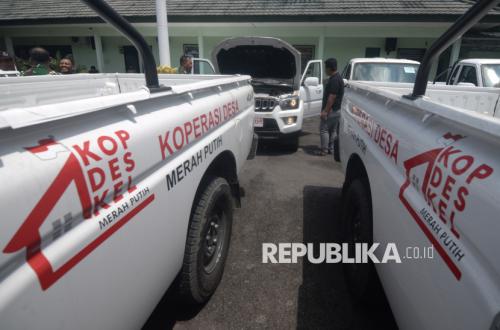
A total of 1,100 Kopdes Merah Putih (KDKMP) in Central Java Province have been built on protected agricultural land (LP2B). However, the Head of the Central Java Public Works and Spatial Planning (PUPR) Agency, Henggar Budi Anggoro, stated that the figure is still within reasonable limits.
Henggar confirmed the existence of KDKMP in Central Java standing on green land, including LP2B. “Indeed, the current condition on the ground is that many KDMP are located on green land and even on LP2B,” he said during an interview on Thursday.
Based on data from the Central Java PUPR Agency, the number of KDKMP buildings situated on LP2B exceeds 1,100. According to Henggar, this number is still considered reasonable. “Accumulatively at the provincial level, this number is actually still within the limits of reasonableness,” he stated.
He claimed that the total area of green land and LP2B used for KDKMP buildings is not significant. “Although if you count them one by one, the number seems large, but the area used for these KDMP is not too vast,” Henggar said.
Nevertheless, Henggar admitted that he has reported the existence of KDKMP in Central Java standing on green land and LP2B to the Ministry of Agrarian Affairs and Spatial Planning/National Land Agency (ATR/BPN). “We have communicated this to our colleagues at the Ministry of ATR/BPN, and they have also been informed about the green land positions where the KDMP are located. We have conveyed this,” he said.
“But again, in terms of area and accumulation, it is not too large,” Henggar added.
A Madya Spatial Planning functional official from the Central Java PUPR Agency, Hariadi Agus Setiawan, revealed that the agency does not yet have data on the total area of green land, particularly LP2B, that has been converted for KDKMP buildings. “Because the data provided by the district/city authorities regarding the Kopdes locations only consists of coordinate points. When viewed in the spatial plan, it turns out the positions are on agricultural land, on rice fields,” he stated.