
Organisers say network security is key to robot competition
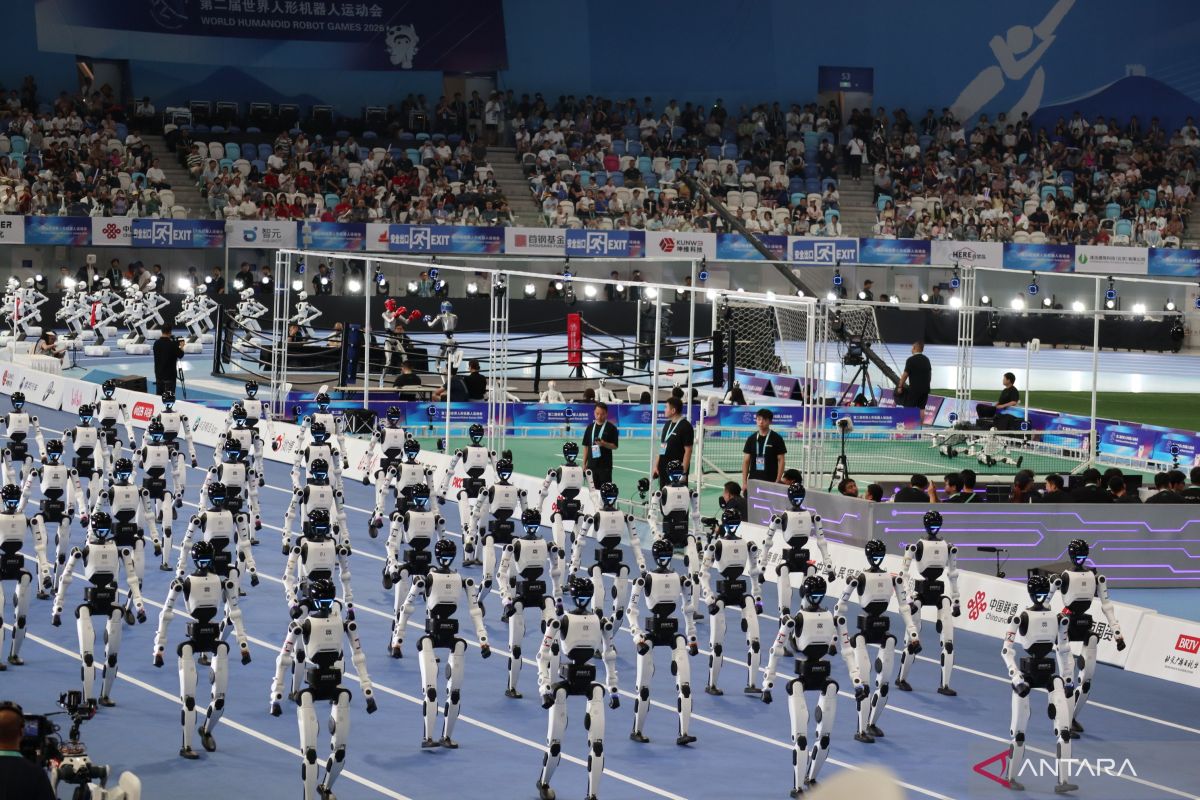
Beijing (ANTARA) - Organisers of the “World Humanoid Robot Games” (WHRG) have said that network security and information security are key to the success of the competition. Deputy General Manager of China Unicom’s Beijing office, Yang Lifan, said at a press conference in Beijing on Sunday (23/8) that his company is tasked with ensuring the basic security of the network, which includes network security and information security. Information security, for example, relates to protection from external attacks, while network security means all devices must be able to operate in good condition.
The second “World Humanoid Robot Games” (WHRG) is being held on 22–26 August 2026 at the “National Speed Skating Oval Beijing” in the Olympic complex in Beijing as a “robot-style Olympics” because it features thousands of humanoid robots, which have human-like forms and move like humans, in sports, arts and work scenario categories. This year’s competition is being attended by 2,056 robots in 51 events across 1,301 competition sessions, consisting of 30 competitive events and 21 scenario-based events. A total of 666 teams from 16 countries are participating in the competition, an increase of 138 percent compared with last year’s event.
“We can say that there is a very large team working quietly behind the scenes. They may rarely be in the spotlight, because their task is precisely to ensure that the network does not experience problems,” Yang Lifan added. The network Yang refers to here is not just the internet network but the system that connects devices so they can send and receive data to each other. Robots can move autonomously by sending video from cameras, sensor data, position, or other information through the network, and then the “server” or “cloud” processes that data and sends instructions back to the robot.
“In the current situation, the network has become an inseparable part of the development of robotics, and its role will become increasingly important in the future,” Yang said. Yang noted that until about a year ago, the robotics industry’s need for networks was not as great as it is now because at that time many robots were still controlled using remote controls, so more development focused on the mechanical capabilities of robots, such as flexibility and movement agility. However, since April this year, namely in the Beijing E-Town Half Marathon and Humanoid Robot Half Marathon, the role of the network has become very important.
“Because in that competition robots had to be able to move independently. Robots need guaranteed communication while moving, and the only network that can provide communication guarantees over such a wide area is the cellular network! In that robot marathon, the six robots that took the top six positions all used the network support we provided,” Yang explained.
Meanwhile, Vice President of Huawei’s Wireless Network Product Line and President of the 5G & LTE TDD Product Line, Li Jie, said at the same event that if network quality is poor, then cloud-based intelligence capabilities will certainly also be affected. “Therefore, we expect that in the future the network will become one of the most important components in the AI era. In other words, the network will become a kind of basic infrastructure for the AI era,” said Li Jie.
Li Jie said that much of China’s experience in building communication networks today can actually also be applied abroad. “For example, Huawei in Indonesia already has very deep cooperation with Indonesia’s main telecommunications operators, namely Telkomsel, Indosat and XL, to begin expanding 5G network development on a large scale this year after obtaining the necessary spectrum allocation or permits,” Li Jie said.
According to Li Jie, the focus is on how 5G networks can provide better connectivity for ordinary consumers, households, smart devices, and various forms of AI devices and the “Internet of Things” in the future. “Therefore, we believe that in the AI era, by combining AI technology and communication networks, we can build an integrated and comprehensive system. For example, if in the future AI chips are also placed directly inside robots, their battery power consumption will increase even more,” Li Jie explained.
“Therefore, there are already advanced robot manufacturers that have begun moving all of the robot’s ‘AI brain’ functions to the cloud. In this way, the battery inside the robot itself can be used more to support the robot’s movement capabilities. If development moves in that direction, then the need for networks in the future will not only relate to network speed,” Li Jie stressed.
In the WHRG event, Chinese telecommunications company China Unicom is the internet network provider using a special “network slice” with 5QI 4 configuration and carrier separation technology to provide network resources reserved specifically for critical robot services. This means China Unicom provides a dedicated 5G network path for robots, with certain quality of service parameters and frequency resources separated from the public network, namely around 12,000 spectators at the competition venue, so that robot communications remain stable even when the spectator network is very congested. With this technology, end-to-end latency (the delay time required for data to move from one point to another in the network) for robot services can be kept stable at around 30 milliseconds (ms).
The network operation and maintenance (O&M) system also uses AI to monitor data traffic and manage resources in real time to ensure an additional layer of protection to keep network performance stable during WHRG.