
Organic Carbon Discovery in Ancient Martian River Strengthens Signs of Life on the Red Planet
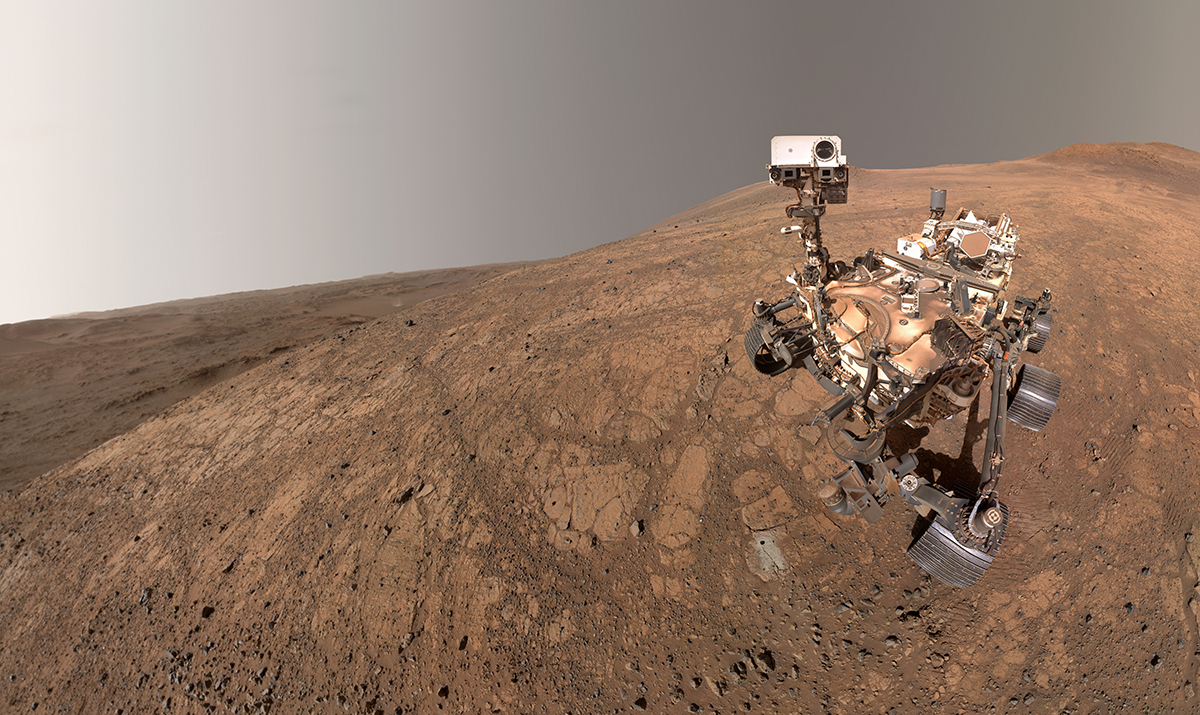
Evidence pointing towards the possible existence of life on Mars has grown further. Scientists have discovered one of the most extensive traces of complex organic carbon ever detected on the Red Planet, preserved within mudstone at a former ancient river channel in Jezero Crater.
The findings were published in the journal Science Advances. The research was based on hundreds of detections of macromolecular carbon (MMC) — large, complex networks composed of carbon atoms — in two rocks sampled by NASA’s Perseverance rover.
Both rocks originate from the Bright Angel formation in Neretva Vallis, a valley that in the past served as a water channel feeding a lake within Jezero Crater.
The researchers describe the discovery as one of the most significant detections of complex organic carbon on Mars. The carbon was found on natural rock surfaces and within sediment minerals, as well as in carbonate and sulphate minerals that formed later.
To identify the material, the team used the SHERLOC instrument (Scanning Habitable Environments with Raman & Luminescence for Organics & Chemicals) mounted on Perseverance. The instrument uses ultraviolet laser and fluorescence spectroscopy to analyse rock composition.
Observations suggest the complex carbon likely entered and was preserved within the rocks through at least two stages in their formation history.
Even so, the discovery of organic carbon cannot yet conclusively prove that Mars was once inhabited by living organisms. Scientists do not yet know whether the molecules originated from biological processes, formed through geological processes without any involvement of life, or were even carried to Mars by material from outside the planet, such as meteorites.
The discovery follows continued interest in rocks at the same location after Perseverance identified in 2024 a distinctive pattern known as “leopard spots”.
On Earth, such millimetre-scale spots can form through chemical and mineral reactions associated with microbial activity. However, scientists have not ruled out the possibility that the pattern could have formed through abiotic processes, that is, without life.
Astronomer Chris Lintott explained that there are a number of findings on Mars which, if discovered on Earth, would most likely be regarded as strong indicators of life. Conditions on Mars, however, are different.
When finding something resembling signs of life on Mars, scientists must in fact take the opposite approach, striving to eliminate all other possibilities before concluding that a phenomenon derives from biological activity.
The greatest challenge for astrobiologists is not merely finding organic molecules, but determining whether those molecules are the product of life or of natural processes without life. This challenge applies to the search for life in various places across the Solar System, from the surface of Mars to the plumes of material from Enceladus, one of Saturn’s moons.
To distinguish between the two possibilities, scientists still require further research and in-depth analysis of the rock samples available.
The European Space Agency (ESA) is preparing to launch the Rosalind Franklin rover to hunt for signs of ancient life believed to be hidden within Martian clay layers.
Source: jawawa.id (https://jawawa.id/newsitem/organic-carbon-discovery-in-ancient-martian-river-strengthens-signs-of-life-on-the-red-planet-1788799885)
Originally published by Media Indonesia (https://mediaindonesia.com/teknologi/930779/temuan-karbon-organik-di-sungai-kuno-mars-perkuat-petunjuk-kehidupan-di-planet-merah), translated from Indonesian