
Orangutan dies from forest and land fires, here is the impact on wildlife
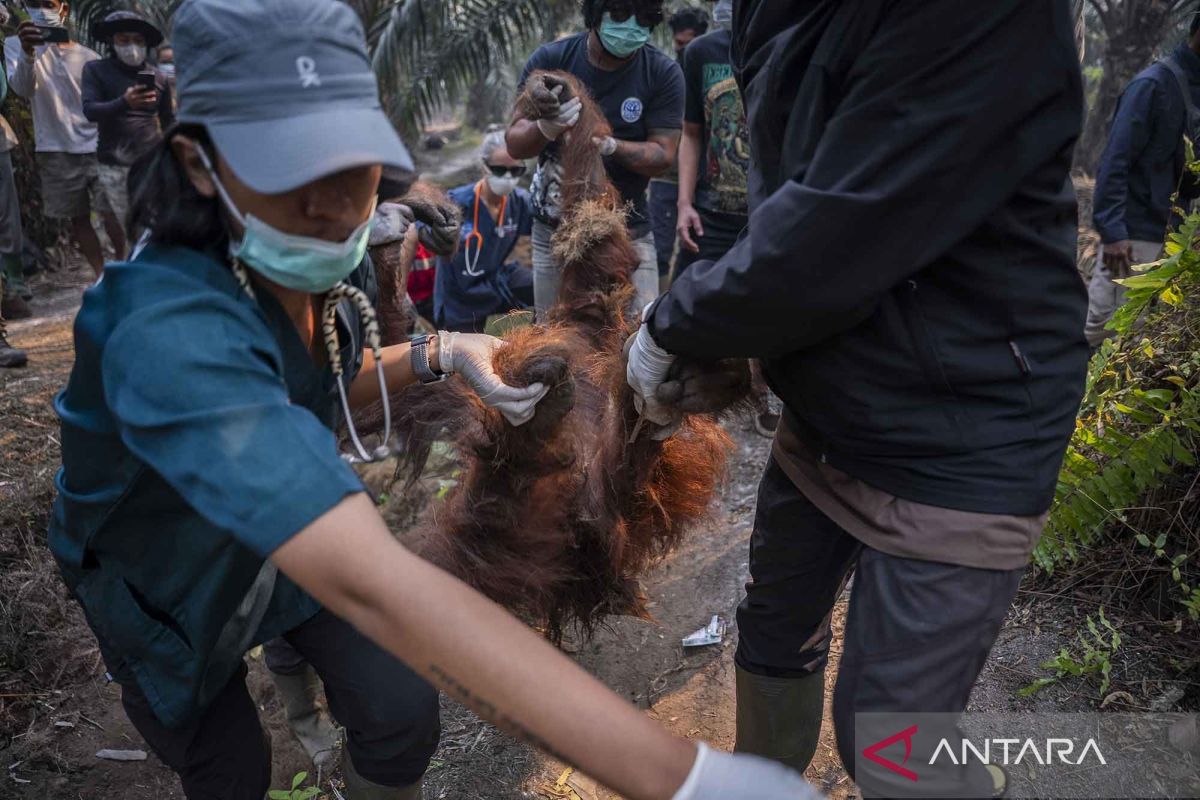
Jakarta (ANTARA) - The story of Sempurna has become heartbreaking news amid the forest and land fires sweeping across several areas of Kalimantan. The adult male Bornean orangutan was found in a very weak condition suffering from breathing difficulties in Sempurna Hamlet, Kuala Satong Village, North Matan Hilir District, Ketapang Regency, West Kalimantan, on Sunday (30/8).
Residents who found Sempurna reported his presence to the authorities. The West Kalimantan Natural Resources Conservation Centre (BKSDA), together with the International Animal Rescue Indonesia Foundation (YIARI), immediately carried out an evacuation. Sempurna received oxygen therapy and intravenous fluids, but his condition continued to deteriorate until he was pronounced dead at 3.20pm local time.
A necropsy conducted on 1 September found pathological changes in several organs, including the lungs, heart and kidneys. The lungs showed congestion and partial atelectasis. Based on his clinical history and examination results, these changes were suspected to be linked to smoke exposure, which can impair lung function and cause acute hypoxia, or oxygen deprivation. This condition was then suspected to have contributed to cardiovascular dysfunction, ultimately leading to Sempurna’s death.
Sempurna’s death makes one thing increasingly clear for orangutans: a burning forest is no longer merely a changed environment. Their home can become a place that is no longer safe to inhabit.
For the Bornean orangutan (Pongo pygmaeus), the forest serves a far greater function than simply shelter.
Trees are where orangutans search for food, move from one location to another, rest and build nests. When the forest is healthy, these needs can be met from the surrounding environment.
Problems arise when the forest is damaged.
Forest and land fires can destroy the trees and vegetation that serve as food sources. Fire can also sever parts of a habitat, so that areas once connected become fragmented patches of forest.
For wildlife that needs space to move and forage, such changes are no small matter.
Even forests still standing may not be entirely safe if surrounded by thick smoke or located near burning areas.
Orangutans that emerge from the forest are often viewed as animals entering human territory. Yet there is a more fundamental reason behind such movements.
When food sources dwindle or habitats are disturbed, orangutans must find other places to survive.
That journey may take them to plantations, community lands, or areas close to settlements. On the one hand, the orangutans are trying to save themselves; on the other, the presence of wild animals in human areas can create the potential for conflict.
Such a situation occurred in Ketapang. In August 2026, a joint team from the West Kalimantan BKSDA, Gunung Palung National Park Office, YIARI and local residents evacuated three orangutans from community plantations affected by forest and land fires.
Incidents like this show that when the forest no longer provides safe space, the boundary between wildlife habitat and human areas can become increasingly thin.
One of the problems with forest fires is that their impact does not end when the flames are extinguished.
Forests need time to regrow. Burned trees do not immediately produce fruit. The vegetation that serves as a food source also needs time to recover.
For orangutans, this means the habitat recovery period can be a difficult time.
They may still have to roam in search of food even though the flames are no longer visible. If the burned forest area is extensive, the journey to find new food sources may become longer still.
This situation can also increase pressure on orangutans living around forest areas that have already been fragmented.
Sempurna’s death also demonstrates that the threat from forest fires does not always come in the form of flames touching an animal’s body.
Smoke can be a problem in its own right.
Sempurna was found with breathing difficulties. The examination after his death showed changes in the lungs suspected to be linked to smoke exposure and oxygen deprivation.
In other words, orangutans near burned areas can face risks even when they are not right at the fire’s source.
Smoke filling a habitat can also make environmental conditions increasingly uncomfortable for wildlife. They must seek safer locations whilst still meeting their needs for food and shelter.
For orangutans unable to leave an area quickly, such a situation poses a serious challenge.
Threats come from all sides
Forest fires are not the only problem facing Bornean orangutans.
These animals also face habitat loss and fragmentation, changes in land use, and conflict with humans.
When these pressures occur simultaneously, the orangutan’s ability to survive becomes increasingly difficult.
Imagine a forest area previously large enough to provide food and shelter. Then part of the area is converted into plantations, while another part burns.
The remaining space becomes ever smaller.
If fires occur again, that space can shrink further. In the end, orangutans have increasingly few options for finding safe places.
Protecting orangutans is not enough simply by rescuing animals found in critical condition.
Evacuation remains important. Rehabilitation is also important. However, these steps must be accompanied by safeguarding the habitats where orangutans live.
Preventing forest fires is one key part of that effort. A forest that does not burn means food sources remain available, trees remain standing, and orangutans have space to live without having to approach human areas.
Restoring damaged forests is equally important. Burned areas need time to once again become habitats that support wildlife.
For that reason, orangutan conservation is fundamentally not just about saving a single animal. What is being saved is the ecosystem that is their home.
Sempurna serves as a reminder
Sempurna could not be saved. Yet his story shows that the impact of forest fires can reach far beyond the visible charred land.
Behind the burned forests, there are animals losing their homes. Behind the smoke blanketing an area, there are animals struggling to breathe enough air. And when food sources disappear, there are orangutans forced to leave their habitats.
The news of Sempurna’s death is also a reminder that protecting orangutans means protecting their home.
For orangutans do not need a forest that merely looks green from a distance. They need a forest that can genuinely provide food, shelter, room to move, and clean enough air to live.
If forests continue to turn into inhospitable places, then the question about the future of the Bornean orangutan is no longer merely how many remain.
The question is: is there still a welcoming home for them?
Source: jawawa.id (https://jawawa.id/newsitem/orangutan-dies-from-forest-and-land-fires-here-is-the-impact-on-wildlife-1788828818)
Originally published by Antara (Indonesian) (https://www.antaranews.com/berita/5730672/orangutan-mati-akibat-karhutla-begini-dampaknya-bagi-satwa), translated from Indonesian