
OPZ Strategy in Disaster Management: Balancing Humanitarian Calls and Regulatory Compliance
Indonesia stands on beautiful land, but it is never truly free from the threat of disaster. From sudden earthquakes and volcanic eruptions to annual floods, crises are no longer just figures on paper, but a living reality affecting millions of citizens.
Looking at the global disaster map, our position is at the forefront of crises. UNISDR data places Indonesia at the top of 2nd65 countries regarding potential tsunami impacts, with over 5.4 million people vulnerable—a risk level that even exceeds the vulnerability of countries like Japan.
There are clear geographical reasons behind these alarming figures. Our nation sits upon highly active tectonic plates, where academic records show seismicity levels in the archipelago reaching ten times that of the United States.
Most tsunamis in the archipelago are triggered by tectonic earthquakes in subduction zones. Historical records from 1600–2000 note at least 105 tsunami events, 90 per cent of which were triggered by tectonic earthquakes, 9 per cent by volcanic eruptions, and 1 per cent by landslides.
This combination of natural, non-natural, and human-induced factors results in concerning field realities. The National Disaster Management Agency (BNPB) records that disaster events in Indonesia can exceed 3,000 incidents per year, with floods being the most frequent ‘regular guest’. This is where our nation’s resilience is continuously tested.
The Potential of ZIS Amidst Disaster Threats
Despite the massive potential for crisis, Indonesia possesses extraordinary social and religious financial capital. A study by the BAZNAS Strategic Study Centre notes that our national zakat potential reaches a staggering IDR 327 trillion per year.
This massive fund spans various sectors, from income zakat, agriculture, and livestock to modern business and financial transactions. Interestingly, this potential of hundreds of trillions would be meaningless if it remained merely a statistical note on a desk.
This is where the beauty of our zakat movement ecosystem works. This potential is powered by the Organisasi Pengelola Zakat (OPZ) machinery, which is structured down to the grassroots level, supporting BAZNAS RI Central, 38 Provincial BAZNAS, 514 Regency/City BAZNAS, as well as over 160 official LAZ, and tens of thousands of Zakat Collection Units (UPZ) in mosques and offices.
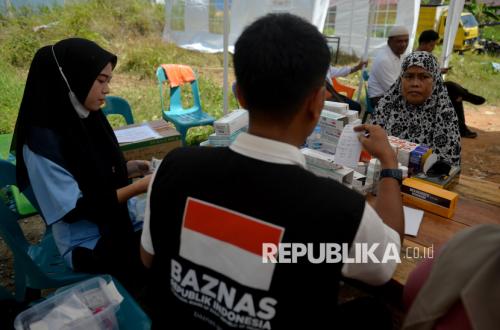
The lifeblood of this magnificent network is its people: more than 100,000 zakat amils, including professionals, volunteers, and UPZ mobilisers. When emergency sirens sound, the combination of fund potential, robust institutions, and the dedication of these amils transforms into a resilient humanitarian fortress to save the lives of survivors.
Humanitarian Calls and Sharia Compliance
When disaster strikes and panic rises, the first reflex of every field amil is to race against time to help others. For OPZ, this rapid action is not merely an organisational duty, but a calling of faith.
However, managing humanitarian actions using massive public funds cannot rely solely on enthusiasm. The presence of MUI Fatwa Number 66 of 2022 regarding the Use of Zakat Funds for Disaster Management serves as a clear compass, stating that zakat funds have strict rules (musharraf) that must be maintained according to the designated asnaf (eligible recipients).
Does this Sharia regulation act as an ‘emergency brake’ that slows down the movement of amils in the field? Not at all. For wise policymakers and zakat managers, Sharia compliance is a fortress of integrity that provides invaluable moral legitimacy and public trust.
This principle actually organises our way of helping. Survivors who have lost property and livelihoods are protected through the criteria of the poor (fakir/miskin), while victims forced into debt to survive are assisted as gharim. As for the operational costs of volunteers, community kitchens, or disaster mitigation? This is where Infak, Sedekah, and Other Religious Social Funds (DSKL) act as a highly flexible lifesaver.
With neat portfolio management of funds from the start of a crisis, OPZ can move agilely through all stages of disaster. In the emergency response phase, zakat meets the basic needs of asnaf survivors, while infak and DSKL power community kitchens and medical services.
In the reconstruction phase, productive zakat revitalises the economic independence of survivors, while DSKL repairs public facilities. Even in the mitigation phase, long-term infak is invested in building Disaster-Resilient Villages (Destana).
The Urgency and Flexibility of Infak-Sedekah
The true test of leadership and humanity becomes increasingly dynamic when disasters strike highly heterogeneous or majority non-Muslim areas. On this stage, the zakat movement proves the face of Islam as being friendly, inclusive, and a blessing for all creation (rahmatan lil ’alamin).
In situations of crisis, universal humanity (ukhuwah basyariyah) transcends all identity barriers. The Quran, through Surah Al-Ma’idah verse 32, beautifully reminds us: preserving the life of one human being is as if one has saved the life of all humanity on earth.
OPZ answers this noble call with the clever use of fund instruments. Zakat funds are distributed with precision to Muslim survivors who meet the asnaf criteria, while our non-Muslim brothers and sisters are assisted massively, equally, and with compassion using the flexibility of Infak, Sedekah, and DSKL funds.
Source: jawawa.id (https://jawawa.id/newsitem/opz-strategy-in-disaster-management-balancing-humanitarian-calls-and-regulatory-compliance-1788515824)
Originally published by Republika (https://khazanah.republika.co.id/berita/tktzao423/strategi-opz-dalam-kebencanaan-di-antara-panggilan-kemanusiaan-dan-menjaga-kepatuhan), translated from Indonesian