
Opinion: The meaning of 9.39 seconds for human ingenuity
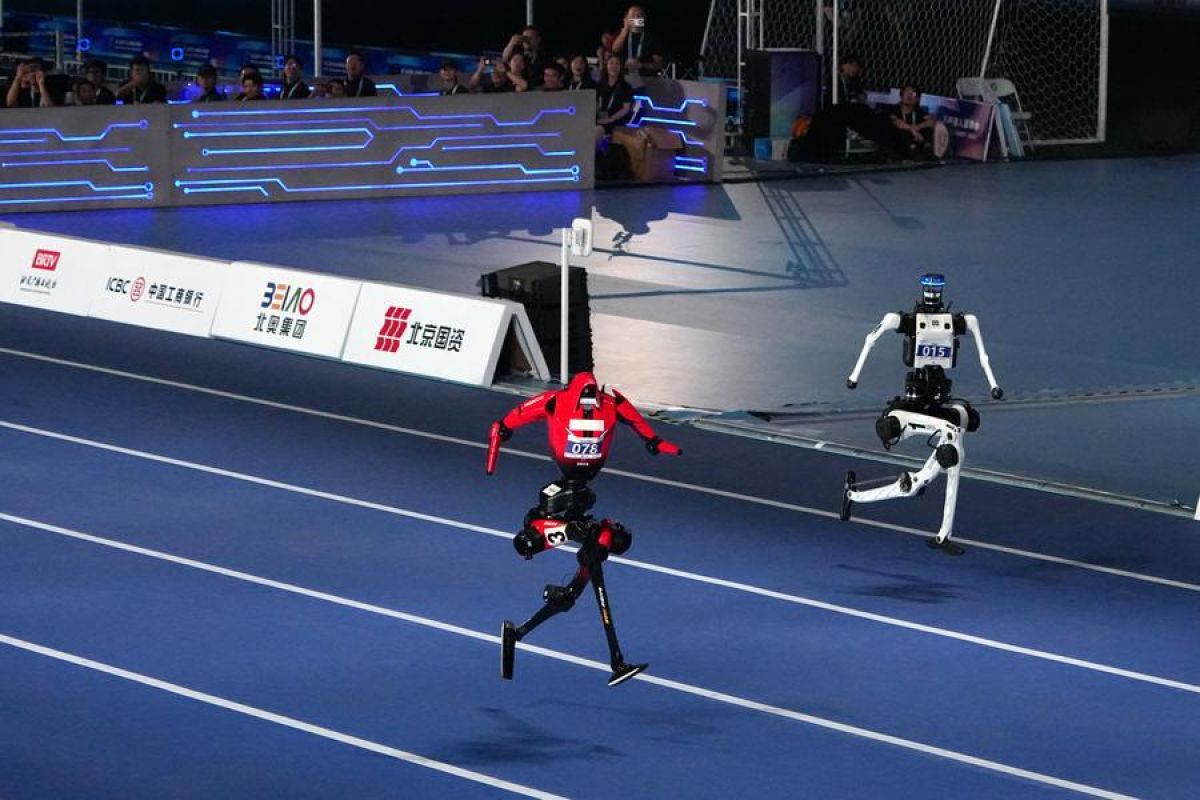
Beijing (ANTARA) - The comparison is indeed difficult to avoid, even though the two achievements are clearly not entirely comparable. Bolt demonstrated how fast the human body can run, while the Tien Kung Ultra robot demonstrated how far human ingenuity can develop.
At the current stage of humanoid robot development, the ability to run remains a formidable challenge. A robot must generate power, absorb repeated impacts, and maintain dynamic balance while coordinating many joints simultaneously. Speed tests every technical limit, because the faster a machine moves, the less time it has to recover from a mistake.
This makes the pace of its refinement remarkable. At last year’s event, Tien Kung Ultra took 21.5 seconds to cover the same distance. A year later, its recorded time has been cut by more than half.
At the second World Humanoid Robot Games held in Beijing on Saturday (22/8), China’s Tien Kung Ultra humanoid robot clocked 9.39 seconds to reach the finish line, breaking the men’s 100-metre world record of 9.58 seconds set by Jamaican sprinter Usain Bolt 17 years ago.
Such progress rarely stems from a single breakthrough. Over the past year, engineers have upgraded the robot’s joint systems, refined its structure, and overhauled its control algorithms to support high-speed running. The engineers have also improved its navigation system, enabling Tien Kung Ultra to maintain its direction at high speed without relying on lane markings.
However, breaking a human record is not the ultimate goal of this technological engineering. Each improvement reveals the next weakness. Even the 9.39-second time on Saturday highlighted the next challenge: the robot had a slower start, although its higher top speed allowed it to surge past competitors at the end of the race.
Competition helps accelerate this process. Events like this provide clear targets, shared benchmarks, and tangible results. Once one team raises the standard, other teams have a new benchmark to reach, as well as proof that a higher level of performance is indeed achievable.
Ultimately, the goal of humanoid robot innovation is not merely to make robots move like humans, but to enable them to work alongside humans and carry out useful tasks in the real world.
A robot in a factory does not need to win a sprint race, and a service robot does not need a medal. Yet every achievement in speed, stability, and precision in the competition arena can bring robots one step closer to being genuinely useful beyond it.
That is where the significance of the 9.39-second time transcends the meaning of the numbers on a stopwatch. The speed record shows how far machine capabilities have developed in a year. Behind that figure lie countless human decisions, experiments, and refinements that made the progress possible. The next test is how far that progress can be applied beyond the track.