
OPINION: Reading Indonesia’s Economic Transformation
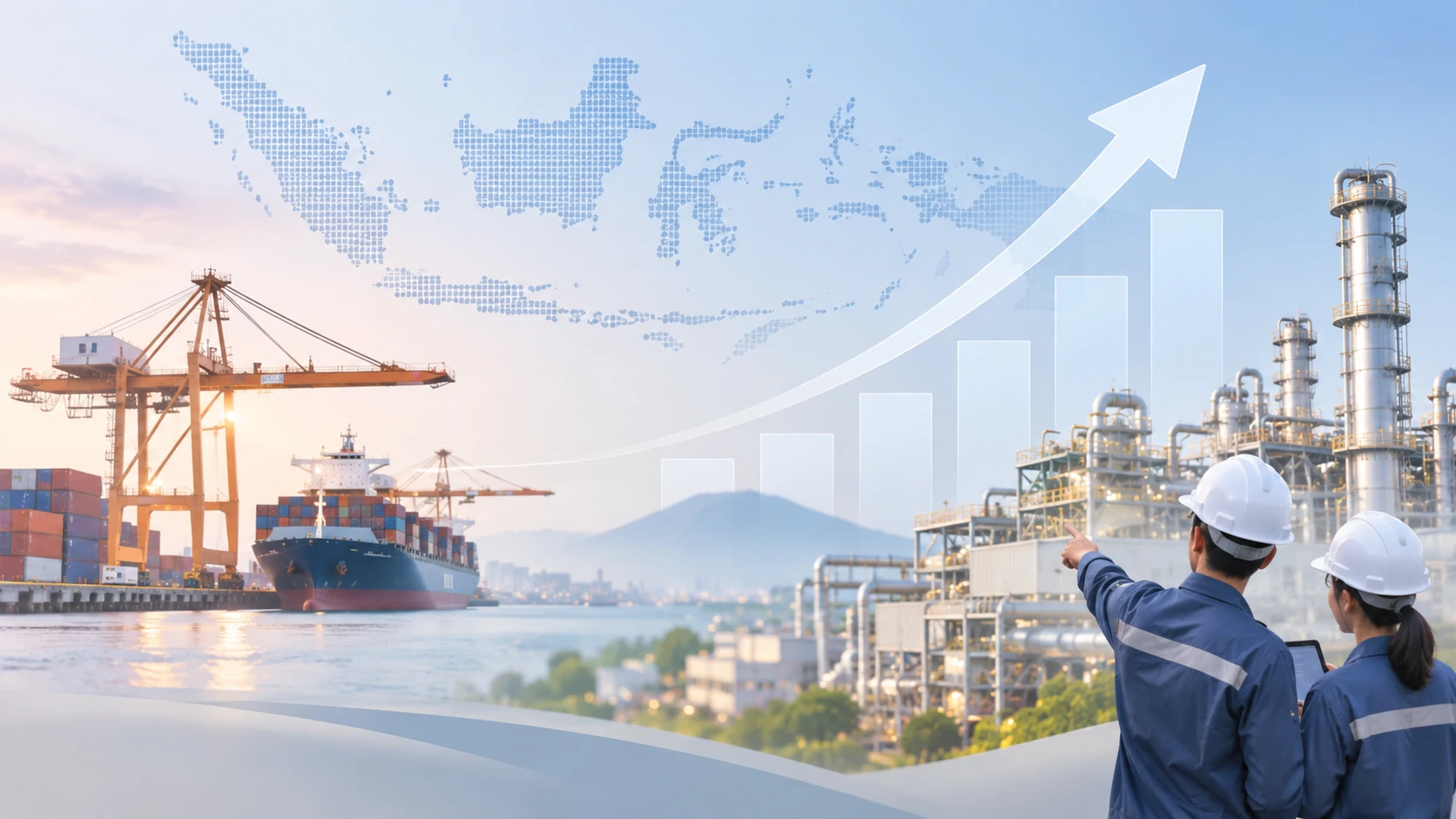
Major changes in an economy often begin far from the noise of public debate. They emerge through a company’s decision to buy machinery, a bank’s willingness to finance investment, raw materials arriving at a port and workers learning new skills.
Before they are reflected in prosperity, these changes first appear as financing, capacity-building and production activity.
Indonesia is showing a series of such signs. Investment credit is growing strongly, working-capital lending is increasing, investment is being realised and downstream processing is playing an important role. At the same time, imports of production inputs are rising and manufacturing indicators show expansion.
This sequence raises a more fundamental question than simply whether the economy is improving or worsening: is Indonesia strengthening its growth engine?
The data provide reason to believe that the foundations for change are being built. But structural transformation requires proof over a longer period.
Additional capital must generate productivity, technological capability and better jobs. That is where optimism gains both a foundation and a measure of success.
Financing Today, Building for Tomorrow
Bank Indonesia recorded annual growth of 23.20 per cent in investment credit in September 2026, while working-capital credit rose by 11.89 per cent. Both outpaced the 4.86 per cent growth in consumer credit. Overall, bank lending grew by 13.26 per cent.
The difference matters because each type of financing serves a different purpose and operates over a different time horizon. Working capital supports the purchase of materials, stock and operating needs. Investment credit can finance machinery and facilities that will be used for years.
If working capital keeps businesses’ pulse beating today, investment prepares their capacity to generate income in the future.
These figures explain both the significance and the limits of investment-credit growth. Financing is the entry point. The eventual result depends on whether machinery is installed, capacity is put to use and production generates added value.
Growth in investment credit is also not synonymous with structural change across the whole economy. Financing may be used to replace old assets or be concentrated in a few sectors.
Nevertheless, its growth signals a commitment to business activity with a longer horizon than short-term consumption.
When Capital Takes Shape
The evidence becomes stronger when financing is considered alongside realised investment.
The Ministry of Investment and Downstreaming/BKPM recorded investment realisation of Rp1,539.2 trillion between January and September 2026, up 7.3 per cent year on year. Foreign investment accounted for Rp777.8 trillion, or 50.5 per cent, while domestic investment reached Rp761.4 trillion, or 49.5 per cent.
In the third quarter alone, investment realisation totalled Rp528.7 trillion, an increase of 7.6 per cent.
This composition demonstrates the substantial involvement of both domestic and foreign capital. Opportunities for transformation arise when foreign investment brings technology and market access, while domestic businesses build their capabilities through production partnerships and learning.
The direction of investment sends an even clearer signal. Downstreaming investment reached Rp480 trillion between January and September, growing by 11.3 per cent—faster than overall investment growth.
It accounted for 31.2 per cent of the total. In the third quarter, downstreaming investment stood at Rp179.9 trillion, up 19.4 per cent year on year.
Almost a third of investment realised in the first nine months of the year fell within the scope of downstream processing. Processing resources is therefore taking an important place in capacity-building.
Its structural significance lies in the expansion of production stages within Indonesia. Processing requires energy, logistics, engineering, maintenance and skilled workers. If links between these activities develop, investment’s benefits can reach more companies and workers.
The depth of industrialisation will ultimately depend on the ability to move towards increasingly complex materials, components and products. Processing facilities are the beginning of the journey; technological mastery and the expansion of added value determine how far it can go.
The regional dimension also deserves attention. Downstreaming investment outside Java reached Rp373.1 trillion, about 78 per cent of the total. Meanwhile, overall investment realised between January and September was associated with the employment of 2,194,496 Indonesian workers.
This distribution creates opportunities for new production centres to emerge. The benefits to local communities will depend on the involvement of local workers and suppliers, and on income circulating around the projects.
Containers Carry Opportunities to Learn
Trade developments offer the next clue. The National Economic Council recorded annual growth of 22.5 per cent in the value of imports of raw and auxiliary materials in August 2026, while imports of capital goods rose by 10.6 per cent.
Imports should be assessed according to the purpose of the goods. Machinery and intermediate inputs can expand production capacity, improve quality or enable companies to make new products.
However, an increase in import value does not automatically indicate an increase in volume, as price changes also have an effect.
Research by Mary Amiti and Jozef Konings, published in the American Economic Review in 2007, provides empirical grounding. Using data from Indonesia’s manufacturing sector from 1991 to 2001, they found that a 10-percentage-point reduction in input tariffs led to a productivity increase of about 12 per cent among firms importing inputs.
The benefits included access to a wider range of higher-quality inputs, as well as opportunities to learn.
That historical finding is not a formula for calculating Indonesia’s productivity in 2026. But it demonstrates a relevant mechanism: access to global inputs can strengthen domestic production capabilities.
A machine carries a technological design. A component introduces quality standards. Links with suppliers open up knowledge of production processes.
For these benefits to materialise, companies need the ability to absorb knowledge. Cohen and Levinthal call this “absorptive capacity”: the ability to recognise the value of external knowledge, absorb it and use it commercially. This capacity is built through prior knowledge and learning.
Two Indices Take the Pulse of Production
Manufacturing activity indicators support this reading. A Bank Mandiri publication summarising S&P Global data recorded an increase in Indonesia’s Purchasing Managers’ Index (PMI), from 52.4 in September to 54.0 in October 2026. Stronger demand drove production and purchases of raw materials.
Meanwhile, Bank Indonesia’s Prompt Manufacturing Index (PMI) reached 52.28 in the third quarter, up from 51.43 in the previous quarter. Production volumes, total orders and finished-goods inventories rose and remained in expansion territory.
The two indices use different methodologies and cover different periods. Their figures are not percentages of output growth. However, their movement in the same direction strengthens the indication that manufacturing activity is expanding.
Read together, they form a logical sequence: financing supports businesses, investment builds capacity, input procurement provides the means, and demand drives production.
From Machinery to National Capability
Paul Romer deepened this explanation through his theory of endogenous growth. In an article published in the Journal of Political Economy in 1990, he argued that technological progress arises from deliberate investment decisions.
Knowledge has characteristics that allow it to be used more widely without being depleted when others use it. This means the value of investment extends beyond buildings and equipment.
It also lies in product design, software, production methods and the ability to solve new problems.
The World Bank summarises this development journey through a strategy of investment, infusion and innovation in its World Development Report 2024. Investment adds capital, infusion spreads technology and business practices, while innovation expands the capacity to create new value.
Indonesia now has an opportunity to strengthen the links between all three. Downstreaming can become a place for industrial learning if domestic companies grow more capable of meeting standards, developing components and improving production processes.
Buying machinery opens the door. The ability to master and develop it determines how far the country can go.
The government needs to oversee investment through to its outcomes: projects completed, capacity brought into operation, domestic suppliers developed and workers benefiting.
Labour productivity, domestic added value, export diversification and real wages should be monitored consistently.
Indonesia is showing concrete steps towards strengthening its production engine. Its commitment is visible in financing, realised investment and industrial activity.
The success of its transformation will depend on its ability to turn all this momentum into lasting progress.
At a port, the future may arrive in a shipping container. In banking, it begins with a financing decision. In a factory, it takes shape through machinery and skills.
Transformation finds its meaning when that journey reaches households in the form of better jobs, more decent incomes and a more open future.
Source: jawawa.id (https://jawawa.id/newsitem/opinion-reading-indonesias-economic-transformation-1793757023)
Originally published by kabarbursa.com (https://www.kabarbursa.com/makro/opini-membaca-transformasi-ekonomi-indonesia), translated from Indonesian