
Opened Slightly Higher, IHSG Battles Against Pressure
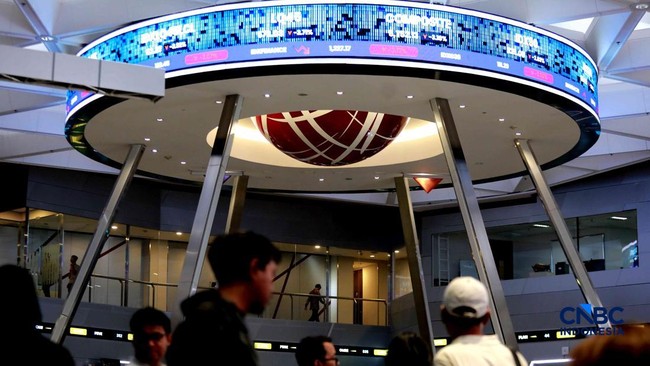
The Composite Stock Price Index (IHSG) opened marginally higher on Friday (5/6/2026), following a previous day’s sell-off that saw it slump nearly 2%. At the opening bell, the IHSG rose 0.11% to a level of 5,846.49. However, selling pressure returned to dominate, pushing the index deeper to a position of 5,795, or a drop of 44 points (-0.75%). During the morning session, the IHSG touched a high of 5,855.07 and a low of 5,795.63.
The majority of shares were still moving in positive territory. A total of 135 stocks weakened, while 184 stocks strengthened and 272 remained stagnant.
Transaction value at the start of trading reached Rp417.86 billion, with trading volume hitting 276.13 million shares changing hands across 32,505 transactions. The market capitalisation of the Exchange was trimmed to Rp10,313 trillion.
Previously, on Thursday (4/6/2026), the IHSG experienced heavy selling pressure. Early in the session, the index had plunged by as much as 5% to a level of 5,644.23 before recovering most of its losses towards the close. The IHSG ultimately closed at 5,839.78, a 1.7% decline, after earlier having fallen 3.48% at the end of the first session.
The movements of foreign investors were a major focus. In the first session, foreigners still recorded net purchases amounting to Rp179 billion. However, the situation changed drastically towards the close of trading. Data showed that foreign investors recorded total purchases of Rp12.52 trillion and sales of Rp13.79 trillion, resulting in a net sell of Rp1.27 trillion across the whole market.
The largest sell-offs were concentrated in major banking stocks. BBCA was offloaded by foreign interests to the tune of Rp475.5 billion, followed by BBRI at Rp451.6 billion, BMRI at Rp164 billion, and BBNI at Rp106.2 billion. In total, the four big banks recorded a foreign sell figure exceeding Rp1.19 trillion.
This sustained correction has pushed the IHSG back to its lowest point within the past year.
Negative sentiment emerged from multiple directions, ranging from the downgrade of Danantara Investment Management’s outlook, the weakening of the rupiah which has breached Rp18,000 per US dollar, to market apprehension regarding the upcoming assessment results from ratings agencies and the MSCI evaluation scheduled for announcement this June. These conditions drove investors to reduce their exposure to risky assets in Indonesia.
Meanwhile, Asia-Pacific stock markets opened lower on Friday, with the South Korean market leading declines in the region.
Negative sentiment followed a correction in technology stocks on Wall Street overnight, triggering sell-offs in the Asian tech sector.
South Korea’s Kospi index plummeted 4.11%, with large-capitalisation stocks such as Samsung Electronics and SK Hynix dropping by around 6% and 8% respectively. Meanwhile, the small-capitalisation Kosdaq index also fell 2.41%.
In Japan, the Nikkei 225 index corrected by 1.1%, tracking the global tech sector weakness. Meanwhile, Australia’s S&P/ASX 200 index dipped 0.2% at the start of trading.
The outlook for the Hong Kong market also remains tilted towards the negative. Hang Seng index futures were last traded at a level of 25,158, lower than the Hang Seng index’s close on Thursday, which stood at 25,253.40.
The declines across Asian markets followed mixed movements on Wall Street during Thursday’s local trading. The Dow Jones Industrial Average actually posted a fresh record high, surging 874.86 points, or 1.73%, to a level of 51,561.93.
Conversely, the tech-heavy Nasdaq Composite fell 0.09% to close at 26,830.96. Meanwhile, the S&P 500 index still managed to edge up 0.41% to a position of 7,584.31.