
Open University Rector: Higher Education Must Adapt to the World of Work and HR Needs
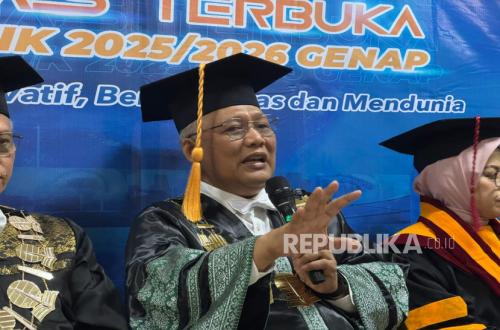
Universitas Terbuka (UT) has stated that higher education must be able to adapt to the needs of the world of work and human resource development. A flexible learning system is considered key to enabling the public to continue improving their competence without leaving their professions and responsibilities. UT Rector Ali Muktiyanto said that higher education is no longer solely aimed at school leavers entering university, but must also cater to workers, leaders, educators, athletes, and the wider community who wish to enhance their capacity at every stage of life. “Higher education must be closer to the needs of the times. Flexibility in learning is not just a technical convenience, but a bridge for workers, leaders, educators, athletes, and the wider community to pursue quality education amidst the continuous rhythm of life,” Ali said. According to Ali, this approach is reflected in the approximately 1,800 graduates from 12 UT regional offices who participated in the Region 1 Graduation Ceremony at the UT Convention Center in South Tangerang. The graduates came from various professional backgrounds, including state officials, directors of state-owned enterprises, professional athletes, KIP-K scholarship recipients, and senior learners. Ali noted that higher education remains an important need, even for those already in decision-making positions. This was evident from several graduates from strategic national sectors. Adrian Sutawijaya, Vice Rector for Finance, Resources, and General Affairs, completed the Doctoral Programme in Management Science at UT Jakarta. Ida Irawati, Director of Audit I.C at the Audit Board of Indonesia (BPK), completed the Doctoral Programme in Public Administration at UT Jakarta. Furthermore, Selvia Vivi Devianti, Head of the Centre for State Financial Audit Policy Analysis at BPK, completed the Law Science Programme at UT Jakarta. Director of Business Support at PT Pertamina (Persero) Muh Erry Sugiharto also graduated from the Law Science Programme at UT Jakarta. In the field of sports, Indonesian professional futsal athlete Marvin Alexa Wossiry completed the Management Programme at UT Jakarta. According to Ali, this shows that sporting achievement and higher education can go hand in hand when the learning system is designed to be adaptive to students’ needs. UT also expands access to education for various groups. Elly Agustina from UT Medan earned the title of dedicated and outstanding graduate in the Master of Basic Education Programme. Ratna, a KIP-K scholarship recipient from the Law Science Programme at UT Jambi, is an example of how access to higher education can open up opportunities for social mobility and a broader future. Meanwhile, Sri Hartati became the oldest graduate from UT Jakarta in the Bachelor of Business Administration Programme. At the age of 67, she demonstrated that education knows no age limit as long as there is a willingness to continue learning. Academic excellence was also shown by Yurni Prawita from UT Bengkulu, who achieved a perfect 4.00 GPA with a Cum Laude distinction in the Master of English Education Programme. Ali affirmed that UT continues to develop a learning ecosystem that allows people to continue working, leading, serving, and achieving while completing their higher education. “UT exists as a learning ecosystem that enables a person to continue working, leading, serving, achieving, and at the same time completing higher education. UT’s contribution is not only producing graduates, but also strengthening lifelong learners who continue to move and make an impact for the nation,” Ali said.