
Open University of Indonesia Physics Education Study Programme Holds AI Training for Senior High School Physics Teachers
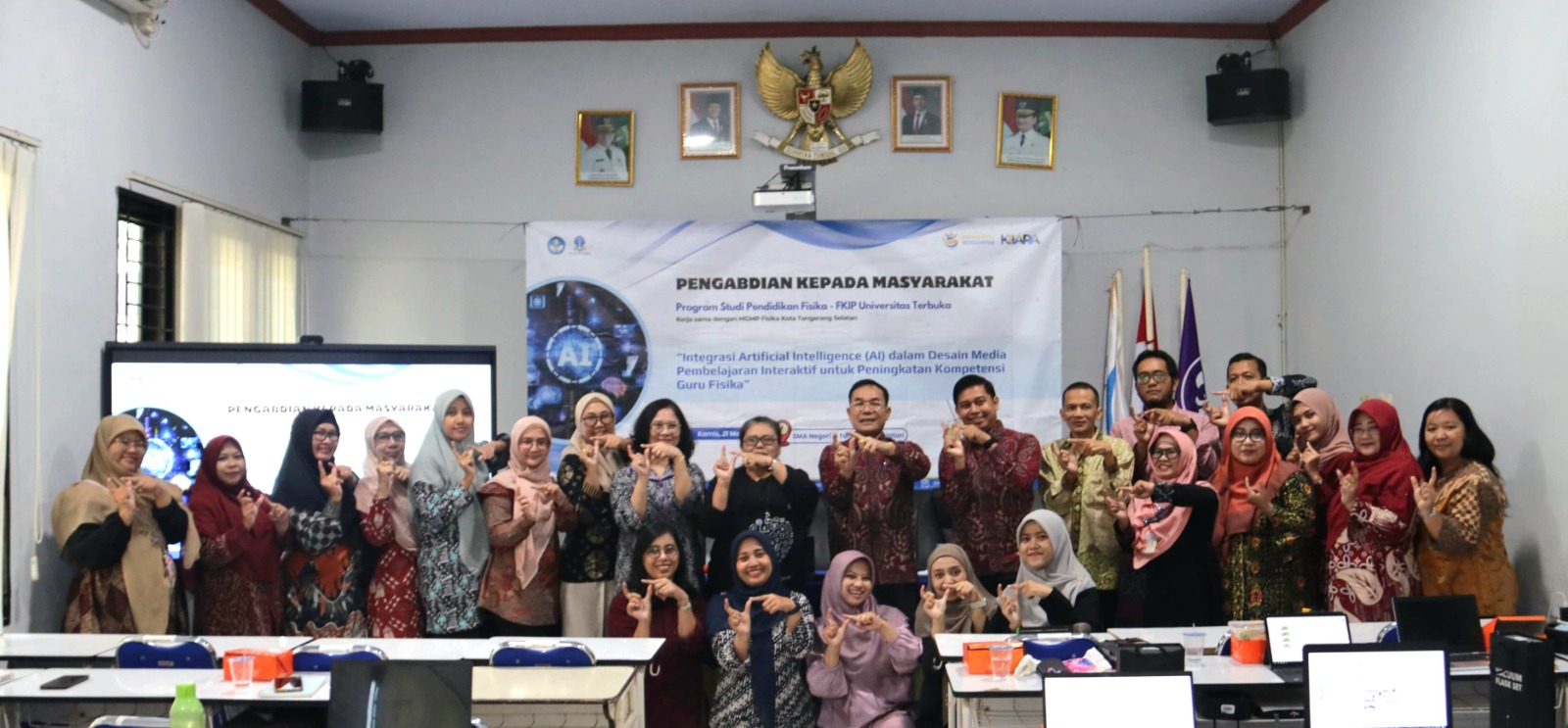
Through the Physics Education Study Programme of the Faculty of Teacher Training and Education (FKIP) at Open University of Indonesia, a Community Engagement Activity (PkM) titled ‘Training on Integrating Artificial Intelligence (AI) into Interactive Learning Media Design for Enhancing Physics Teachers’ Competencies in South Tangerang City’ was held on Thursday, 21 May.
Led by Khoirotun Nadiyyah as Chairperson, the training is a continuation of the first phase conducted online, which introduced the initial use of AI in teaching.
Attendees included Open University of Indonesia’s Vice Rector for Information Systems, Distance Learning and Alumni Affairs, Paken Pandiangan; FKIP UT Physics Education Study Programme Head, Widiasih; and Chair of the South Tangerang City Physics Teachers’ Forum (MGMP), Eko Supariyono.
EMPHASISING COLLABORATION
During their addresses, speakers highlighted the importance of collaboration between higher education institutions and teachers in adapting to digital technology, particularly the use of Artificial Intelligence to support more innovative and interactive learning.
As a training session speaker, Rika Aprianti, a lecturer from UT’s Physics Education Study Programme, delivered content and guided practical simulations for developing AI-based teaching materials and interactive learning media. Participants received both theoretical knowledge and hands-on practice.
“The training was structured in stages for ease of participation, starting with prompt engineering using ChatGPT to generate lesson ideas, setting learning objectives, creating activities, and developing physics-specific assessment questions,” she explained.
Rika added that participants were guided to use NotebookLM to process various physics reference materials in PDF format into more systematic and structured lesson plans. After developing the materials, they practised integrating them into interactive learning platforms such as Nearpod and Lumio.
“During this session, teachers learned to create interactive presentations, quizzes, collaborative activities, and simulations to enhance student engagement in classroom physics lessons,” she said.
The practical sessions were lively and interactive, with participants enthusiastically discussing, testing features, and sharing ideas for developing teaching materials tailored to their respective school subjects.
TASK ASSIGNMENT
Khoirotun Nadiyyah, the activity’s lead organiser, stated that tasks were assigned to participants as follow-up to the training.
“The teaching materials and interactive media developed by participants will be showcased in a product exhibition at a South Tangerang school in late July 2026,” she said.
Khoirotun added that the initiative aims to sustain collaboration between universities and teachers to support innovative, creative, and adaptable physics education in the digital age.