
Open Session for ITB's 67th Dies Natalis: Strengthening Impactful Research and the Downstream Processing of Natural Materials
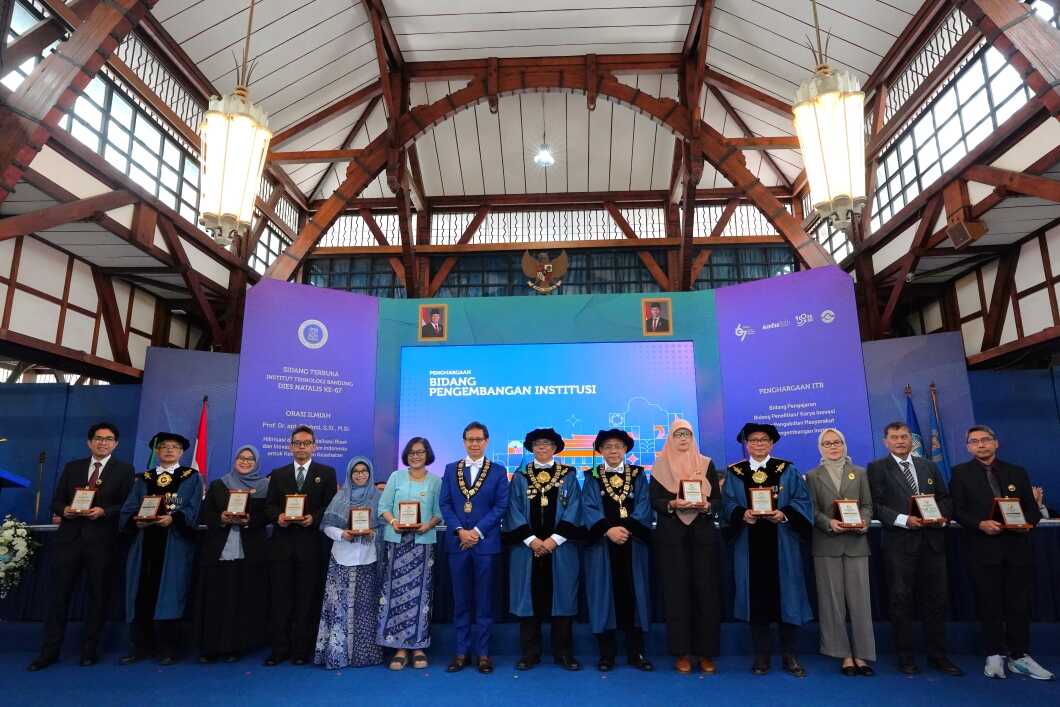
Open Session to mark ITB’s 67th Dies Natalis was held at ITB’s Ganesha Campus on Monday, 2 March, with a focus on strengthening research and innovation for national self-reliance. The anniversary served as a moment of reflection and a reaffirmation of ITB’s commitment as a leading, impactful university.
In his address, Budi Gunadi Sadikin, Chair of ITB’s Board of Trustees (MWA ITB), stressed the importance of adaptive and accountable governance to meet global challenges. He noted that ITB plays a strategic role in strengthening the national innovation ecosystem through synergy among the campus, government, and industry, ensuring research outputs connect with industrial needs and public policy.
“Synergy between academics, government, and industry is considered the key to driving the downstreaming of research with competitive strength,” he said.
Chairman of the Academic Senate (AS) ITB, Edy Tri Baskoro, asserted that institutional transformation must remain grounded in academic quality. Academic freedom, scientific integrity and high quality standards form the foundation for upholding ITB’s heritage while ensuring the intellectual contributions are relevant to national development.
Meanwhile, ITB Rector Tatacipta Dirgantara, in his address outlined ITB’s strategic direction toward achieving a World University Ranking of 150 by 2030. The achievement rests on the quality of the academic staff and the strengthening of the substance of the tridharma—the three pillars of higher education—in line with the vision “ITB Berdampak” (ITB with Impact).
“Through interdisciplinary collaboration, strengthened governance, and expansion of international networks, ITB is directed to continue delivering solutions to national challenges in the fields of industry, energy, and health,” he said.
SCIENTIFIC ORATION
On that occasion, ITB’s Director of Research and Innovation, and also a Professor in the Biopharmacology Expertise Group of the ITB School of Pharmacy (SF), Elfahmi, delivered his scientific oration on the topic “Downstreaming and Commercialisation of Indonesia’s Natural Materials-based Research and Innovation for Health Autonomy”.
Elfahmi highlighted Indonesia’s biodiversity potential as a source of drug materials and health products based on natural materials. “However, this potential must be optimised through downstream processing that is structured, starting from basic research, safety and efficacy testing, to the development of market-ready products,” he said.
Elfahmi stressed that research should not stop at publication or patents. The research results must be translated into products that can be produced, utilised, and directly benefit the people. “Therefore, close collaboration between the campus, industry, government, and regulators is essential,” he stated.
According to Elfahmi, health self-sufficiency is part of national sovereignty. By strengthening research and production based on domestic natural resources, Indonesia has a great opportunity to reduce import dependence while becoming a leading player in the health industry based on natural materials. (E-2)