
Open Dialogue: KSP Confirms Development Shift Towards Restorative Economy
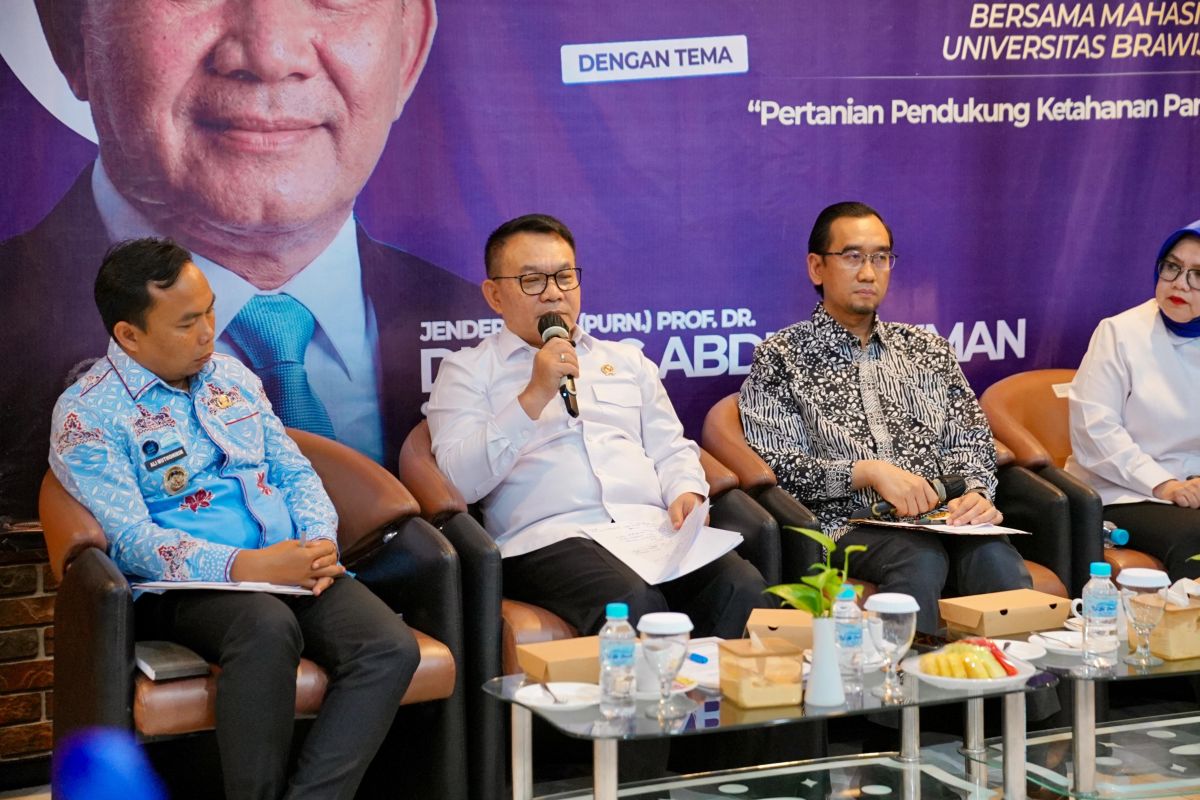
Jakarta (ANTARA) - Presidential Chief of Staff, General (Ret.) Dudung Abdurachman, stated that the government is continuously shifting its development orientation towards a restorative economy, during an open dialogue with students of Brawijaya University (UB).
According to a statement from the Presidential Staff Office (KSP) received in Jakarta on Saturday, the dialogue, titled “Ngopi Bareng Kepala Staf Kepresidenan” with the theme “Agriculture Supporting Food Security” in Malang, East Java, on Friday (12/6), saw Dudung express appreciation for the comprehensive questions and perspectives posed by UB undergraduate students regarding the ecological crisis and economic transformation, the Golden Indonesia 2045 vision and farmer demographics, research commercialisation and start-up ecosystems, regional agro-climate, and evaluation of the Free Nutritious Meal Programme (MBG).
“The restorative economy approach and environment-based development must be enhanced. If not, ecological problems will turn into absolute obstacles for our future food security,” said the Presidential Chief of Staff.
The statement responded to a question from student Aldian Adam Faris of the Faculty of Agricultural Bio-Industry and Forestry, who questioned the regulations and government commitment in leading a structural transformation from an extractive economic pattern to an ecology-based economy.
A second student, Naufal Syahfahlevie Samosir from the same faculty, also critically tested the reliability of the food self-sufficiency vision towards Golden Indonesia 2045. The student’s analysis highlighted the fundamental aspect of human regeneration duration, noting that producing an independent, adaptive, and resilient farmer requires a long time investment, ranging between 10 to 12 years.
Physical infrastructure and agricultural technology development will be futile if the government lacks a long-term macro strategy to attract the younger generation and cut the negative stigma of the farming profession.
Responding to this framework, Chief of Staff Dudung began by straightening out the conceptual dichotomy in the public sphere. He distinguished between food self-sufficiency and rice self-sufficiency. Dudung also clarified that the large volume of rice reserves in Bulog warehouses is not a single indicator of self-sufficiency, but rather an instrument for state emergency intervention. Regarding regeneration, the Chief of Staff confirmed data that the majority of Indonesian farmers are over 40 years old and asserted that technological modernisation is the main key to making the agrarian sector attractive again in the eyes of the younger generation.
A third student, Muhammad Ziyad Husaini from the Faculty of Agro-Industrial Technology and Biosystems, steered the debate towards the technology downstream sector. He observed a large gap between the high quality of academic research within campus and diaspora environments and the reality of commercialisation in the industrial world. Great innovations often end up as scientific documents or obsolete proposals due to the absence of a supporting ecosystem. He demanded a strategic government plan to facilitate capital, entrepreneurial guidance, and ecosystem formation so that student innovations can transform into enterprises or start-ups. The results of this discussion are committed to be reported directly to the President to formulate a formula so that higher education investment transforms into real economic value.
The fourth student, Farhan Fariz Rizqullah, presented scientific arguments regarding commodity spatial planning based on agro-climate conditions (altitude, soil type, and climate). He assessed that import dependency on commodities unsuitable for Indonesia’s climate, such as soybeans, is understandable, but for adaptive commodities, the government must maximise production through regional zone clustering, including maximising urban farming in large cities. Furthermore, the student delivered constructive criticism based on field data regarding the implementation of the MBG Programme, which he deemed not yet precise in its targeting. He proposed the government involve academic circles from universities to provide technical assistance.
Regarding this, the Chief of Staff openly disclosed strategic information that the government will soon conduct a comprehensive evaluation and restructuring of the MBG. He confirmed findings of quality implementation disparities between regions in the field, including cases of food not being fully consumed by children. “Matters like this will be restructured so that the programme truly achieves its goal, which is ensuring beneficiaries receive nutritious, proper food that is genuinely consumed,” said Dudung.
The government has established three pillars for the future restructuring of MBG: standardisation of menu nutritional quality standards, feasibility of food commodities, and macro targeting accuracy by prioritising areas with high nutritional vulnerability as well as Disadvantaged, Frontier, and Outermost (3T) regions. Accommodating the students’ proposals, Dudung stated that the government will officially involve students and universities in the future in aspects of logistics distribution supervision and nutritional education in the field.
Source: jawawa.id (https://jawawa.id/newsitem/open-dialogue-ksp-confirms-development-shift-towards-restorative-economy-1781405471)
Originally published by Antara (Indonesian) (https://www.antaranews.com/berita/5607416/berdialog-terbuka-ksp-pastikan-arah-pembangunan-ke-ekonomi-restoratif), translated from Indonesian