
Ookla Study in Manila: Mobile Operator VoLTE Networks Outperform OTT Applications in Call Quality and Reliability
A network study conducted by Ookla using fixed parameters has found that mobile operator networks provide a far better voice call experience compared to Over-the-Top (OTT) applications such as WhatsApp, particularly regarding audio quality, resilience in weak signal conditions, and connection reliability.
The study, which evaluated the networks of the three largest mobile operators in the Philippines—Smart Communications, Globe Telecom, and DITO Telecommunity—demonstrates that operator-managed Voice over LTE (VoLTE) infrastructure remains the primary standard for delivering consistent, high-quality communication services, outperforming OTT-based voice services.
VoLTE Operators Deliver Consistent HD Audio, While OTT Applications Remain at Standard Quality
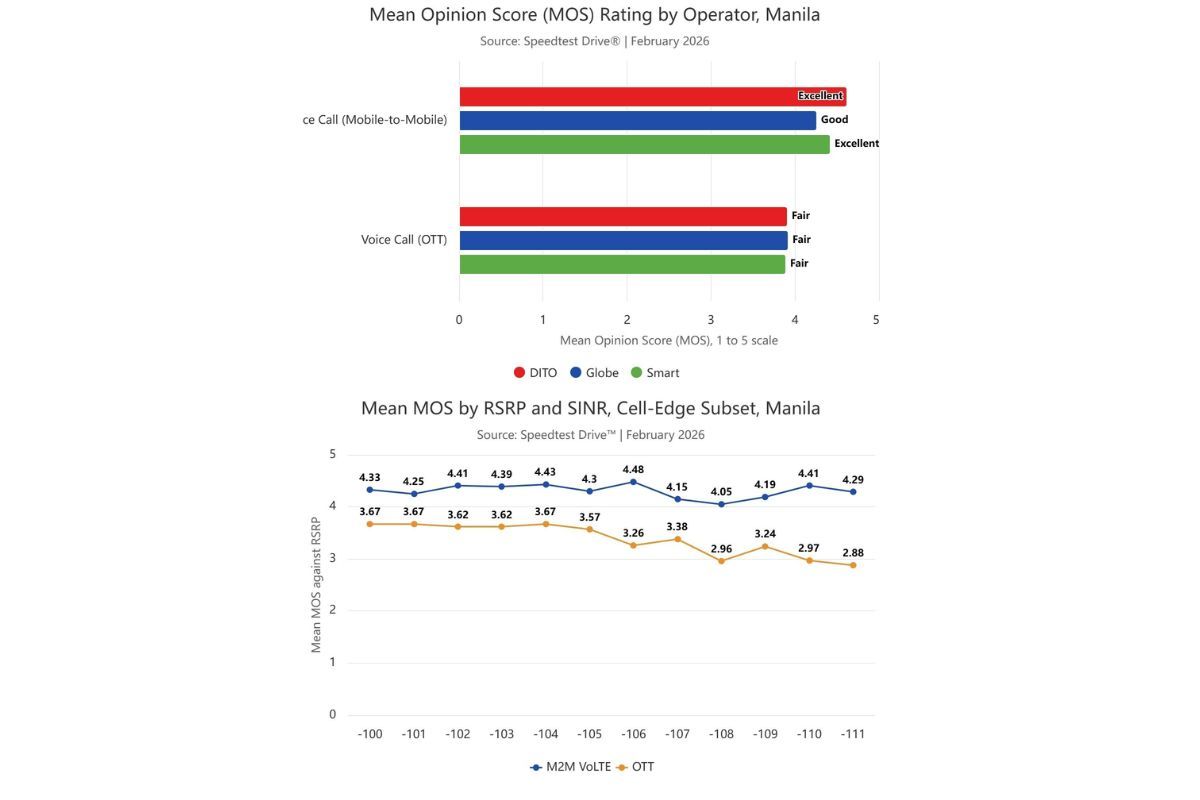
Research results show a clear gap in audio quality. Voice calls via operator networks consistently produced HD-standard audio, ranging from ‘Good’ (score >4.0) to ‘Excellent’ (score >4.3) across all three networks. In contrast, voice calls via OTT applications only achieved a ‘Fair’ rating (score <4.0). Smart and DITO recorded higher Mean Opinion Scores (MOS) than Globe due to the use of the Enhanced Voice Services (EVS) codec, which is superior to the AMR-WB codec used by Globe.
This discrepancy arises because OTT applications treat voice calls as standard data packets, relying on ‘best effort’ internet delivery mechanisms. Although operators optimise their networks, OTT voice services lack the guaranteed Quality of Connection (QoC) provided by VoLTE. When networks experience congestion, signal weakness, packet loss, or increased jitter, the audio quality of OTT applications degrades significantly. Conversely, VoLTE utilises high-priority cellular channels to maintain call quality.
VoLTE Maintains HD Audio in Weak Signals, Whereas OTT Call Quality Declines
The performance difference becomes even more pronounced when devices are in areas with weak signals or at the edge of cellular coverage. Under medium to low radio frequency (RF) coverage conditions (R2SRP ≤ -100 dBm), voice calls on operator-managed VoLTE networks were still able to maintain HD-standard audio quality.
In contrast, the quality of voice calls on OTT applications continued to decline, dropping from ‘Fair’ to ‘Poor’ (score <3.6) or even ‘Bad’ (score <3.0). This finding is crucial for users in areas with signal obstructions or locations far from base stations (BTS), as the study shows that the dedicated voice channels in VoLTE can maintain call quality, while OTT services relying on best-effort data delivery cannot provide the same level of reliability.
VoLTE Offers More Reliable Call Connections Than OTT
Connection reliability is another key differentiator between VoLTE and OTT services. The study showed that the call setup failure rate on VoLTE is much lower than on OTT services. For instance, Globe recorded a VoLTE call failure rate of 0.47%, significantly lower than the 1.64% seen in OTT services. Similar trends were observed with other operators. These results prove that specialised signalling protocols in VoLTE, such as optimised Session Initiation Protocol (SIP) and Single Radio Voice Call Continuity (SRVCC), provide more reliable connections than the best-effort data delivery model used by OTT applications.
Building the VoLTE Foundation for the Era of AI-Based Voice Services
In line with the Philippine National Telecommunications Commission (NTC) policy, which mandates the decommissioning of 3G networks by December 2026 at the latest, the telecommunications industry needs to accelerate the expansion of VoLTE coverage and the migration of customers to these services. Looking ahead, the integration of voice services with Artificial Intelligence (AI) is expected to be a primary direction for industry development. However, this transformation requires high-performance VoLTE networks as a fundamental foundation. Therefore, operators must continue to refine VoLTE infrastructure so that voice services can integrate seamlessly with AI and deliver a smarter next-generation communication experience.