
Ono Surono Urges Public to Turn Waste into an Economic Asset
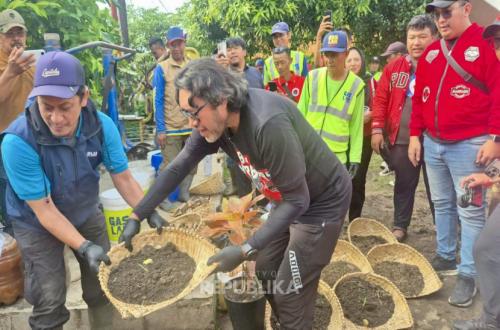
BANDUNG — West Java PDI-P provincial chairman Ono Surono has urged stronger community-based waste management, involving residents and party members. One of the initiatives is the construction of 740 teba, or organic-waste processing pits, in various parts of West Java.
The programme is part of the Caring for the Earth Movement, initiated by PDI-P chairwoman Megawati Soekarnoputri. It was reinforced through a mass community clean-up and waste-sorting drive held across Indonesia on Saturday (14 November 2026) for National Waste Awareness Week 2026.
In West Java, the event was centred at the RW 07 Blok G field in Margahayu Utara urban village, Babakan Ciparay district, Bandung. About 140,000 party members and residents across the province took part.
Surono said environmental campaigns should involve more than clean-up activities. The public, he said, should be encouraged to manage waste at its source so that it can be put to practical use and even generate economic value.
“The 740 teba built in West Java have involved at least 140,000 party members and members of the public. This is part of a joint movement taking place simultaneously across Indonesia,” Surono said.
He said the initiative must continue and not remain a ceremonial event. RW 07 in Margahayu Utara has therefore been designated as an area to be supported by the West Java PDI-P provincial board.
Alongside the teba and waste baskets, the organisers have provided two waste carts, an organic-waste shredder and a biodecomposer — bacteria that accelerate the decomposition process.
Surono said successful waste management depended not only on the availability of facilities and infrastructure, but also on the readiness of human resources. Changing public attitudes, he added, was essential to ensuring waste management could be sustained.
“Waste should not be seen only as something dirty or as a problem. If people can see it as an economic opportunity, they will be more focused on processing it,” he said.
He added that the government needed to provide tangible support to community groups working in waste management. That support should reach groups at neighbourhood, community, urban-village and village levels, rather than consist solely of instructions to regency and city administrations.
In line with these efforts, the West Java Regional House of Representatives is discussing a draft regional regulation on community-based waste management. The regulation is expected to provide a basis for the provincial government to strengthen public participation in addressing waste problems.
Surono, who served for 10 years on Commission IV of the House of Representatives, also highlighted several waste-management assistance programmes that had not been implemented effectively. Support in the form of waste banks, transport vehicles and shredders, he said, needed to be matched by the community’s preparedness and commitment to managing them.
Nevertheless, he said, some communities had successfully developed waste processing initiatives that delivered economic benefits.
“There are communities focused on managing waste. As a result, waste is no longer a burden but is already generating economic returns,” said Surono, deputy speaker of the West Java Regional House of Representatives.
The event was also attended by Budi Setiawan, treasurer of the West Java PDI-P provincial board; faction secretary Tom Maskun; and members of the party’s board and faction in the West Java Regional House of Representatives.
Source: jawawa.id (https://jawawa.id/newsitem/ono-surono-urges-public-to-turn-waste-into-an-economic-asset-1794635469)
Originally published by Republika (https://rejabar.republika.co.id/berita/toh5zz416/ono-surono-ajak-masyarakat-jadikan-sampah-bernilai-ekonomi), translated from Indonesian