
Online Motorcycle Taxis and the New Path to Digital Economic Justice
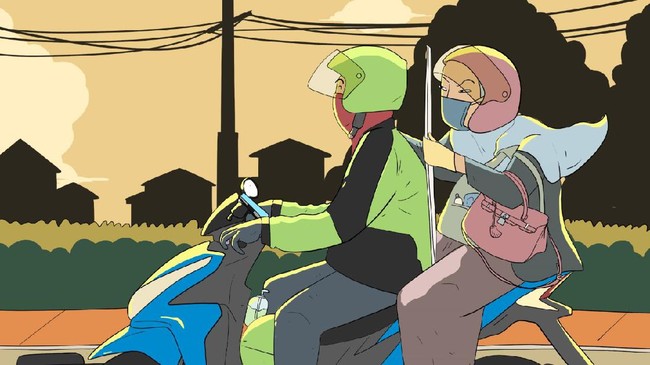
Behind the ease of ordering vehicles, food, medicine, and various needs via mobile phones, there are millions of journeys made by online motorcycle taxi (ojol) drivers. They work amid heat, rain, traffic congestion, accident risks, and uncertainty over the number of orders. They are the most tangible face of Indonesia’s digital economy.
Discussions about the digital economy have often been dominated by transaction figures, company valuations, technological sophistication, and market growth. Yet technology does not move on its own. Behind the applications are people who ride motorcycles, deliver orders, face consumers, and bear most of the risks on the ground.
Therefore, President Prabowo Subianto’s courage in strengthening protections for online transport drivers deserves appreciation. The government is pushing for a minimum income share of 92 percent for drivers and a maximum of 8 percent for app operators. Previously, platform deductions could reach 20 percent.
This change is not merely a correction to the percentage of income distribution. It marks a shift in how the state views the platform economy. The government is affirming that innovation and digital business growth must go hand in hand with economic justice.
In his address at the 2026 International Labour Day commemoration on 1 May, the President said that ojol drivers work hard and risk their safety every day. The President also stressed the need for workplace accident insurance, BPJS Kesehatan, health insurance, holiday bonuses, and a fairer income distribution.
This alignment is important because the state must not allow technological progress to produce new inequalities. If previously one-fifth of trip income could be deducted by the platform, reducing the commission cap to 8 percent gives drivers more room to take home the fruits of their labour. The difference can be used to buy fuel, maintain vehicles, pay instalments, meet family needs, or set aside savings.
Prabowo’s move has also received intensive support from Deputy Speaker of the House of Representatives Sufmi Dasco Ahmad. In his capacity as a House leader, Dasco has acted as a bridge between driver aspirations, government policy, and the interests of app companies.
This role was evident when Dasco received input from driver groups, led coordination between the House and the government, and opened dialogue with platform companies. The meetings overseen by House leadership then produced commitments from Gojek and Grab to implement a maximum 8 percent commission on two-wheeled passenger transport services starting 1 July 2026.
Dasco also oversaw the refinement of digital transport ecosystem regulations so that they cover not only passenger transport but also goods and food delivery services. This aspect is crucial because many drivers’ incomes come from various types of services within a single application.
Such involvement deserves appreciation because public policy requires more than just the courage to make decisions. It requires political communication, alignment of interests, and oversight to ensure benefits reach the public. The collaboration between the President, the government, and the House on the ojol issue shows that siding with the people can be realised when the executive and legislative branches move in the same direction.
However, digital economic justice does not end at the 92:8 ratio. Driver income is determined not only by the distribution percentage but also by base fares, order volume, trip distance, operational costs, incentives, and algorithm decisions that are not always known to drivers.
This is the next challenge. The government must ensure that the increase in drivers’ income share is not followed by unilateral changes to fares, incentives, service grouping, or order distribution mechanisms. The commission cap will lose meaning if driver income is reduced again through other non-transparent components.
Algorithms in the platform economy are not merely technical devices. They hold the power to determine who receives orders, who receives incentives, and whose accounts are restricted. Indonesia therefore needs a principle of algorithmic transparency.
Transparency does not mean companies must reveal all their trade secrets. But drivers have the right to know the main factors affecting order distribution, performance assessment, sanctions, and account deactivation. Every decision that affects a person’s livelihood must be explainable and accountable.
The government also needs to build an independent dispute resolution mechanism. When accounts are deactivated, drivers often face only an automated system or a complaint service with limited responses. Losing an account can mean losing a source of income in an instant.
A tripartite forum bringing together the government, app operators, and driver representatives needs to be institutionalised. The forum can discuss fares, safety, changes to application systems, sanctions, and policy evaluation. Drivers should not merely be recipients of decisions. They need to have a voice in formulating rules that affect their lives.
Positioning ojol drivers as micro-business actors also opens new opportunities. This recognition can provide access to Kredit Usaha Rakyat, training, business protection, and MSME empowerment programmes. However, this status must not stop at administrative classification or become a reason to reduce platform responsibility.
Partnership should contain a balance of rights and obligations. If one party sets fares, controls consumer access, manages order distribution, sets service standards, and has the power to deactivate accounts…