
Online Motorcycle Taxi Drivers Face Mounting Hardship, Living from Hand to Mouth
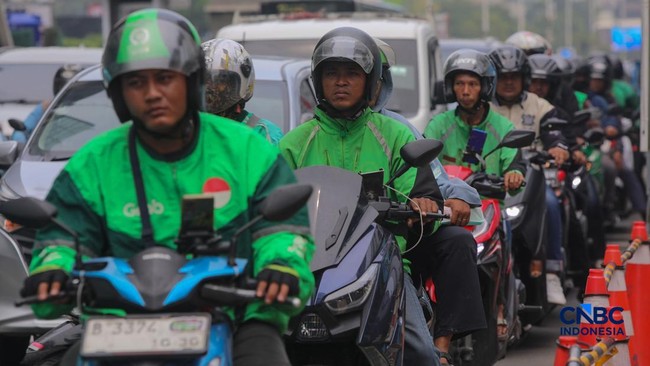
Jakarta, CNBC Indonesia – The government’s policy of encouraging online motorcycle taxi (ojek online, or ojol) drivers to join the Micro, Small and Medium Enterprises (MSME) scheme and expanding their access to credit has come under scrutiny. A recent study has revealed a stark reality: most ojol drivers are in debt not to build business capital, but to cover daily needs that their earnings do not meet.
A report by the Institute for Demographic and Affluence Studies (IDEAS), entitled “Under the Shadow of the Debt Trap”, found that 90.96% of ojol drivers currently have outstanding debt or instalments.
The findings highlight the fragile economic security of Indonesia’s platform workers. With fares under pressure and app commissions and operating costs high, debt has shifted from a financing tool to a primary means of survival.
Low earnings, crushing repayments
The research, which surveyed 531 ojol drivers in 51 regencies and cities, found a wide gap between net income and daily obligations.
After deducting petrol, food and drink, and mobile data costs, 73.07% of drivers take home less than Rp100,000 a day. A further 19.59% earn less than Rp50,000.
Despite net earnings far below the Regional Minimum Wage (UMR), daily loan repayments continue to pile up. Of drivers in debt, 37.89% have to set aside at least Rp80,000—and in some cases more than Rp100,000—each day just to pay their instalments.
This leaves drivers with very little financial room to meet their families’ basic needs.
Borrowing to stay afloat
The reasons drivers borrow further demonstrate their financial vulnerability. Among indebted drivers, the most commonly reported uses of loans were:
Daily or household needs: 56.31%
Instalments for work equipment, including motorbikes, mobile phones and work attire: 56.31%
Children’s education: 42.03%
Repaying previous debt: 31.88%
Healthcare: 13.04%
Business capital: 10.97%
Other purposes: 3.11%
Home mortgages: 2.69%
Only 10.97% of respondents used debt for productive business capital. The fact that nearly a third had to borrow to repay existing debt points to a worrying cycle of “borrowing from Peter to pay Paul”.
New debt is no longer a way out; it merely postpones and deepens a future crisis. IDEAS found that 85.71% of drivers said they had been forced to borrow in the previous three months because their ojol income was insufficient to cover daily living costs.
Half of them (50.45%) had to borrow at least four times during that short period.
More borrowing sources and warnings of default
Under pressure to meet living costs, ojol drivers turn to a range of formal and informal lenders. Leasing companies financing work equipment (43.89%) and online loans (43.27%) were the two largest sources, followed by loans from friends or family (40.58%), buy-now-pay-later apps (30.06%), banks (26.71%) and loan sharks (7.45%).
The high reliance on loans from relatives and friends suggests that some drivers may no longer qualify for credit from formal financial institutions, shifting the economic burden to social networks that are themselves vulnerable.
This cash-flow imbalance has resulted in a high risk of default. In the previous three months, 79.71% of indebted drivers said they had been late paying an instalment, while 38.18% had fallen behind repeatedly—four times or more.
Risks of classifying ojol drivers as MSMEs to expand credit
IDEAS has urged the government not to rush into addressing ojol drivers’ problems simply by granting business credit or imposing an MSME scheme.
Unlike shop or business owners, who can set prices and manage their operations, ojol drivers have no control over the market, fares, order-allocation algorithms or the rules governing the termination of their partnerships, including suspension.
Providing new credit to drivers whose incomes are already inadequate could create a double burden: they would face fluctuating platform earnings while continuing to be pursued for repayments.
The government should follow the principle of “income first, credit later”, IDEAS said. Platform workers primarily need measures to ensure higher net incomes, decent employment protections and adequate social and economic security—not new loans.
Source: jawawa.id (https://jawawa.id/newsitem/online-motorcycle-taxi-drivers-face-mounting-hardship-living-from-hand-to-mouth-1793785866)
Originally published by CNBC Indonesia (https://www.cnbcindonesia.com/tech/20261104131807-37-782246/nasib-ojol-makin-memprihatinkan-hidup-gali-lubang-tutup-lubang), translated from Indonesian