
One Metre for Inclusion
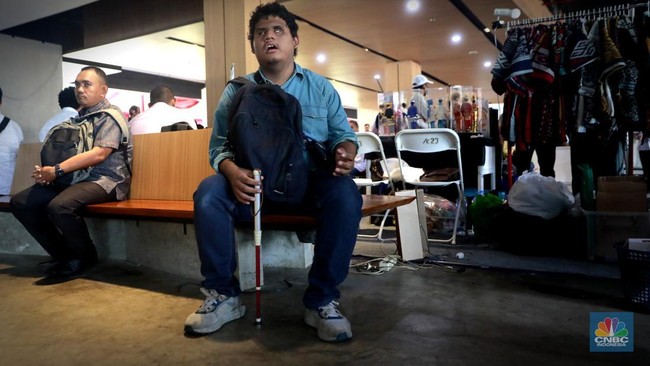
How much space does a company need to prove that persons with disabilities are truly included? The answer is even simpler: one square metre!
For a long time, disability inclusion has been discussed in much larger terms. There are seminars, training, campaigns, corporate social responsibility programmes, and sustainability reports containing commitments to diversity and equality. All of this is important. However, there is one question rarely asked: once the seminar ends, once the training certificates are issued, and once the annual reports are published, where should persons with a disability go to sell the fruits of their labour?
This question is vital because the issue for persons with disabilities is not merely a matter of skill. Many persons with disabilities possess skills and produce goods, ranging from processed foods, crafts, and fashion to household products and various creative works. The problem arises when these products need to meet the market.
An inclusive ecosystem is also required. Production can be carried out from home, and training can be provided in various locations. However, customers do not always arrive on their own. This is where a problem often overlooked in discussions regarding the economic empowerment of persons with disabilities exists. We too easily state that they must be economically independent, but we have not been serious enough about discussing the ecosystem that allows such independence to occur.
Persons with disabilities are asked to become entrepreneurs. However, once they become entrepreneurs, the market is not necessarily open. As a result, economic empowerment risks remaining merely an activity rather than becoming a transformation. Orders arrive only during events or social activities. Afterwards, orders dwindle. In such situations, the products of persons with disabilities are indirectly placed in a different position from other products. Products are purchased not because of their quality and competitiveness, but because of sympathy. In truth, inclusion should eliminate such a perspective.
Persons with disabilities do not need a market that feels pity. What is needed is a market that provides the opportunity to compete fairly. Therefore, corporations can take a more concrete role. Rather than just providing aid, they can open market access.
The method does not even have to be complicated. Every company can provide a small space, for example, one by one metre, in a lobby, canteen, waiting room, or office public area. That space could serve as a ‘Disability Works Corner’, a place where products from entrepreneurs with disabilities are displayed and sold.
The company provides the space, and the entrepreneurs provide the products. The products are curated to meet proper standards of quality, packaging, price, and safety. Sales are conducted through a consignment system and recorded transparently.
The mechanism is simple. There is no need for company funds to be tied up, nor is there a need to treat transactions as a donation. There is a product, there is a price, there is a buyer, and there is payment. The simplicity of this mechanism is what makes this idea important. We often assume that inclusion must always take the form of a programme, whereas inclusion can also be built through daily business habits and mechanisms.
Offices are potential hubs. Every day, hundreds of people work within them, purchasing food, drinks, souvenirs, meeting supplies, hampers, or various other products. On a corporate scale, these are not small transactions. The question is, why can’t some of these needs be directed towards products produced by entrepreneurs with disabilities?
The answer is not always easy. Companies have standards for quality, volume requirements, punctuality, and price that must be met. Therefore, the ‘Disability Works Corner’ must not turn into a mere display space that only fulfils a moral obligation. Products must be truly saleable. Entrepreneurs must also receive mentoring to meet market standards. This is where the approach to inclusion becomes more serious. Companies should not just provide a table, but open a door to an economic ecosystem.
If a product does not yet meet the standard, help the entrepreneur improve it. If the packaging is not attractive, help enhance its quality. If production capacity is insufficient, help build a business network. If financial record-keeping is not orderly, provide guidance. Thus, one square metre is not just a place to sell goods; that one metre becomes an entry point to a much wider market.
For companies, this step can also be part of sustainability practices. Discussions regarding ESG (Environmental, Social, and Governance) often feel far removed from daily life, filled with targets, indicators, reports, and various technical terms. However, should a company’s social value not ultimately be visible in the lives of those around it? A company can write extensively about diversity in its sustainability report, but a simpler measure is to see who is given the opportunity to become a supplier, who gains market access, and who derives economic benefit from the company’s activities.
That is where inclusion is tested. Imagine if 100 companies in the Greater Jakarta area (Jabodetabek) provided one corner. There would be 100 new marketing points. If each point generates an average transaction of Rp2 million per month, the potential economic turnover would reach Rp200 million per month. This figure is merely an illustration, not a guarantee. However, this simple illustration shows that a very small space can unlock much larger economic activity.