
One in Three New Motorbikes Sold in Vietnam Is Now Electric, Threatening Honda and Yamaha
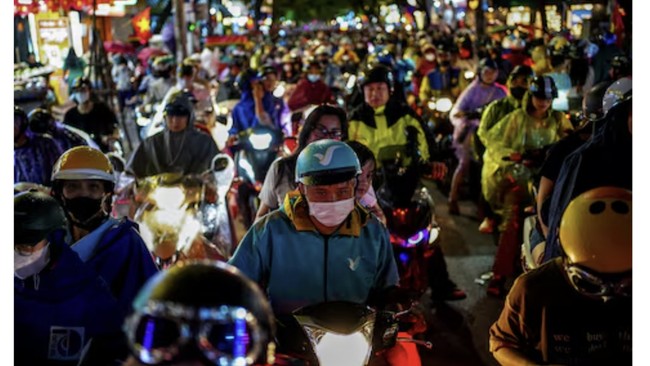
Jakarta, CNBC Indonesia — Millions of motorbikes fill Vietnam’s streets every day. Two-wheelers are essential for commuting, taking children to school and delivering orders. For decades, most have run on petrol. Now, more people are switching to electric motorbikes.
This year, one in three new motorbikes sold in Vietnam was electric. Rising oil prices amid the US-Iran war, government policies to reduce pollution and the growth of domestic manufacturers are driving the change.
The shift threatens the dominance of Japanese manufacturers such as Honda and Yamaha. Local companies, including VinFast and Dat Bike, are beginning to seize opportunities to win market share.
The US-Iran war, thousands of kilometres from Vietnam, has given the electric motorbike industry fresh momentum. Disruptions to oil supplies have pushed up petrol prices and increased the cost of running fossil-fuel vehicles.
The governments of Hanoi and Ho Chi Minh City, Vietnam’s two largest cities, are also seeking to reduce the use of petrol-powered vehicles. The policies face a number of challenges, but are beginning to steer the market towards electric transport.
According to MotorCycles Data, electric motorbike sales in Vietnam exceeded 973,000 units from January to September this year, up 91% on the same period a year earlier.
Rising petrol prices are beginning to influence consumer decisions. Similar trends are emerging in cities including Sydney, London and Rio de Janeiro, where higher fuel costs are prompting people to consider electric vehicles, including electric cars widely produced by Chinese companies.
Vietnam is different: its shift to electric vehicles is taking place mainly in the motorbike market. Local manufacturers are among the biggest beneficiaries, rather than Chinese automotive giants such as BYD and Geely.
Petrol prices change consumer choices
Phung Quang Duyen, 54, began considering an electric motorbike after trying a Dat Bike product in Hanoi.
He was drawn to a red motorbike displayed at a stand. Duyen walked around it, filmed it on his phone and took it for a test ride. Its acceleration was so strong that he was briefly pushed backwards.
Duyen had planned to buy a Honda Vision for his daughter, who is about to start her first job. The Honda Vision is one of Vietnam’s most popular petrol motorbikes.
The Dat Bike electric motorbike costs about US$1,160, roughly the same as a Honda Vision. It also requires no petrol.
“Now I have to look into it first and convince my wife,” Duyen said with a laugh as he collected several brochures.
Rising petrol prices are also squeezing the budgets of workers who rely on motorbikes to earn a living.
Nguyen Van Sy, 26, uses an old brown Honda inherited from his parents to work as a chef for a catering company. He also works part-time as a Grab delivery rider.
“The rise in oil prices has affected my work,” Sy said at a petrol station in Hanoi.
Sy plans to buy an electric motorbike to cut fuel costs, but still needs to save enough money to afford one.
Dat Bike founder Nguyen Son said the company’s sales surged when petrol prices rose 40% in March. Demand even exceeded available stock.
“We didn’t even have stock to sell,” he said. Son believes the shift to electric vehicles is ultimately inevitable.
Electric motorbikes begin to challenge Honda’s dominance
Electric motorbikes in Vietnam are no longer synonymous with basic e-bikes commonly used by secondary school pupils. Technological advances have enabled some models to rival petrol motorbikes in power and performance.
Some electric motorbikes can be charged directly at home. Others use removable batteries that can be exchanged for fully charged ones in minutes.
This shift is beginning to challenge the longstanding dominance of Honda and Yamaha in the market.
“In Vietnam, we have been using Honda motorbikes for more than 50 years. So switching to VinFast or other electric vehicles is not easy,” said Hoang Ha, deputy chief executive of VinFast E-Motorcycle Vietnam.
A major obstacle to electric motorbike adoption is the availability of charging infrastructure. Consumers worry about running out of battery during a journey. Manufacturers are building charging and battery-swapping networks and offering incentives to address these concerns.
VinFast offers a programme providing 20 free battery swaps each month. The company says this is enough for the daily travel needs of many riders.
VinFast claims it has built 60,000 bright-blue battery-swapping stations this year and aims to increase the number to 150,000 by the end of the year.
“At first, you have to encourage people to switch. That takes time and costs a great deal,” Ha said. VinFast is willing to bear the costs to attract consumers and encourage greener transport.
Electric motorbikes create new business opportunities
The growth of electric motorbikes is also giving rise to new businesses in Vietnam. Some cafés in Ho Chi Minh City provide battery-charging facilities for customers, while families in some neighbourhoods have started selling access to electricity from their homes.
Some charging locations also offer food, showers and beds for riders waiting for their batteries to charge.
Le Huy Hoi is among those taking advantage of the opportunity. He runs an electric motorbike charging business from his home on the outskirts of the city.
On a Wednesday evening, around 20 electric motorbikes were lined up inside his home, plugged into sockets installed along the living-room walls.
Hoi started the business two years ago, serving students, nearby apartment residents and app-based transport drivers. Demand has continued to rise, forcing him to move to larger premises several times. His current home is the business’s third location.
Hoi, his wife and their two sons live in two rooms. They have converted a third room into a dormitory with 15 bunk beds. He also provides food and shower facilities for riders.
The business earns about US$400 a month. Hoi said he still cannot meet all the demand, despite expanding twice.
“As you can see, I still can’t meet market demand,” he said.
Once dismissed, electric motorbikes now draw queues
Dat Bike’s Nguyen Son sees the surge in demand as a major shift for an industry that once struggled to win consumer trust.
Seven years ago, Son taught himself to assemble electric motorbikes using YouTube videos. He later pitched his product on Shark Tank Vietnam, but the judges were not interested in the idea. One even said nobody would buy the motorbike.
Now, Son posts photos of crowds of customers at Dat Bike showrooms. They take queue numbers and wait their turn to buy electric motorbikes.
Vietnam’s changing market shows how rising energy prices can speed up the adoption of new technology. Domestic manufacturers have an opportunity to challenge Japanese brands that have long dominated the motorbike industry.
The growth of electric vehicles is also creating demand beyond vehicle sales, from battery-swapping stations to home-based charging services.
Electric motorbikes are no longer merely an alternative form of transport in Vietnam. They are beginning to reshape competition in the automotive industry and create new sources of income for local people.
Source: jawawa.id (https://jawawa.id/newsitem/one-in-three-new-motorbikes-sold-in-vietnam-is-now-electric-threatening-honda-and-yamaha-1795697435)
Originally published by CNBC Indonesia (https://www.cnbcindonesia.com/research/20261125130232-128-788312/1-dari-3-motor-baru-di-vietnam-kini-listrik-honda-yamaha-terancam), translated from Indonesian